
South Asian Women motion picture producers and directors
Member of
Creator: Kabir Cultural Centre
Description
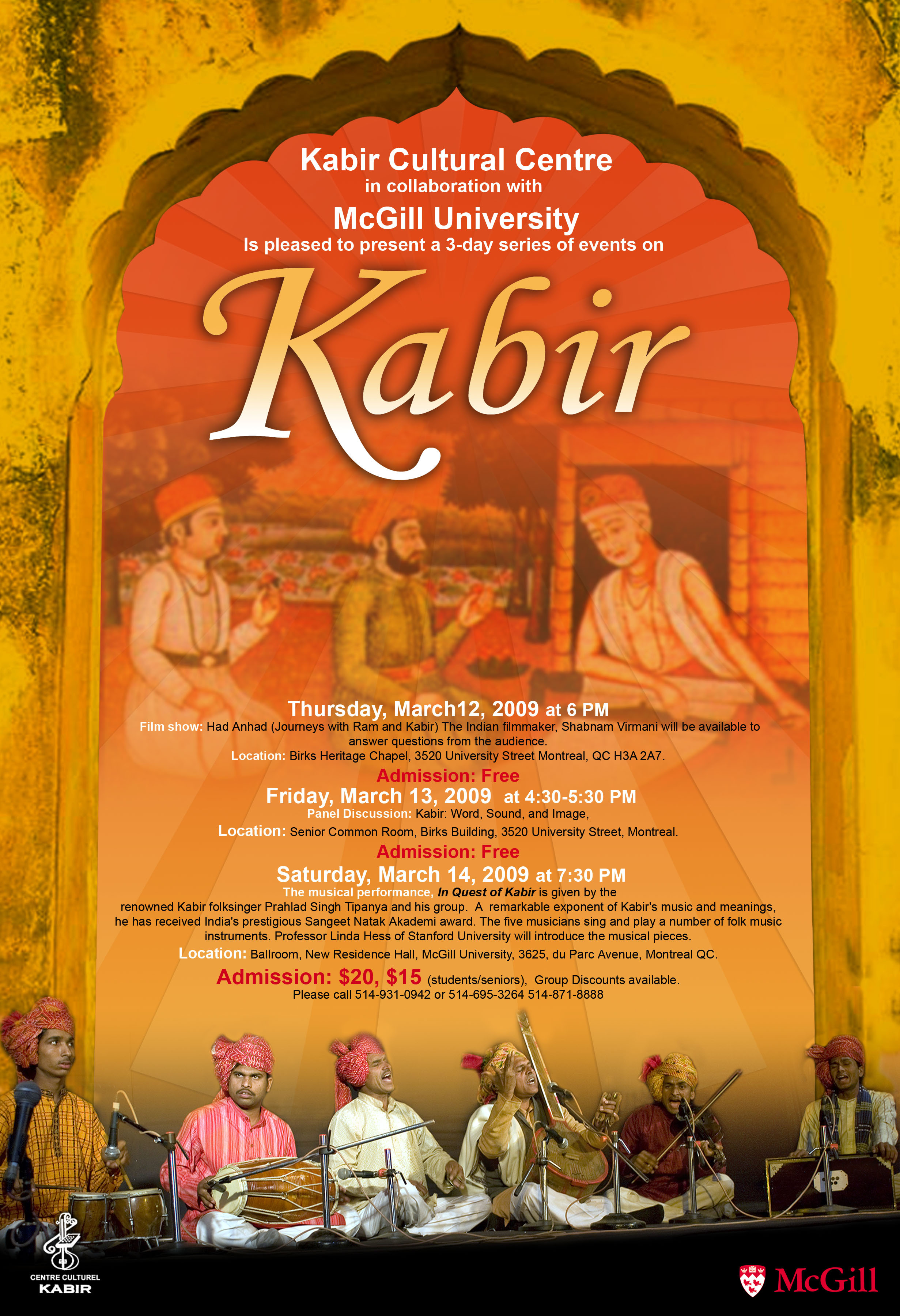
Poster advertising a 3-day series of events on the historical poet Kabir held at McGill University, Montreal, Quebec. The first is a screening of Shabnam Virmani's 2008 documentary Had Anhad: Journeys with Ram and Kabir followed by a panel with Indian filmmaker Shabnam Virmani held at the Birks Heritage Chapel. The second is a panel discussion on Kabir: Word, Sound, and Image held in the Senior Common Room in the Birks Building. The third is a musical performance of In Quest of Kabir performed by Kabir folksinger Prahlad Singh Tipanya and his group at the New Residence Hall Ballroom. Kabir was a 15th century mystic and philosopher. He was born in 1398[disputed] in the city of Varanasi in what is now Uttar Pradesh, India. His writings on religious practices he deemed unethical or meaningless made him a divisive figure among the Hindus and Muslims of his day. After his death, his writings would go on to influence the Bhakti Movement of medieval Hinduism and would be included in the Sikh text Guru Granth Sahib. He is regarded as a saint by Vaishnavist Hindus, and his teachings are followed by the Kabir Panth denomination of the Sant Mat movement. Had Anhad (Bounded Boundless) is a multi-part[?] documentary series exploring the life and philosophy of Kabir in the contexts of religion, politics, and Indian/Pakistani tensions. Shabnam Virmani is a documentary filmmaker and artist. Since 2002, she has been artist in residence at the Srishti School of Art, Design and Technology in the city of Bangalore in Karnataka, India. She is also the co-founder of the Drishti Media Collective and a member of the Kabir Project. Prahlad Singh Tipanya is an Indian folk singer. He was born on September 7, 1954 in the town of Tarana in Madhya Pradesh, India. Along with backing instrumentalists, he performs Kabir bhajans in the Malwi folk style from Madhya Pradesh. He is a member of the Kabir Project.
2023_01_02_006.pdf
(107.79 KB)
Member of
Creator: Kabir Cultural Centre
Description
Poster advertising the screening of Sabiha Sumar's 2003 film Khamosh Pani (Silent Waters) at de Seve Cinema, Montreal, Quebec. Khamosh Pani takes place in 1979 Pakistan and follows Ayesha, a widow who lives with her adored son Saleem in the village of Charkhi. Ayesha's quiet life is thrown into turmoil when Pakistan is placed under martial law and the directionless Saleem finds himself caught up in the fervor of Islamic fundamentalism. The film deals with themes of radicalization, religious intolerance, and generational trauma. Sabiha Sumar is a film director who was born in 1961 in the city of Karachi in Sindh, Pakistan. She studied filmmaking and political science at the Sarah Lawrence College, New York, and international relations at the University of Cambridge. She also founded Vidhi Films in 1992.
2023_01_02_001.pdf
(77.35 KB)
Member of
Creator: Kabir Cultural Centre
Description
Poster advertising the screening of Shireen Pasha's 2005 documentary, Hima Remembers at de Seve Cinema, Montreal, Quebec. Hima Remembers covers the story of Hima, a woman from Awadh, Northern India, focusing on her relationship with her father, Mohammad Ali Radulvi, and her experiences during the establishment of Pakistan. Shireen Pasha is a writer and director. She was born on February 14, 1946 in the city of New Delhi in Delhi, India. She is known for her documentaries and has been active since 1980.
2023_01_01_001.pdf
(122.89 KB)
Member of
Creator: Kabir Cultural Centre
Description
Poster detailing the screening of Safina Uberoi's 2001 documentary My Mother India at Kabir Cultural Centre's Inaugural Film Show in Montreal, Quebec. My Mother India is a documentary film about Patricia Uberoi, an Australian woman who moved to India with her Indian husband and started a multi-cultural family before anti-Sikh tensions pushed her leave with her family to Australia. Safina Uberoi is an Australian-Indian filmmaker known for directing documentaries. She has been active since 2001.