
Award presentations
Authority Sources
Member of
Creator: Bodalia, Chandra
Description
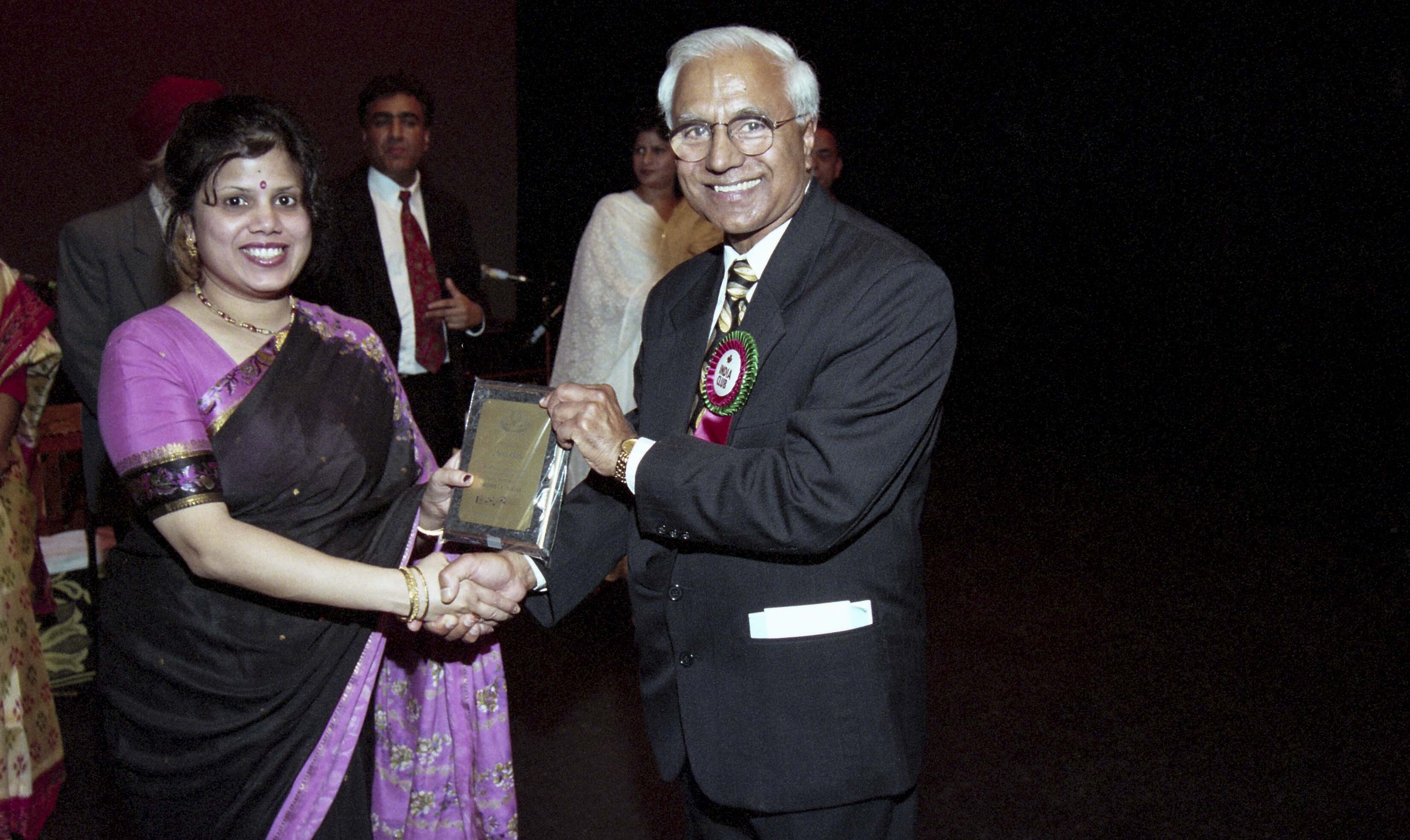
Group portrait of an unidentified woman receiving a plaque at a musical event organized by the India Club, entitled Mehfil-e-Ghazal: An Evening of Hindustani Music and Poetry.
Established in 1969, India Club preserved Indian heritage and traditions, as well as promoted responsible citizenship. They intended to positively impact the lives of Indian origin citizens of Vancouver, B.C, through engaging in charitable work and organizing events like Holi, Diwali, and picnics. Their services include conducting lectures, provide music lessons, hold cultural events, and other enriching opportunities.
Established in 1969, India Club preserved Indian heritage and traditions, as well as promoted responsible citizenship. They intended to positively impact the lives of Indian origin citizens of Vancouver, B.C, through engaging in charitable work and organizing events like Holi, Diwali, and picnics. Their services include conducting lectures, provide music lessons, hold cultural events, and other enriching opportunities.
Member of
Creator: Bodalia, Chandra
Description
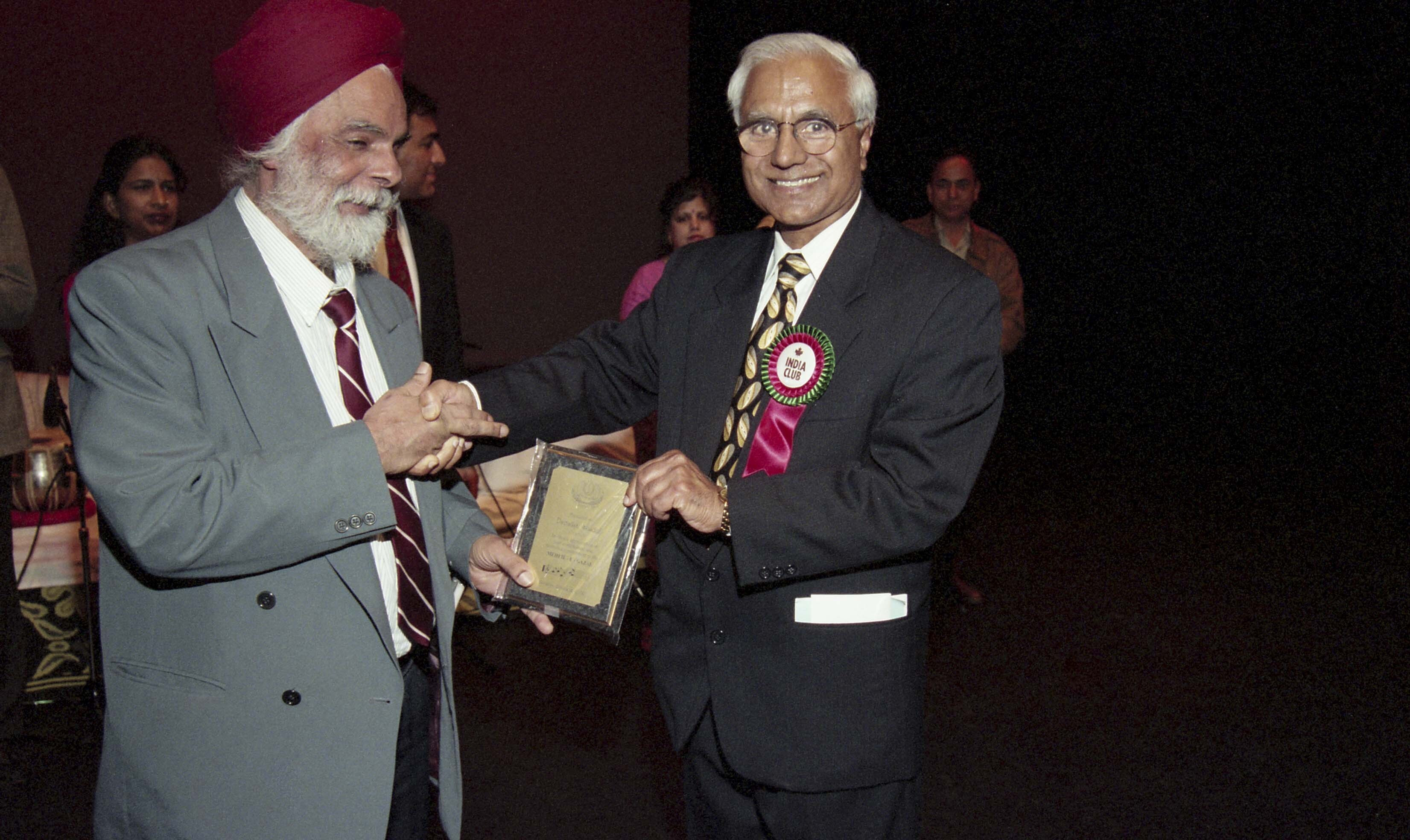
Group portrait of an unidentified man receiving a plaque at a musical event organized by the India Club, entitled Mehfil-e-Ghazal: An Evening of Hindustani Music and Poetry.
Established in 1969, India Club preserved Indian heritage and traditions, as well as promoted responsible citizenship. They intended to positively impact the lives of Indian origin citizens of Vancouver, B.C, through engaging in charitable work and organizing events like Holi, Diwali, and picnics. Their services include conducting lectures, provide music lessons, hold cultural events, and other enriching opportunities.
Established in 1969, India Club preserved Indian heritage and traditions, as well as promoted responsible citizenship. They intended to positively impact the lives of Indian origin citizens of Vancouver, B.C, through engaging in charitable work and organizing events like Holi, Diwali, and picnics. Their services include conducting lectures, provide music lessons, hold cultural events, and other enriching opportunities.
Creator: Bodalia, Chandra
Description
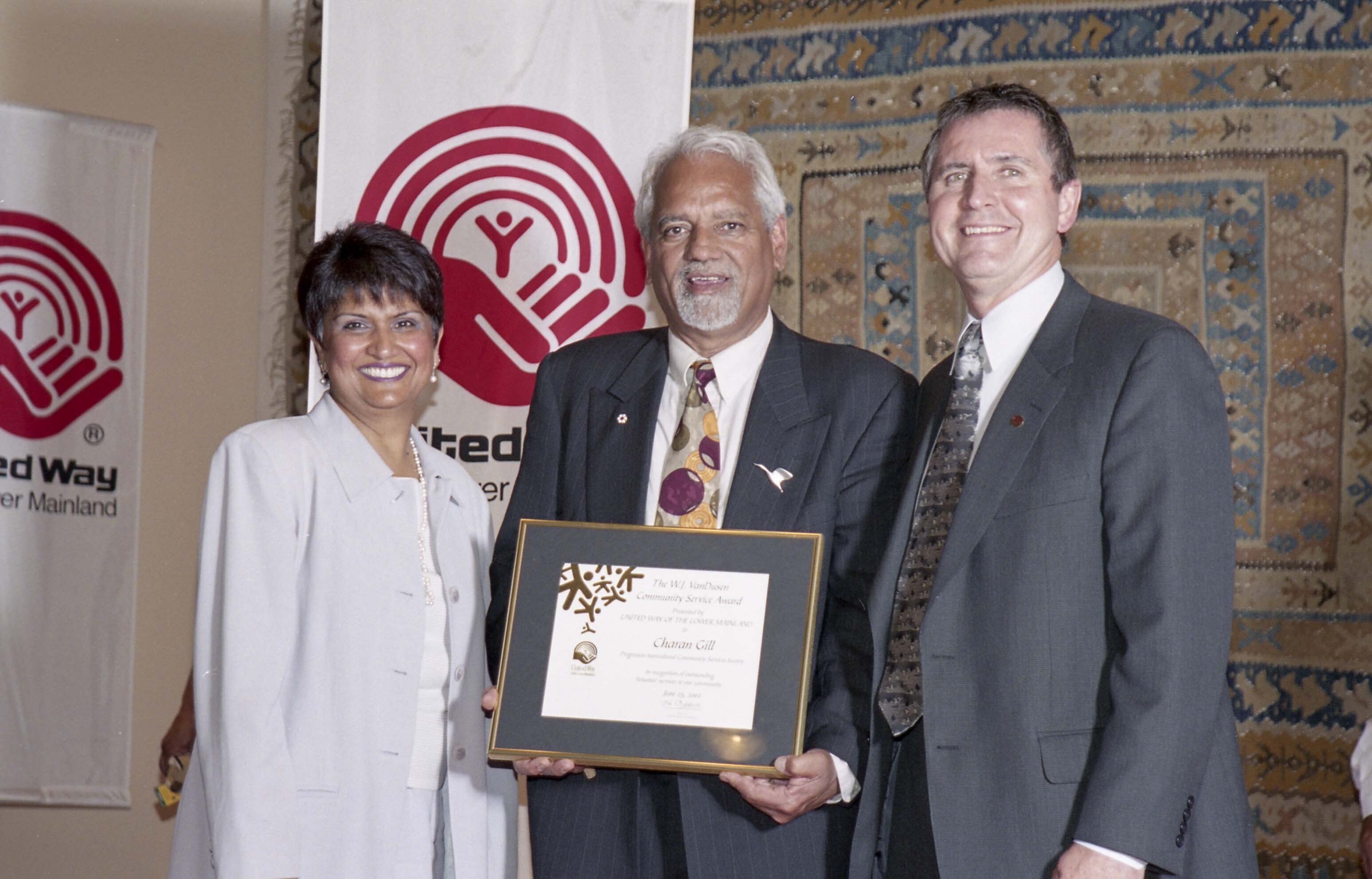
Group portrait of Charan Gill holding a certificate with unidentified individuals at a charity event hosted by the United Way British Columbia (then United Way of Lower Mainland), and hosted at one of the Ismaili jamatkhanas in Lower Mainland, B.C.
Charan Pal Gill (June 17, 1936 - February 2, 2021), born in Hong Kong, was a social worker, social activist, labour organizer, anti-racism pioneer and a South Asian community leader in British Columbia. Gill relocated to Vancouver, Canada in 1967, where he briefly worked as a berry picker before finding employment in a sawmill in Williams Lake, British Columbia. Due to an injury to his wrist, Gill left the sawmill and after some training began working as a social worker in Prince Rupert. After working for five years as a social worker, Gill became a registered social worker after obtaining his bachelor's degree from the University of British Columbia in 1970. Gill was involved with the Indian People's Association in North America (IPANA) in Vancouver. Founded in Montreal in June 1975, IPANA was a left-wing social group initially focused on generating support for the Naxalite movement in India. In 1979, Gill with IPANA in Vancouver played significant roles in the formation of the Farm Workers Organizing Committee (FWOC). On 6 April 1980, the FWOC transformed into the Canadian Farmworkers Union (CFU). The CFU became the first union in Canada's history centred on farmworkers. Gill was elected CFU founding secretary (by 2004 he also served as secretary and treasurer). He also became the editor of the Farmworker, the CFU's newspaper (published in English and Panjabi). While contributing towards the CFU, Gill pursued postgraduate studies and earned his master's degree in social work in 1983. For much of his professional career he worked for the BC Ministry of Human Resources and Ministry of Social Services and Housing. In November 1980, Gill co-founded the volunteer organization British Columbia Organization to Fight Racism (BCOFR). In 1985 Gill established a new service provider catering to the immediate needs of the South Asian community in British Columbia. The charitable organization was originally known as the Progressive Indo-Canadian Community Services Society and later became the Progressive Intercultural Community Services Society (PICS). Gill served as the organization's chief executive officer until 2017. Gill gradually retired from social work while working with PICS. He also served on the boards of various organizations, including the agriculture cooperative AgSafe (formerly FARSHA) since 1993; Rainbow Community Health Co-operative since 1998; Canadian Agricultural Safety Association (CASA) since 2011; and the BC Non-Profit Housing Association from 2008 to 2012. Gill was the recipient of numerous awards and honours in recognition of his activism and contributions to human rights and workers' rights, such as, the Order of British Columbia (1999) and the Queen's Diamond Jubilee Medal (2012).
United Way British Columbia (United Way BC) is a unified provincial organization with the mission to strengthen vital connections that support people in need in their local communities. Their vision is of creating and supporting a healthy, caring, and inclusive community. United Way BC undertakes many initiatives, such as maintaining a BC wildfire recovery fund, a BC flood response campaign, a campaign for Ukraine, and support for those vulnerable due to the COVID-19 pandemic.
Jamatkhanas, meaning "the house of the community," is a place of gathering and worship for Ismaili muslims. In jamatkhanas, the values of the Islamic faith are put into practice, including humility, generosity, kindness, compassion, pluralism, search for knowledge, and service to others.
Charan Pal Gill (June 17, 1936 - February 2, 2021), born in Hong Kong, was a social worker, social activist, labour organizer, anti-racism pioneer and a South Asian community leader in British Columbia. Gill relocated to Vancouver, Canada in 1967, where he briefly worked as a berry picker before finding employment in a sawmill in Williams Lake, British Columbia. Due to an injury to his wrist, Gill left the sawmill and after some training began working as a social worker in Prince Rupert. After working for five years as a social worker, Gill became a registered social worker after obtaining his bachelor's degree from the University of British Columbia in 1970. Gill was involved with the Indian People's Association in North America (IPANA) in Vancouver. Founded in Montreal in June 1975, IPANA was a left-wing social group initially focused on generating support for the Naxalite movement in India. In 1979, Gill with IPANA in Vancouver played significant roles in the formation of the Farm Workers Organizing Committee (FWOC). On 6 April 1980, the FWOC transformed into the Canadian Farmworkers Union (CFU). The CFU became the first union in Canada's history centred on farmworkers. Gill was elected CFU founding secretary (by 2004 he also served as secretary and treasurer). He also became the editor of the Farmworker, the CFU's newspaper (published in English and Panjabi). While contributing towards the CFU, Gill pursued postgraduate studies and earned his master's degree in social work in 1983. For much of his professional career he worked for the BC Ministry of Human Resources and Ministry of Social Services and Housing. In November 1980, Gill co-founded the volunteer organization British Columbia Organization to Fight Racism (BCOFR). In 1985 Gill established a new service provider catering to the immediate needs of the South Asian community in British Columbia. The charitable organization was originally known as the Progressive Indo-Canadian Community Services Society and later became the Progressive Intercultural Community Services Society (PICS). Gill served as the organization's chief executive officer until 2017. Gill gradually retired from social work while working with PICS. He also served on the boards of various organizations, including the agriculture cooperative AgSafe (formerly FARSHA) since 1993; Rainbow Community Health Co-operative since 1998; Canadian Agricultural Safety Association (CASA) since 2011; and the BC Non-Profit Housing Association from 2008 to 2012. Gill was the recipient of numerous awards and honours in recognition of his activism and contributions to human rights and workers' rights, such as, the Order of British Columbia (1999) and the Queen's Diamond Jubilee Medal (2012).
United Way British Columbia (United Way BC) is a unified provincial organization with the mission to strengthen vital connections that support people in need in their local communities. Their vision is of creating and supporting a healthy, caring, and inclusive community. United Way BC undertakes many initiatives, such as maintaining a BC wildfire recovery fund, a BC flood response campaign, a campaign for Ukraine, and support for those vulnerable due to the COVID-19 pandemic.
Jamatkhanas, meaning "the house of the community," is a place of gathering and worship for Ismaili muslims. In jamatkhanas, the values of the Islamic faith are put into practice, including humility, generosity, kindness, compassion, pluralism, search for knowledge, and service to others.
Creator: Bodalia, Chandra
Description
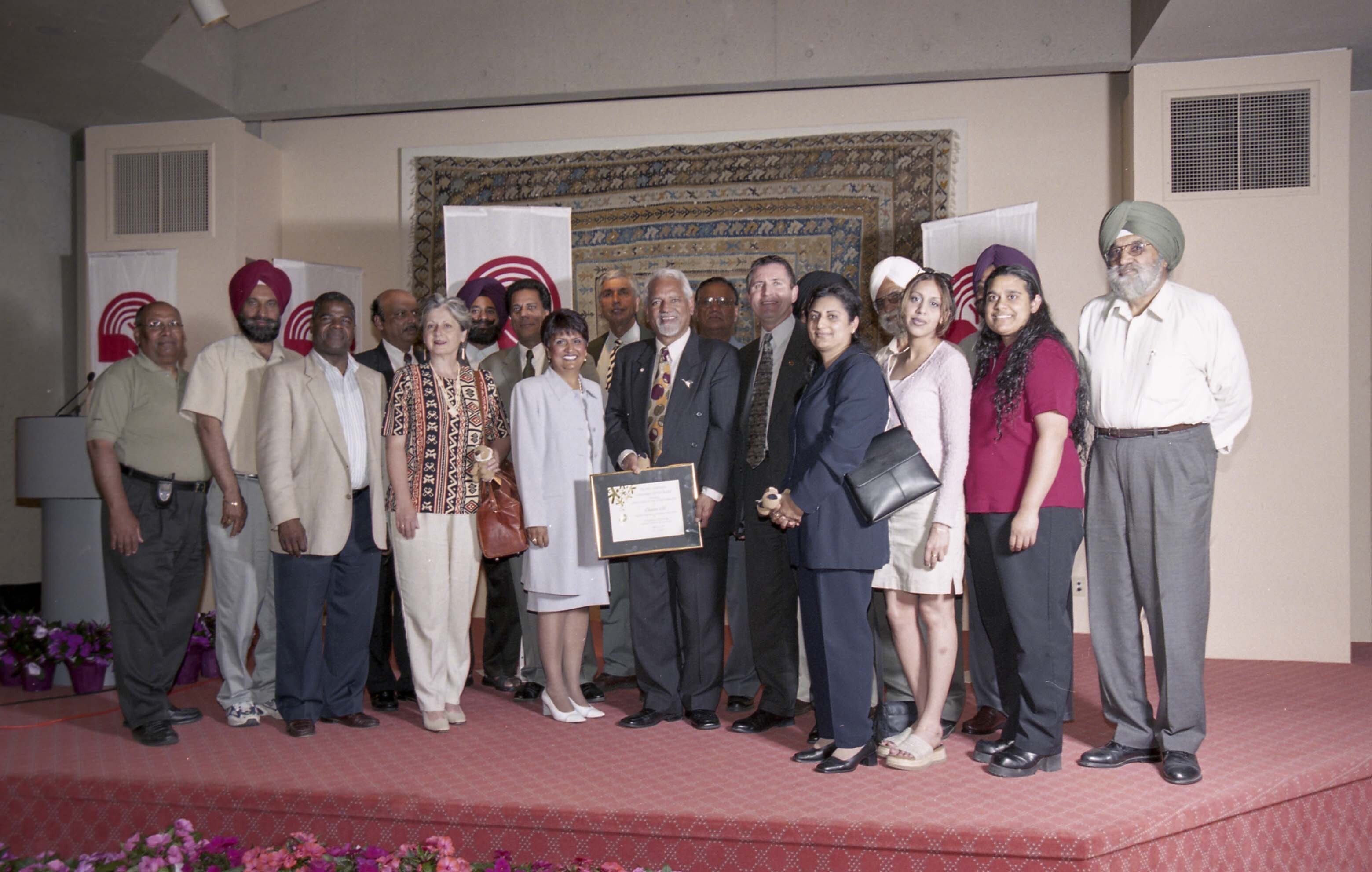
Group portrait of Charan Gill holding a certificate with unidentified individuals at a charity event hosted by the United Way British Columbia (then United Way of Lower Mainland), and hosted at one of the Ismaili jamatkhanas in Lower Mainland, B.C.
Charan Pal Gill (June 17, 1936 - February 2, 2021), born in Hong Kong, was a social worker, social activist, labour organizer, anti-racism pioneer and a South Asian community leader in British Columbia. Gill relocated to Vancouver, Canada in 1967, where he briefly worked as a berry picker before finding employment in a sawmill in Williams Lake, British Columbia. Due to an injury to his wrist, Gill left the sawmill and after some training began working as a social worker in Prince Rupert. After working for five years as a social worker, Gill became a registered social worker after obtaining his bachelor's degree from the University of British Columbia in 1970. Gill was involved with the Indian People's Association in North America (IPANA) in Vancouver. Founded in Montreal in June 1975, IPANA was a left-wing social group initially focused on generating support for the Naxalite movement in India. In 1979, Gill with IPANA in Vancouver played significant roles in the formation of the Farm Workers Organizing Committee (FWOC). On 6 April 1980, the FWOC transformed into the Canadian Farmworkers Union (CFU). The CFU became the first union in Canada's history centred on farmworkers. Gill was elected CFU founding secretary (by 2004 he also served as secretary and treasurer). He also became the editor of the Farmworker, the CFU's newspaper (published in English and Panjabi). While contributing towards the CFU, Gill pursued postgraduate studies and earned his master's degree in social work in 1983. For much of his professional career he worked for the BC Ministry of Human Resources and Ministry of Social Services and Housing. In November 1980, Gill co-founded the volunteer organization British Columbia Organization to Fight Racism (BCOFR). In 1985 Gill established a new service provider catering to the immediate needs of the South Asian community in British Columbia. The charitable organization was originally known as the Progressive Indo-Canadian Community Services Society and later became the Progressive Intercultural Community Services Society (PICS). Gill served as the organization's chief executive officer until 2017. Gill gradually retired from social work while working with PICS. He also served on the boards of various organizations, including the agriculture cooperative AgSafe (formerly FARSHA) since 1993; Rainbow Community Health Co-operative since 1998; Canadian Agricultural Safety Association (CASA) since 2011; and the BC Non-Profit Housing Association from 2008 to 2012. Gill was the recipient of numerous awards and honours in recognition of his activism and contributions to human rights and workers' rights, such as, the Order of British Columbia (1999) and the Queen's Diamond Jubilee Medal (2012).
United Way British Columbia (United Way BC) is a unified provincial organization with the mission to strengthen vital connections that support people in need in their local communities. Their vision is of creating and supporting a healthy, caring, and inclusive community. United Way BC undertakes many initiatives, such as maintaining a BC wildfire recovery fund, a BC flood response campaign, a campaign for Ukraine, and support for those vulnerable due to the COVID-19 pandemic.
Jamatkhanas, meaning "the house of the community," is a place of gathering and worship for Ismaili muslims. In jamatkhanas, the values of the Islamic faith are put into practice, including humility, generosity, kindness, compassion, pluralism, search for knowledge, and service to others.
Charan Pal Gill (June 17, 1936 - February 2, 2021), born in Hong Kong, was a social worker, social activist, labour organizer, anti-racism pioneer and a South Asian community leader in British Columbia. Gill relocated to Vancouver, Canada in 1967, where he briefly worked as a berry picker before finding employment in a sawmill in Williams Lake, British Columbia. Due to an injury to his wrist, Gill left the sawmill and after some training began working as a social worker in Prince Rupert. After working for five years as a social worker, Gill became a registered social worker after obtaining his bachelor's degree from the University of British Columbia in 1970. Gill was involved with the Indian People's Association in North America (IPANA) in Vancouver. Founded in Montreal in June 1975, IPANA was a left-wing social group initially focused on generating support for the Naxalite movement in India. In 1979, Gill with IPANA in Vancouver played significant roles in the formation of the Farm Workers Organizing Committee (FWOC). On 6 April 1980, the FWOC transformed into the Canadian Farmworkers Union (CFU). The CFU became the first union in Canada's history centred on farmworkers. Gill was elected CFU founding secretary (by 2004 he also served as secretary and treasurer). He also became the editor of the Farmworker, the CFU's newspaper (published in English and Panjabi). While contributing towards the CFU, Gill pursued postgraduate studies and earned his master's degree in social work in 1983. For much of his professional career he worked for the BC Ministry of Human Resources and Ministry of Social Services and Housing. In November 1980, Gill co-founded the volunteer organization British Columbia Organization to Fight Racism (BCOFR). In 1985 Gill established a new service provider catering to the immediate needs of the South Asian community in British Columbia. The charitable organization was originally known as the Progressive Indo-Canadian Community Services Society and later became the Progressive Intercultural Community Services Society (PICS). Gill served as the organization's chief executive officer until 2017. Gill gradually retired from social work while working with PICS. He also served on the boards of various organizations, including the agriculture cooperative AgSafe (formerly FARSHA) since 1993; Rainbow Community Health Co-operative since 1998; Canadian Agricultural Safety Association (CASA) since 2011; and the BC Non-Profit Housing Association from 2008 to 2012. Gill was the recipient of numerous awards and honours in recognition of his activism and contributions to human rights and workers' rights, such as, the Order of British Columbia (1999) and the Queen's Diamond Jubilee Medal (2012).
United Way British Columbia (United Way BC) is a unified provincial organization with the mission to strengthen vital connections that support people in need in their local communities. Their vision is of creating and supporting a healthy, caring, and inclusive community. United Way BC undertakes many initiatives, such as maintaining a BC wildfire recovery fund, a BC flood response campaign, a campaign for Ukraine, and support for those vulnerable due to the COVID-19 pandemic.
Jamatkhanas, meaning "the house of the community," is a place of gathering and worship for Ismaili muslims. In jamatkhanas, the values of the Islamic faith are put into practice, including humility, generosity, kindness, compassion, pluralism, search for knowledge, and service to others.
Creator: Bodalia, Chandra
Description
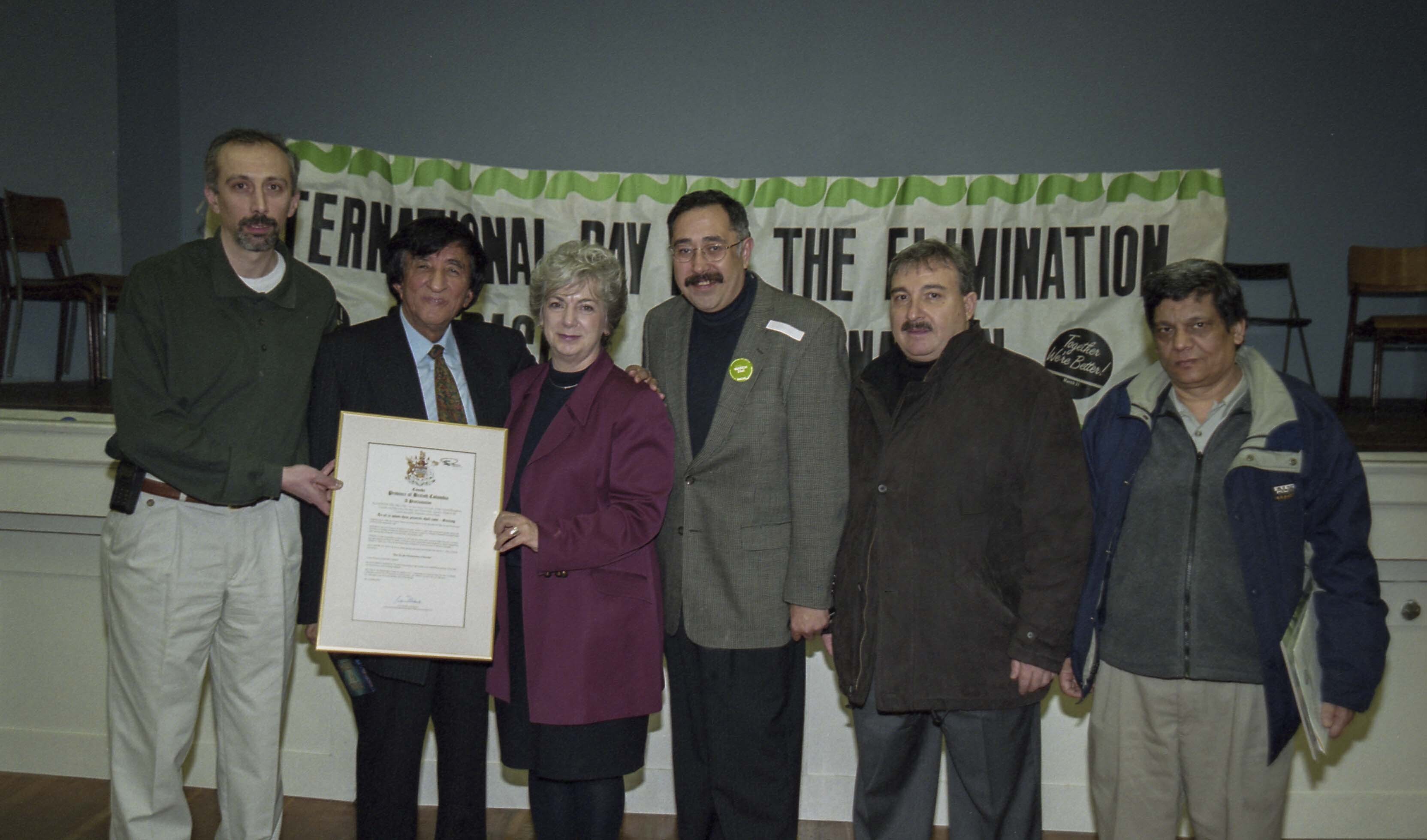
Group portrait of Aziz Khaki receiving an award from the Province of British Columbia at an International Day for the Elimination of Racial Discrimination event.
Dr. Abdulaziz 'Aziz' Khaki was an activist and leader in the Canadian Muslim community. He served as vice-president of the Canadian Muslim Federation and the Council of Muslim Communities of Canada. Dr. Khaki was a strong advocate for human rights, interfaith dialogue, and the integration of Muslim communities into Canadian society.
The International Day for the Elimination of Racial Discrimination is guided by the United Nations International Convention on the Elimination of All Forms of Racial Discrimination and recognizes that the injustices and prejudices fueled by racial discrimination take place every day. Observed annually on March 21, it commemorates the day police in Sharpeville, South Africa, opened fire and killed 69 people at a peaceful demonstration against apartheid "pass laws" in 1960. This day serves as a call to action for individuals, organizations, and all levels of government to actively work to eliminate all forms of racial discrimination, injustice, systemic racism and hate.
Dr. Abdulaziz 'Aziz' Khaki was an activist and leader in the Canadian Muslim community. He served as vice-president of the Canadian Muslim Federation and the Council of Muslim Communities of Canada. Dr. Khaki was a strong advocate for human rights, interfaith dialogue, and the integration of Muslim communities into Canadian society.
The International Day for the Elimination of Racial Discrimination is guided by the United Nations International Convention on the Elimination of All Forms of Racial Discrimination and recognizes that the injustices and prejudices fueled by racial discrimination take place every day. Observed annually on March 21, it commemorates the day police in Sharpeville, South Africa, opened fire and killed 69 people at a peaceful demonstration against apartheid "pass laws" in 1960. This day serves as a call to action for individuals, organizations, and all levels of government to actively work to eliminate all forms of racial discrimination, injustice, systemic racism and hate.
Creator: Bodalia, Chandra
Description
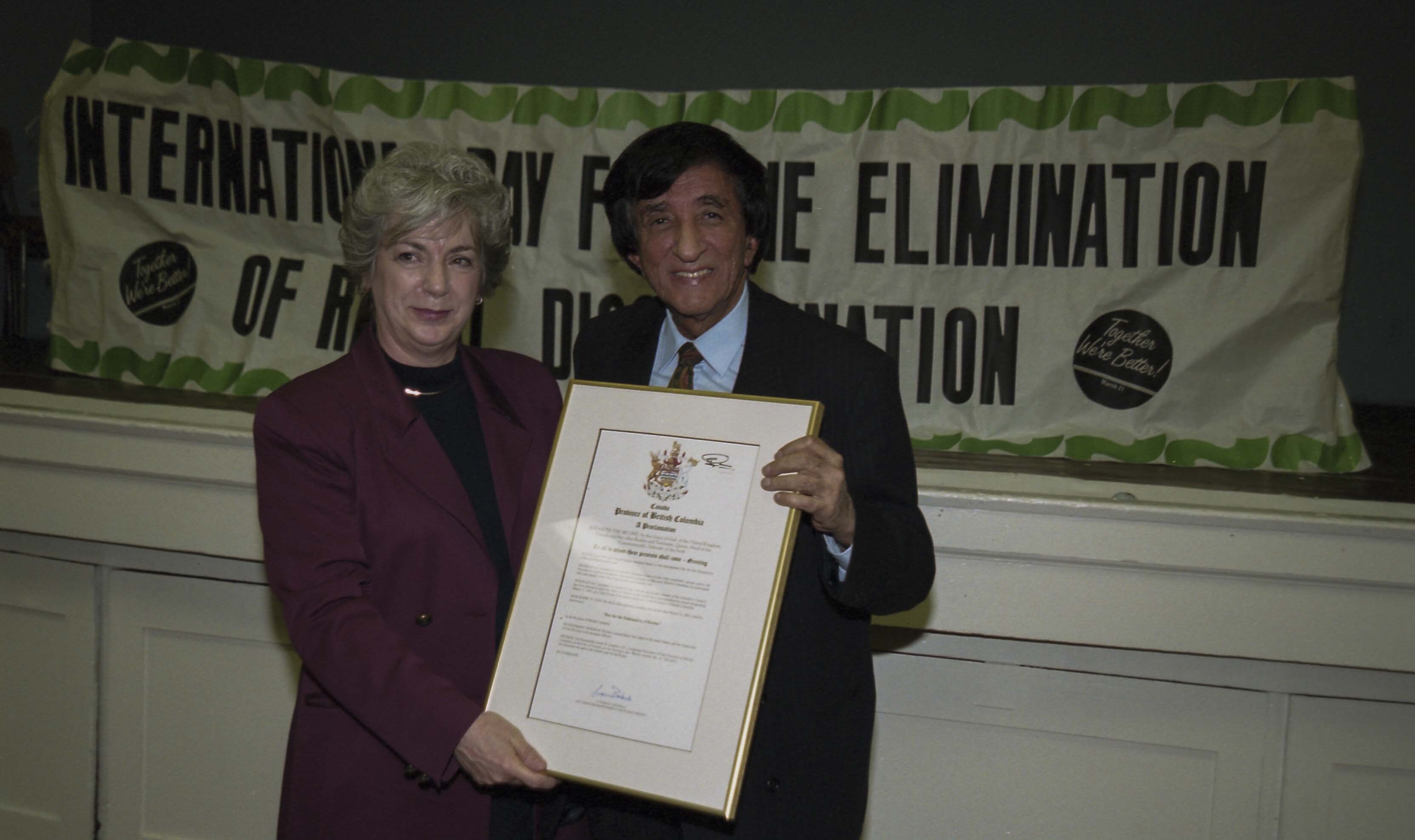
Photograph of Aziz Khaki receiving an award from the Province of British Columbia at an International Day for the Elimination of Racial Discrimination event.
Dr. Abdulaziz 'Aziz' Khaki was an activist and leader in the Canadian Muslim community. He served as vice-president of the Canadian Muslim Federation and the Council of Muslim Communities of Canada. Dr. Khaki was a strong advocate for human rights, interfaith dialogue, and the integration of Muslim communities into Canadian society.
The International Day for the Elimination of Racial Discrimination is guided by the United Nations International Convention on the Elimination of All Forms of Racial Discrimination and recognizes that the injustices and prejudices fueled by racial discrimination take place every day. Observed annually on March 21, it commemorates the day police in Sharpeville, South Africa, opened fire and killed 69 people at a peaceful demonstration against apartheid "pass laws" in 1960. This day serves as a call to action for individuals, organizations, and all levels of government to actively work to eliminate all forms of racial discrimination, injustice, systemic racism and hate.
Dr. Abdulaziz 'Aziz' Khaki was an activist and leader in the Canadian Muslim community. He served as vice-president of the Canadian Muslim Federation and the Council of Muslim Communities of Canada. Dr. Khaki was a strong advocate for human rights, interfaith dialogue, and the integration of Muslim communities into Canadian society.
The International Day for the Elimination of Racial Discrimination is guided by the United Nations International Convention on the Elimination of All Forms of Racial Discrimination and recognizes that the injustices and prejudices fueled by racial discrimination take place every day. Observed annually on March 21, it commemorates the day police in Sharpeville, South Africa, opened fire and killed 69 people at a peaceful demonstration against apartheid "pass laws" in 1960. This day serves as a call to action for individuals, organizations, and all levels of government to actively work to eliminate all forms of racial discrimination, injustice, systemic racism and hate.
Creator: Bodalia, Chandra
Description
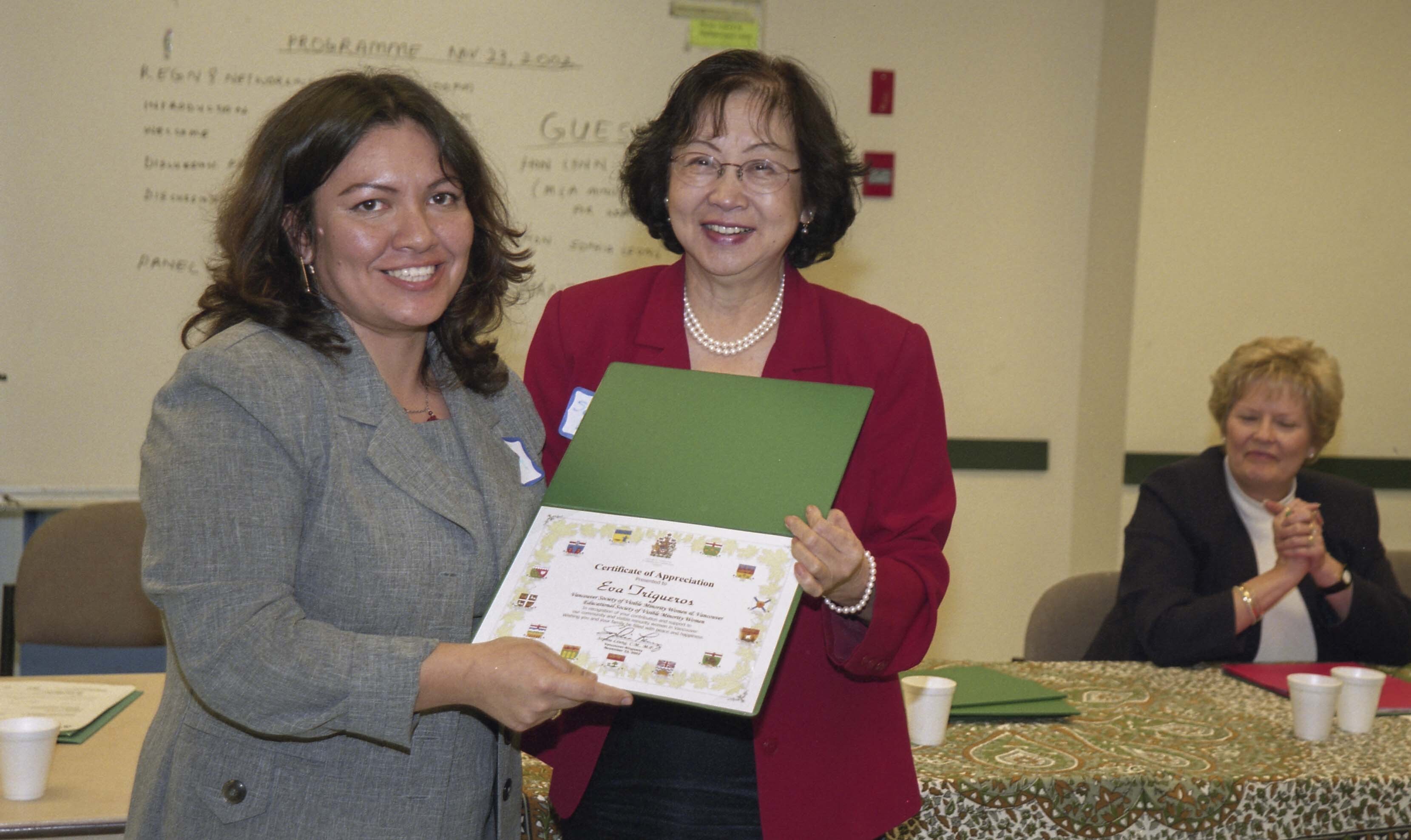
Photograph of MP Sophia Leung presenting a certificate to Eva Trigueros at a educational event for visible minority women hosted by the Vancouver Society of Visible Minority Women and the Vancouver Educational Society of Visible Minority Women in Vancouver, B.C.
A social worker by profession, Sophia Leung has distinguished herself as a family counsellor, writer and lecturer, and consultant in Asian culture, art and business. Her research on the impact of adolescent learning disabilities on their behavioral problems, and on the cross-cultural differences in patterns of child abuse, has effected positive changes in therapeutic approaches in both China and North America. She was awarded the Member of the Order of Canada in 1994. Sophia Leung is a former Member of Parliament for the Liberal Party; she served two terms as MP from the Vancouver Kingsway riding. She was Parliamentary Secretary to the Minister of National Revenue, and she was made a Member of the Order of Canada.
A social worker by profession, Sophia Leung has distinguished herself as a family counsellor, writer and lecturer, and consultant in Asian culture, art and business. Her research on the impact of adolescent learning disabilities on their behavioral problems, and on the cross-cultural differences in patterns of child abuse, has effected positive changes in therapeutic approaches in both China and North America. She was awarded the Member of the Order of Canada in 1994. Sophia Leung is a former Member of Parliament for the Liberal Party; she served two terms as MP from the Vancouver Kingsway riding. She was Parliamentary Secretary to the Minister of National Revenue, and she was made a Member of the Order of Canada.
Creator: Bodalia, Chandra
Description
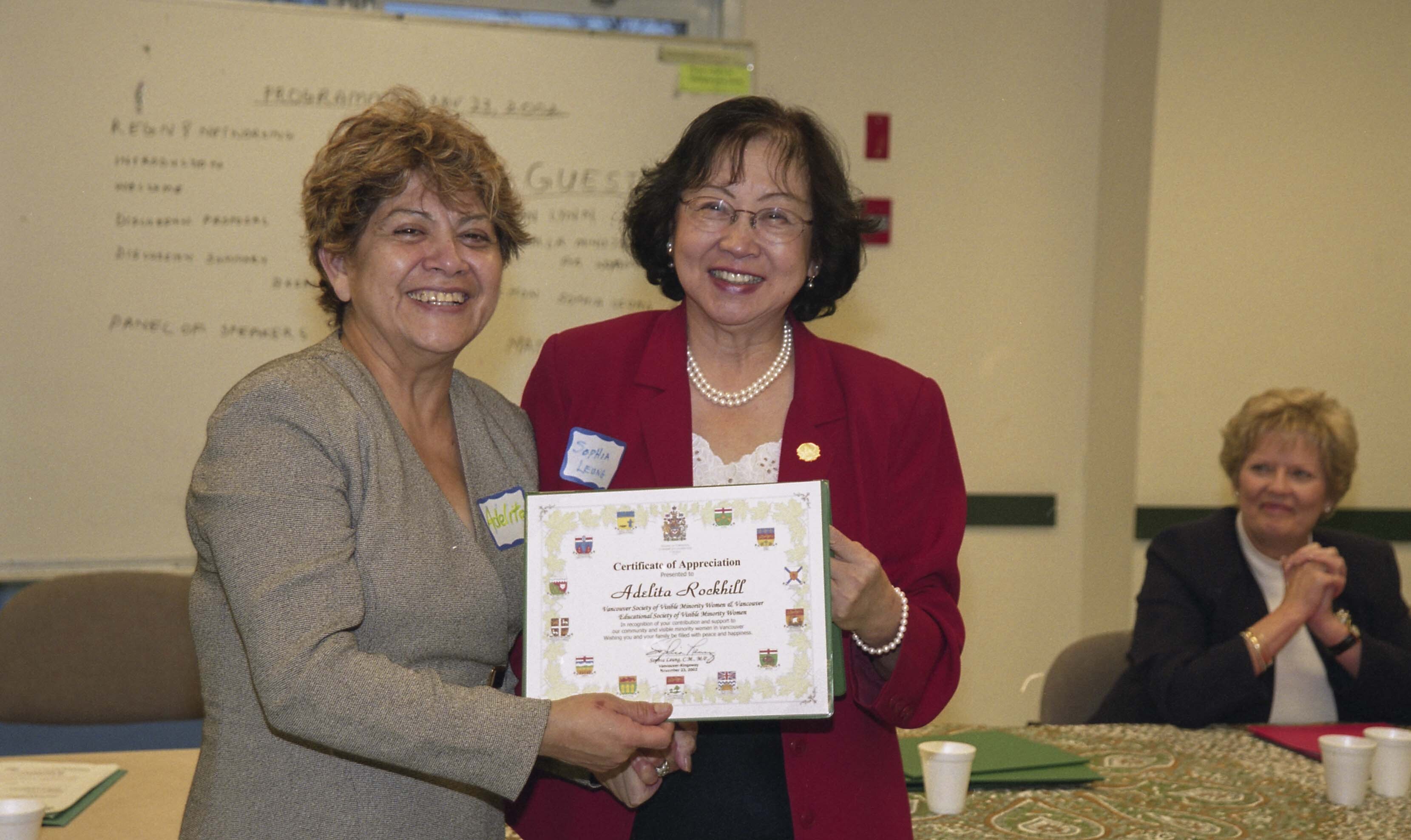
Photograph of MP Sophia Leung presenting a certificate to Adelita Rockhill at a educational event for visible minority women hosted by the Vancouver Society of Visible Minority Women and the Vancouver Educational Society of Visible Minority Women in Vancouver, B.C.
A social worker by profession, Sophia Leung has distinguished herself as a family counsellor, writer and lecturer, and consultant in Asian culture, art and business. Her research on the impact of adolescent learning disabilities on their behavioral problems, and on the cross-cultural differences in patterns of child abuse, has effected positive changes in therapeutic approaches in both China and North America. She was awarded the Member of the Order of Canada in 1994. Sophia Leung is a former Member of Parliament for the Liberal Party; she served two terms as MP from the Vancouver Kingsway riding. She was Parliamentary Secretary to the Minister of National Revenue, and she was made a Member of the Order of Canada.
A social worker by profession, Sophia Leung has distinguished herself as a family counsellor, writer and lecturer, and consultant in Asian culture, art and business. Her research on the impact of adolescent learning disabilities on their behavioral problems, and on the cross-cultural differences in patterns of child abuse, has effected positive changes in therapeutic approaches in both China and North America. She was awarded the Member of the Order of Canada in 1994. Sophia Leung is a former Member of Parliament for the Liberal Party; she served two terms as MP from the Vancouver Kingsway riding. She was Parliamentary Secretary to the Minister of National Revenue, and she was made a Member of the Order of Canada.
Creator: Bodalia, Chandra
Description
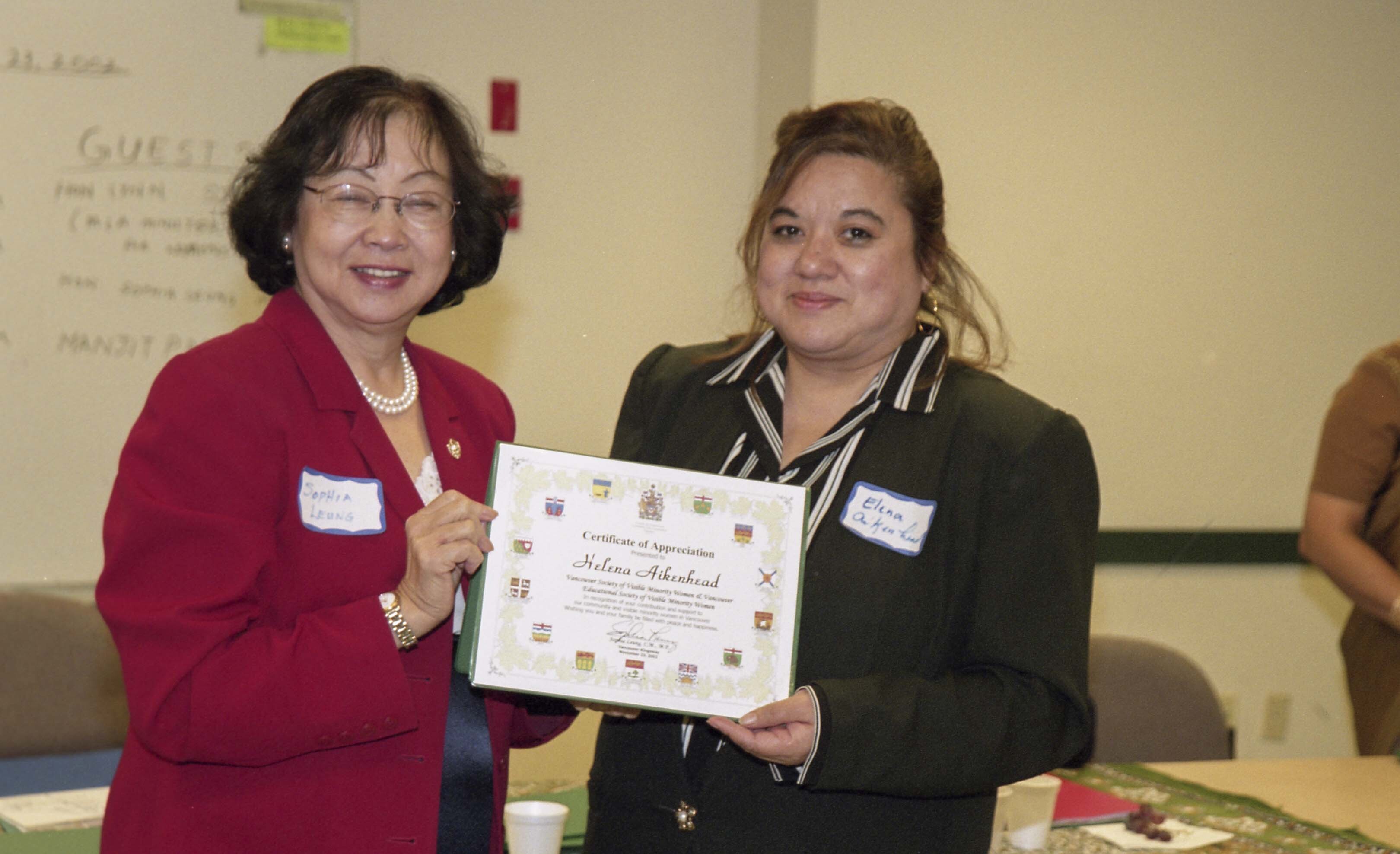
Photograph of MP Sophia Leung presenting a certificate to Elena Aikenhead at a educational event for visible minority women hosted by the Vancouver Society of Visible Minority Women and the Vancouver Educational Society of Visible Minority Women in Vancouver, B.C.
A social worker by profession, Sophia Leung has distinguished herself as a family counsellor, writer and lecturer, and consultant in Asian culture, art and business. Her research on the impact of adolescent learning disabilities on their behavioral problems, and on the cross-cultural differences in patterns of child abuse, has effected positive changes in therapeutic approaches in both China and North America. She was awarded the Member of the Order of Canada in 1994. Sophia Leung is a former Member of Parliament for the Liberal Party; she served two terms as MP from the Vancouver Kingsway riding. She was Parliamentary Secretary to the Minister of National Revenue, and she was made a Member of the Order of Canada.
A social worker by profession, Sophia Leung has distinguished herself as a family counsellor, writer and lecturer, and consultant in Asian culture, art and business. Her research on the impact of adolescent learning disabilities on their behavioral problems, and on the cross-cultural differences in patterns of child abuse, has effected positive changes in therapeutic approaches in both China and North America. She was awarded the Member of the Order of Canada in 1994. Sophia Leung is a former Member of Parliament for the Liberal Party; she served two terms as MP from the Vancouver Kingsway riding. She was Parliamentary Secretary to the Minister of National Revenue, and she was made a Member of the Order of Canada.
Member of
Creator: Bodalia, Chandra
Description
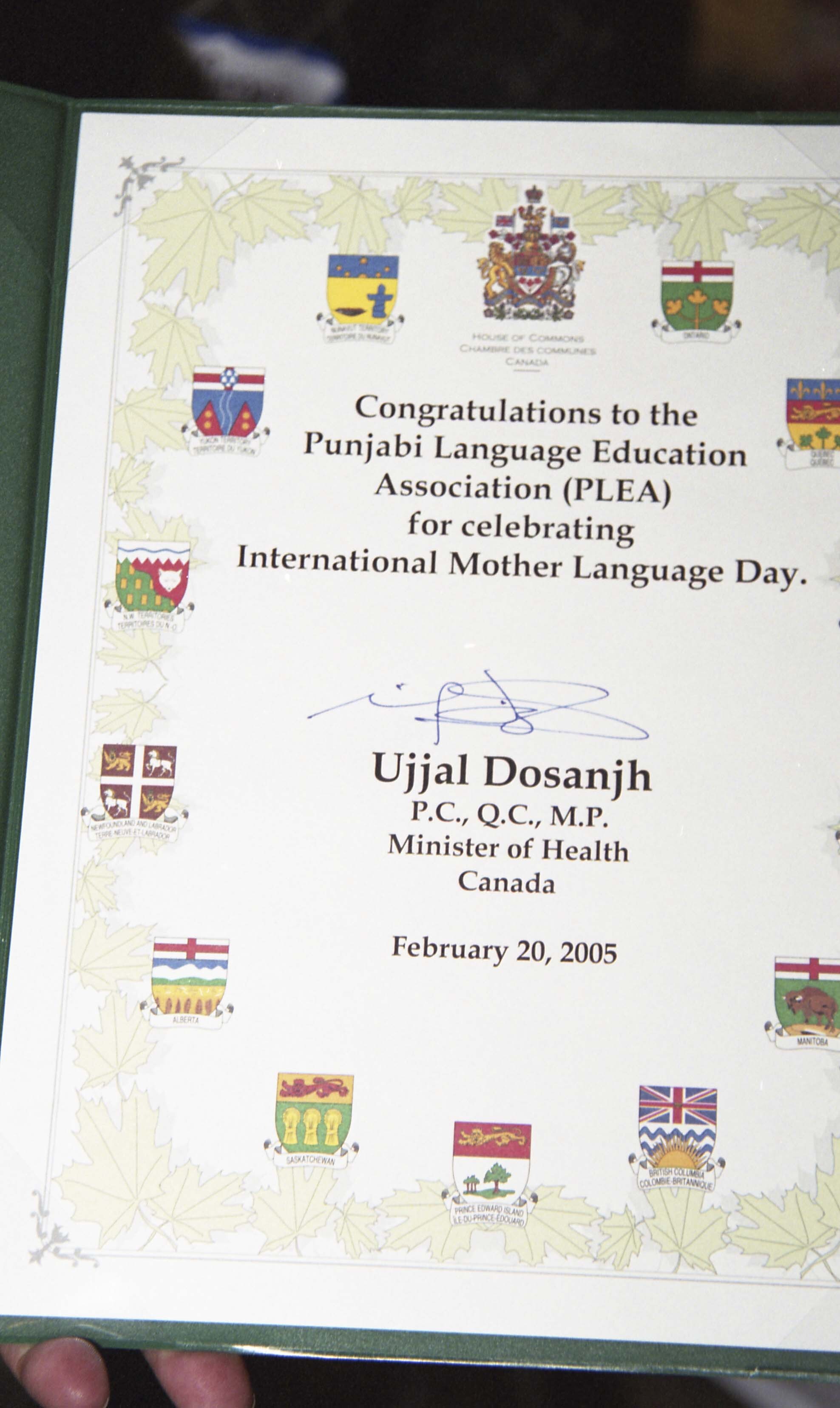
Photograph of a certificate from former Premier Ujjal Dosanjh to the Punjabi Language Education Association at the 3rd annual celebration of International Mother Language Day in Surrey, B.C.
International Mother Language Day is observed globally on February 21, following UNESCO's declaration on November 17, 1999, after advocacy led by Bangladesh and other nations. This day is celebrated worldwide with enthusiasm to honor linguistic heritage and promote the preservation of mother languages.
Ujjal Dosanjh is a Canadian lawyer, civil rights activist, and politician. Born in Panjab, India in 1947, Dosanjh emigrated to England at the age of 17 and came to Canada four years later, in 1968. He started off at a Vancouver sawmill, but when a back injury hindered his career at the mill, he enrolled at Langara College and completed a degree in political science at Simon Fraser University. He earned a law degree at the University of British Columbia and established a law practice in Vancouver in 1979. First elected as MLA for Vancouver-Kensington in 1991, Dosanjh twice served as Caucus Chair and also chaired the Select Standing Committee on Parliamentary Reform, Ethical Conduct, Standing Orders and Private Bills. Dosanjh was sworn in as British Columbia's 33rd Premier and Canada's first Indo-Canadian Premier on February 24, 2000, serving until 2001. He had previously served as Minister of Government Services and Minister Responsible for Multiculturalism, Human Rights, Sports and Immigration in 1995, and served as Attorney General from August 1995 to February 2000. He was also the leader of the provincial New Democratic Party (NDP) and later served as a Member of Parliament with the Liberal Party. A long time human rights activist, his past community involvements include: South Vancouver Neighbourhood House, MOSAIC, the B.C. Multicultural Society and the B.C. Civil Liberties Association. In 1977 he helped set up the first farm workers' legal information services while he was chair of the Labour Advocacy Research Association. Throughout his career, Dosanjh has been a strong advocate for social justice, healthcare, and public policy issues.
The Punjabi Language Education Association (PLEA) is a community-based organization dedicated to raising awareness about the challenges faced by the Punjabi language and advocating for its inclusion in British Columbia's educational institutions. Since 2002, PLEA has organized annual IMLD celebrations, along with various events aimed at promoting Punjabi language and culture.
Princess Margaret Secondary School is a public school located in Surrey, British Columbia, as part of the Surrey School District. Formed in 1906, the Surrey School District serves the cities of Surrey and White Rock and the rural area of Barnston Island. Princess Margaret Secondary School was initially built in 1949-50. The school was named after H.R.H. Princess Margaret, second daughter of Queen Elizabeth and King George VI, and opened on December 4, 1950. In 1999, a new Princess Margaret Secondary School was built on what had been the running track, and the site of the old school became the parking lot for the new one.
L.A. Matheson Secondary School is a public secondary school in Surrey, British Columbia, Canada, and is part of School District 36 Surrey. The school opened in 1969 as a junior secondary school as a feeder to High School but in 1998 became a full secondary school serving grades 8 through 12.
International Mother Language Day is observed globally on February 21, following UNESCO's declaration on November 17, 1999, after advocacy led by Bangladesh and other nations. This day is celebrated worldwide with enthusiasm to honor linguistic heritage and promote the preservation of mother languages.
Ujjal Dosanjh is a Canadian lawyer, civil rights activist, and politician. Born in Panjab, India in 1947, Dosanjh emigrated to England at the age of 17 and came to Canada four years later, in 1968. He started off at a Vancouver sawmill, but when a back injury hindered his career at the mill, he enrolled at Langara College and completed a degree in political science at Simon Fraser University. He earned a law degree at the University of British Columbia and established a law practice in Vancouver in 1979. First elected as MLA for Vancouver-Kensington in 1991, Dosanjh twice served as Caucus Chair and also chaired the Select Standing Committee on Parliamentary Reform, Ethical Conduct, Standing Orders and Private Bills. Dosanjh was sworn in as British Columbia's 33rd Premier and Canada's first Indo-Canadian Premier on February 24, 2000, serving until 2001. He had previously served as Minister of Government Services and Minister Responsible for Multiculturalism, Human Rights, Sports and Immigration in 1995, and served as Attorney General from August 1995 to February 2000. He was also the leader of the provincial New Democratic Party (NDP) and later served as a Member of Parliament with the Liberal Party. A long time human rights activist, his past community involvements include: South Vancouver Neighbourhood House, MOSAIC, the B.C. Multicultural Society and the B.C. Civil Liberties Association. In 1977 he helped set up the first farm workers' legal information services while he was chair of the Labour Advocacy Research Association. Throughout his career, Dosanjh has been a strong advocate for social justice, healthcare, and public policy issues.
The Punjabi Language Education Association (PLEA) is a community-based organization dedicated to raising awareness about the challenges faced by the Punjabi language and advocating for its inclusion in British Columbia's educational institutions. Since 2002, PLEA has organized annual IMLD celebrations, along with various events aimed at promoting Punjabi language and culture.
Princess Margaret Secondary School is a public school located in Surrey, British Columbia, as part of the Surrey School District. Formed in 1906, the Surrey School District serves the cities of Surrey and White Rock and the rural area of Barnston Island. Princess Margaret Secondary School was initially built in 1949-50. The school was named after H.R.H. Princess Margaret, second daughter of Queen Elizabeth and King George VI, and opened on December 4, 1950. In 1999, a new Princess Margaret Secondary School was built on what had been the running track, and the site of the old school became the parking lot for the new one.
L.A. Matheson Secondary School is a public secondary school in Surrey, British Columbia, Canada, and is part of School District 36 Surrey. The school opened in 1969 as a junior secondary school as a feeder to High School but in 1998 became a full secondary school serving grades 8 through 12.