
South Asian Canadian men sawmill workers
Video file
Description
Interview with Gian Rai about his immigration to Canada. Gian Rai's grandfather came to Yuba, California where his brother Dalip worked. His father came to the US with a student visa, but started to work. He fled the US after the government was told about him violating the visa terms. Gian Rai was one of the only educated ones in his village, and he became the Sarpanch at the age of 24, making him the youngest Sarpanch in the village. After leaving his village with his siblings and moving to America where they met their father, they took a bus to cross the border to Canada. After arriving, he did not attend university and started to work in a mill despite his student visa. When the government found out about the violation of his visa, his father found a family that helped to find a girl for Gian Rai to get married to, making him a Canadian citizen. Gian Rai describes how he regrets not finishing his studies at the University of British Columbia. This is a full-length interview conducted on June 24,1996.
Video file
Creator: Gill, Sewa Singh
Description
Interview with Sewa Singh about his move to Canada as well as his father's story of working in Canada in the early 1900s. Sewa Singh spent his childhood tutoring and helping out at school, as well as working on his 15-acre family farm. His father came to Canada in 1906, to work on the railroad, while sending money frequently to his family in India. After losing his job, he went to the United States and worked as a farm labourer and lived in a barn. He returned to India to attend to his family in 1932. He returned to Canada in 1935. When he came back, Sewa Singh was with him. Sewa Singh and his father stayed in San Francisco for two months before they finally reached Canada. Sewa Singh found a job as a janitor in a sawmill in North Vancouver. Both of them lived in the bunkhouses with 12 others and one cook. Sewa then got another job at the mill and a raise of 5 cents. Sewa Singh always kept short hair and was clean shaven. Sewa married a Canadian woman and settled down. This is a full-length interview recorded on June 27, 1996 conducted by Nirakshik Chand in Abbotsford, BC.
Video file
Description
Mr. Najar Singh Gill was thirty years old when he moved to Canada in 1963 from Punjab. He was a farmer in India and also the first member of his family to come to Canada. Mr. Najar's wife was a Canadian citizen and she sponsored him. He then moved to Canada with his daughter who was only one and a half years old at that time. Further, Mr. Gill knew several friends and acquaintances in Canada who were from the same village, all of whom helped him to start his new life. He first started to work in Mission in a mill and then came to Abbotsford.This is a full-length interview recorded on June 4, 1996, conducted by Nirakshik Chand at Mr. Fateh Chand's residence in Abbotsford.
Video file
Creator: Gill, Nash
Description
Interview with Nash Gill about his life growing up in Canada. Nash Gill's family immigrated in 1949. Nash's father, Indar Singh Gill, was already a Canadian resident therefore, Nash got his citizenship directly. Gill was only one and a half years old when he moved from Punjab to Canada with his mother. He grew up in Mission and his family used to visit the gurdwara in Abbotsford weekly. He was one of the few South Asian Canadians in his school. In high school, during graduation, he was the only South Asian Canadian in his class. He spent his summers berry picking. Nash Gill describes how during the Great Depression, his father started working for Kapoor Lumber, and later on, he built his own mill, calling it Fraser Valley Sawmill. This is a full-length interview recorded on August 30th, 1996 conducted by Nirakshik Chand at Mr. Gill's law office in Abbotsford.
Video file
Description
Interview with Indar Singh Gill about his experiences moving to Canada. Indar Singh Gill's uncle was already a resident in Canada therefore, he helped Indar Singh with the government documentation. Eventually, with his uncle's guidance, Indar immigrated to Canada in the year 1930, when he was only 17 years old. Gill's uncle used to feed them even though he did not have a job. Indar Singh used to stay at Mayo Lumbers. He was then sent to Kamloops to pick tomatoes for three months, $54 was his wage. In 1932, he started to work at Kapoor Lumber Company. Indar Singh took over the lumber mill after the previous lumber owner retired. At one point in the interview, Indar Singh speaks about the Pearl Harbor attack in 1941, and talks about the forced removal of Japanese Canadians. This is a full-length interview recorded on January 6th, 1994.
Video file
Creator: Dhaliwal, Paul Singh
Description
Interview with Mr. Paul Singh Dhaliwal describing his life, particularly focusing on his move to Canada and the changes he faced. Mr. Dhaliwal's father lived in Canada for several years but died before bringing his family to Canada. Paul Singh came to Canada in 1932 at the age of 16 and lived with his uncle, Bhagat Singh. While on his journey to Canada he met some people who helped him cook his food and get his health examination done. He and his uncle used to work at Greenlake Mill. After that mill shut down in winter, he lived with his uncle in Abbotsford where his uncle had property and a house, before going to Ducan to work at Hillcrest mill. During the Second World War, Dhaliwal attempted to sign up for service, but was denied after taking the medical exams. During the war, it was easy for him to find work. After the war, and after the British left, it was easier for him to travel to India and back. In 1945, he was spotted by an American promoter while wrestling and he was given a passport, allowing him to travel. He went from place to place and wrestled in high profiled matches. He made hundreds of dollars per match. In 1950 he decided to quit wrestling and was married. Afterward, he focused mostly on his trucking business. This is a full length interview recorded at Mr. Paul's residence.
Description
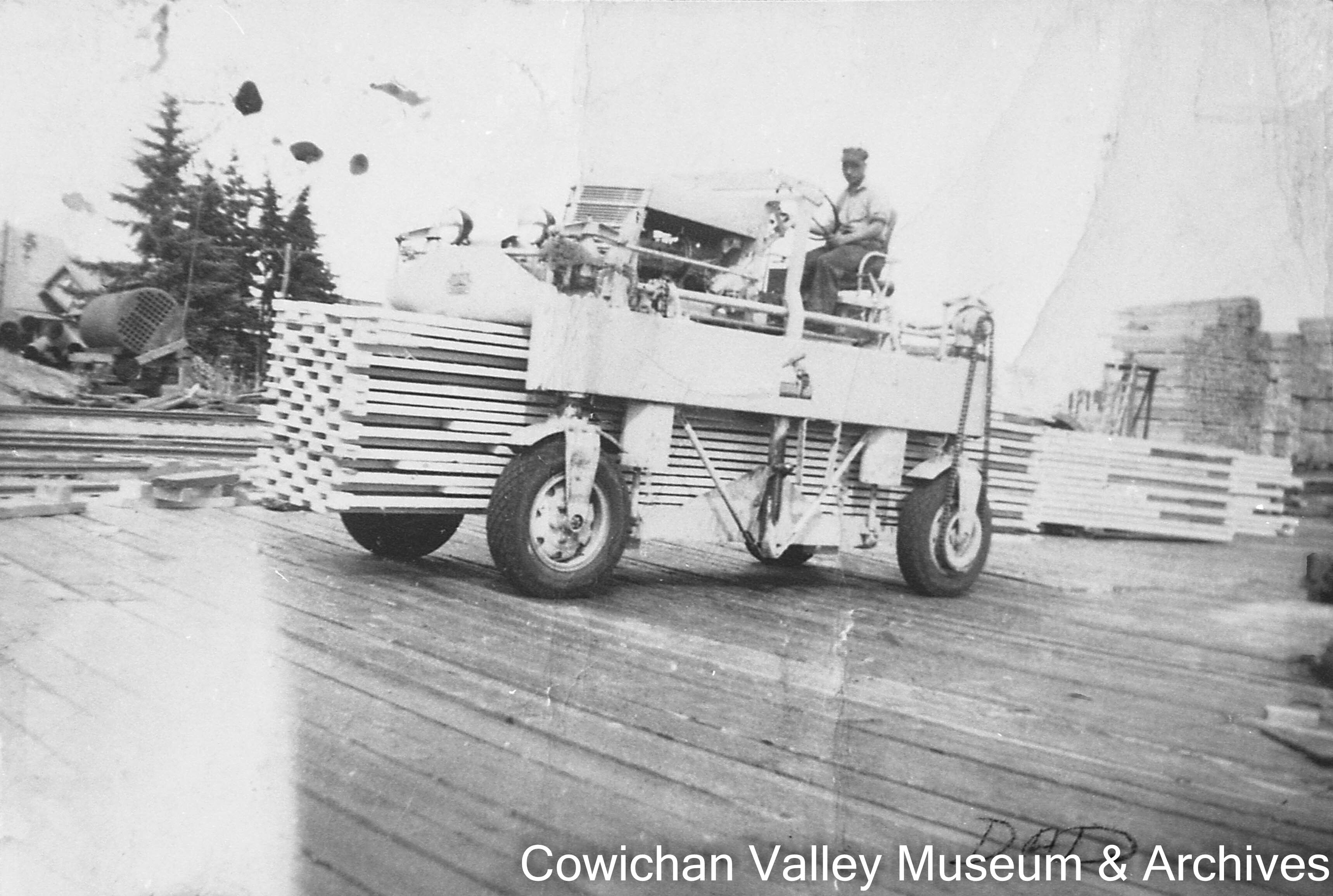
Image of a man transporting piles of lumber on a large vehicle near the railroad tracks. Photo labelled 'Dad'.
Description
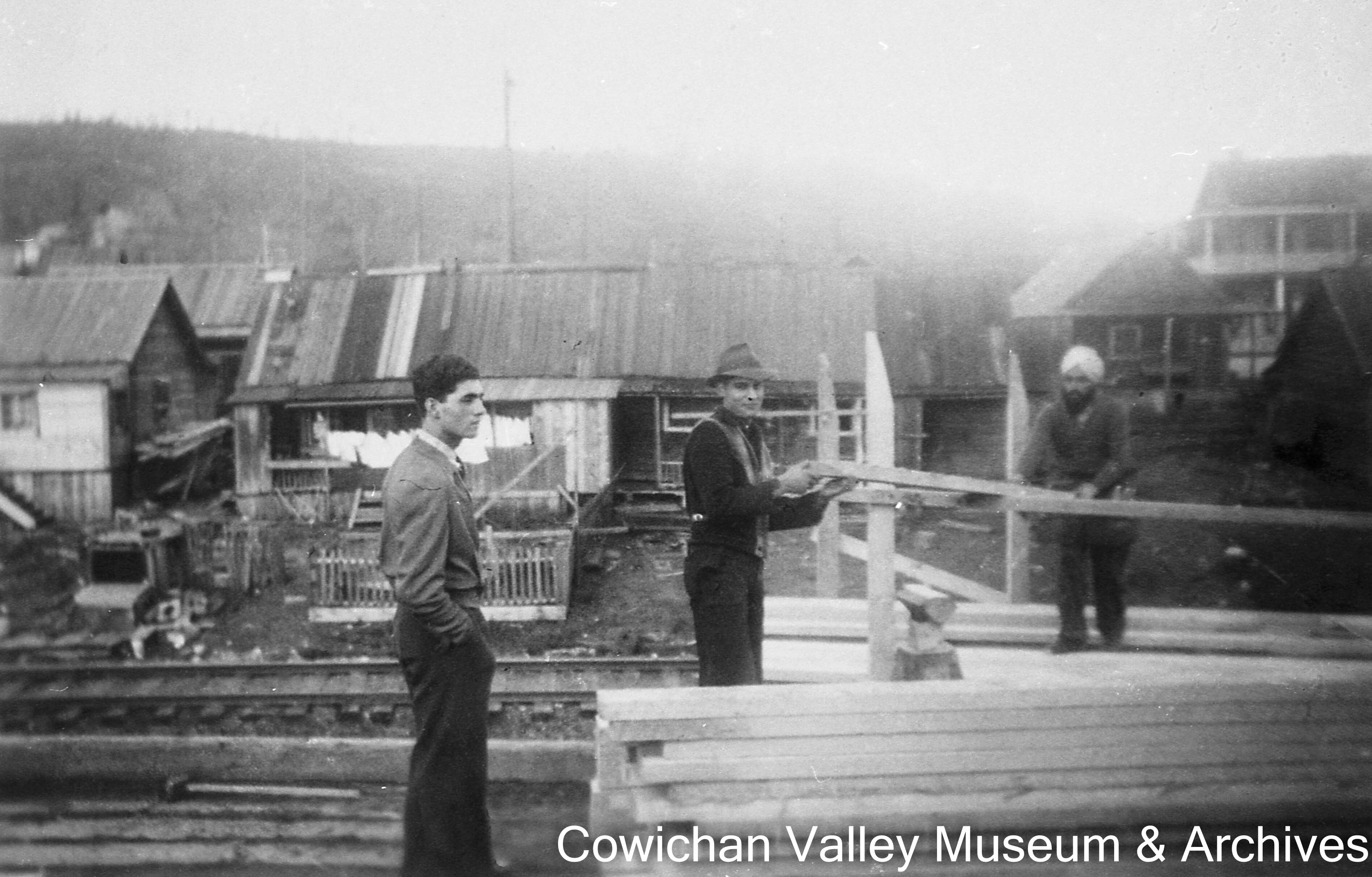
Image of three unidentified sawmill workers stacking lumber next to railroad tracks.
Member of
Description
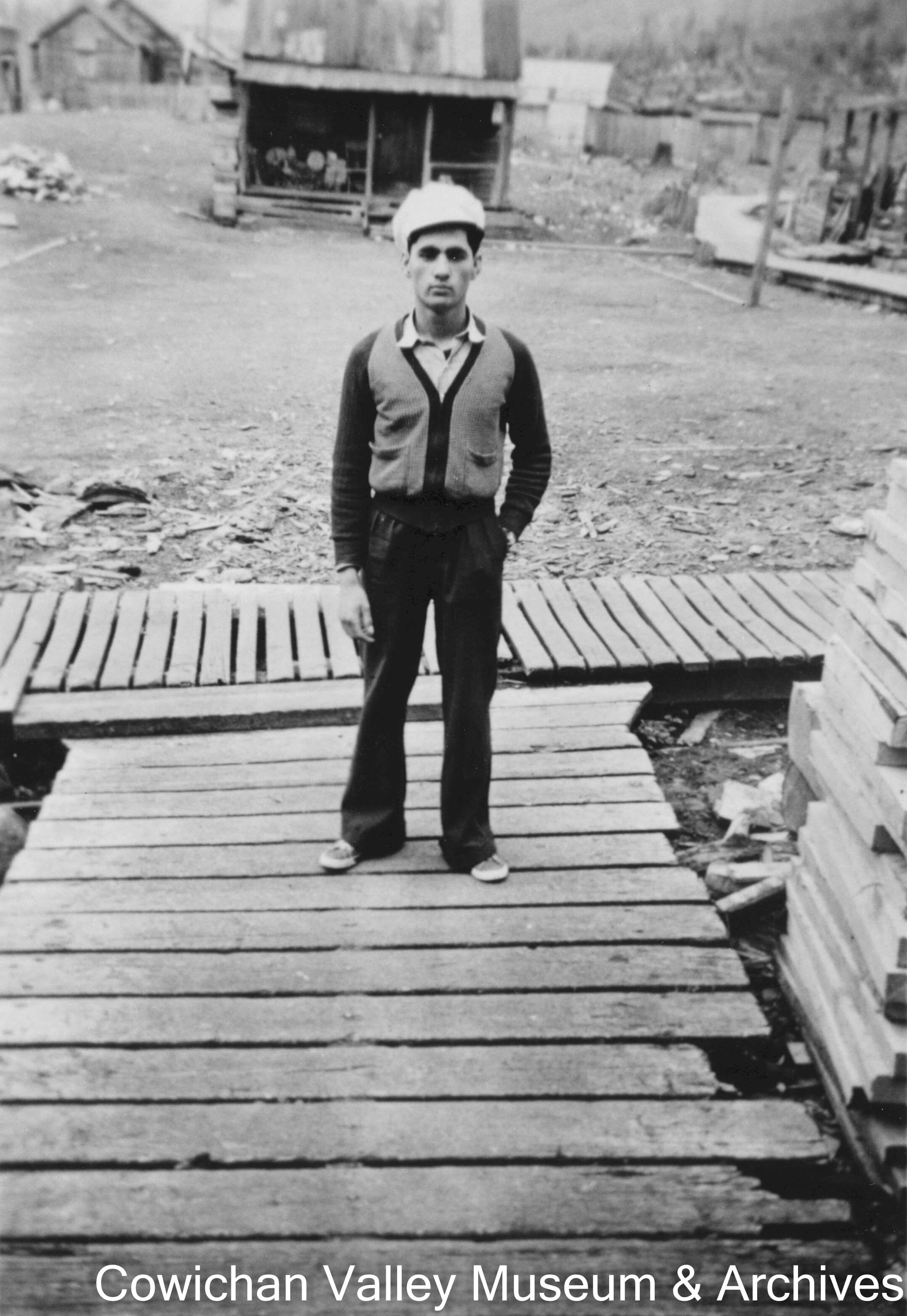
Image of Nirmal Sundher posing for a photo on the Paldi boardwalk.
Member of
Description
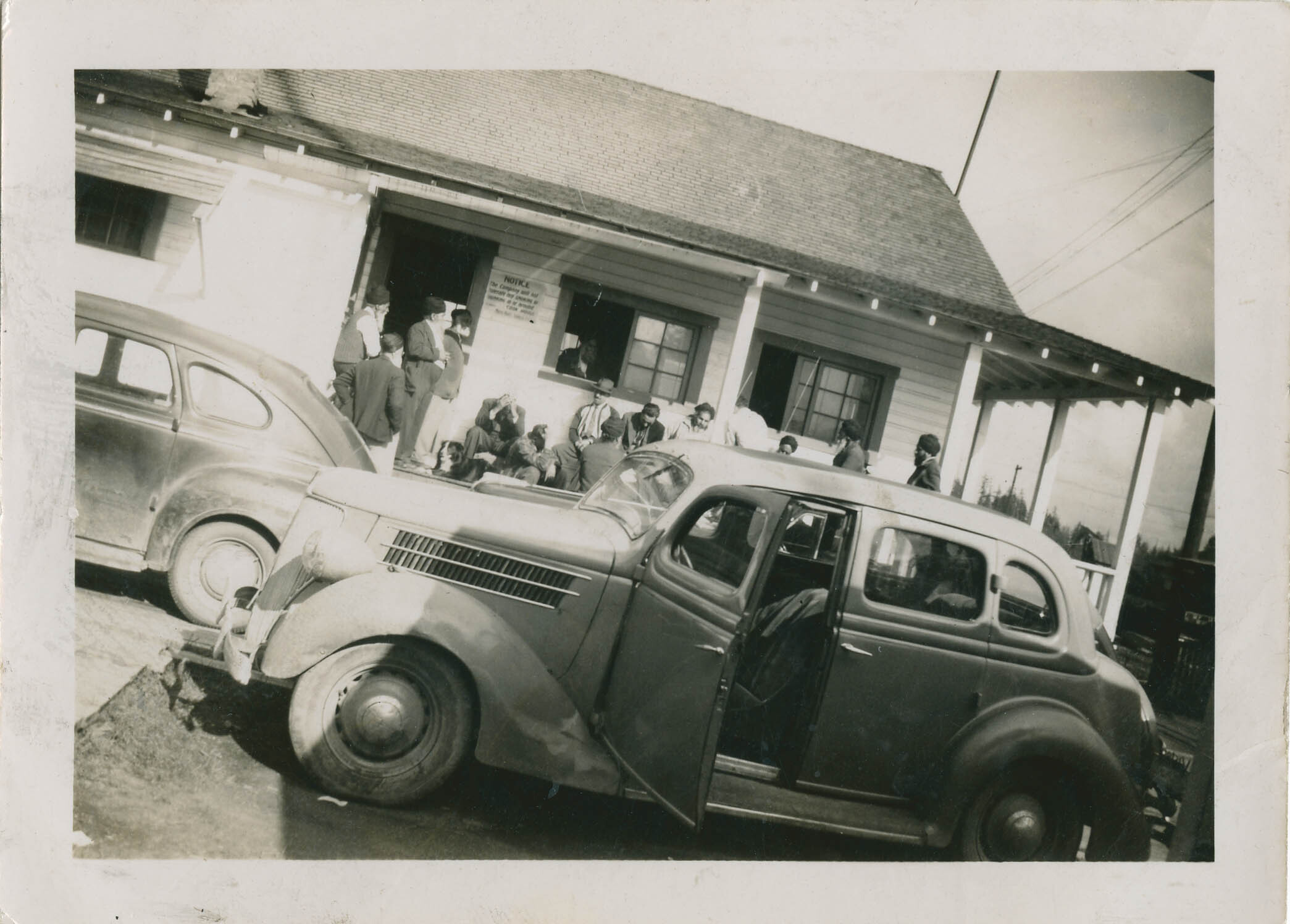
Image of two cars and a group of men gathered outside of the Mayo Bros Lumber Co. cookhouse. The sign outside of the cookhouse reads: "NOTICE; The Company will not tolerate any smoking or drinking in or around cook house; Mayo Bros Lumber Co."