
Bharata natyam dancers
Authority Sources
2023_01_05_005.pdf
(1.23 MB)
Member of
Creator: Kabir Cultural Centre
Description
Brochure advertising Abhinava Dance Company's performance of Ojhas at Oscar Peterson Concert Hall, Montreal, Quebec. Features choreography by Nirupama and Rajendra, associate choreography by Guru Kumudini Lakhia, and music by Praveen Rao and Pravin Ghodkindi. Features dances in both Kathak and Bharatanatyam styles. Abhinava Dance Company is a dance troupe from Bangalore, South India that was founded in 1994 by Kathak dancers Nirupama and Rajendra. Nirupama and Rajendra are a husband and wife duo of Kathak dancers. They were both students of Guru Maya Rao. In 1994 they founded the Abhinava Dance Company. Guru Kumudini Lakhia is a Kathak dancer and choreographer based in the city of Ahmedabad in Gujarat, India. She was born on May 17, 1930 in India. In 1967 she founded the Kadamb School of Dance and Music. Praveen Rao is a musician, music director and a lyricist for Kannada language songs based in Bangalore, India. Pravin Ghodkindi is a classical Hindustani bansuri player. He was born on October 28, 1973 in the city of Dharwad in Karnataka, India. He is the son and pupil of Pandit Venkatesh Godkhindi and was a student under Guru Vidwan Anoor Ananth Krishna Sharma.
2023_01_04_004.pdf
(200.71 KB)
Member of
Creator: Kabir Cultural Centre
Description
Poster advertising Geeta Chandran's recital of Satyam Shivam Sundaram – In search of Eternity! at the D.B.Clarke Theatre, Montreal, Quebec. Geeta Chandran is a Bharatanatyam dancer and vocalist from India. She is a student of Swarna Saraswathy among others. She is the founder and president of Natya-Vriksha, an organization devoted to promoting Bharatanatyam dance.
2023_01_02_005.pdf
(135.17 KB)
Member of
Creator: Kabir Cultural Centre
Description
Poster advertising the India-Pakistan Music and Dance Show, a fundraising concert for South Asian earthquake relief held at McGill University in Montreal, Quebec. Features ghazals performed by Akram Butt, classical dance performed by Manasi Jain, geet performed by Deepa Mathur & Hita Raghunathan, Catherine Potter on the bansuri, Jagjit Singh Soni on the tabla and Aditya Verma on the sarod. Akram Butt is a published poet, music composer and formally trained vocalist. He is a disciple of the Patiala Gharana (school) of Hindustani classical music and sings ghazal, geet and semi-classical composition. In Pakistan, he was a staff artist at Radio Pakistan and Pakistan TV. Manasi Jain is a student of the Bharatanatyam form of Indian classical dance who was born in Montreal, Quebec. She is a member of the Kabir Cultural Centre and a reputed junior artist who performs extensively in Montreal and other cities. She also has a PhD in Pharmacology and Therapeutics. Deepa Mathur is a vocalist who sings geet. Hita Raghunathan is a trained singer of Hindustani music, ghazals and bhajans who lives in Montreal, Quebec, where, according to the Kabir Cultural Centre, she is "arguably the most popular South Asian singer". Catherine Potter was a Canadian bansuri player. She was born on December 25, 1957 in the city of Guelph in Ontario, Canada. She studied the bansuri in India with Pandit Hariprasad Chaurasia. She was the founder of the Duniya Project music ensemble. She died on December 3, 2010. Jagjit Singh Soni is a tabla player and instructor. He was born and raised in the city of Batala in Punjab, India and now lives in Brampton, Ontario. He began learning tabla at the age of 4. He holds the Guinness World Record for Longest Drumming Marathon, having played 110 hours of tabla for five days and four nights straight. Aditya Verma is a sarod, sitar and tabla player from Montreal, Quebec. He was first trained in the tabla by his father, Dr. Narendra Verma, and Ustad Zakir Hussain. in 1987, Aditya moved to India where he studied North Indian classical music in the tradition of the Maihar Senia Gharana (school). He has also studied under the sitar player Pandit Ravi Shankar and the sarod players Ustad Aashish Khan and Ustad Ali Akbar Khan.
Member of
Creator: Bodalia, Chandra
Description
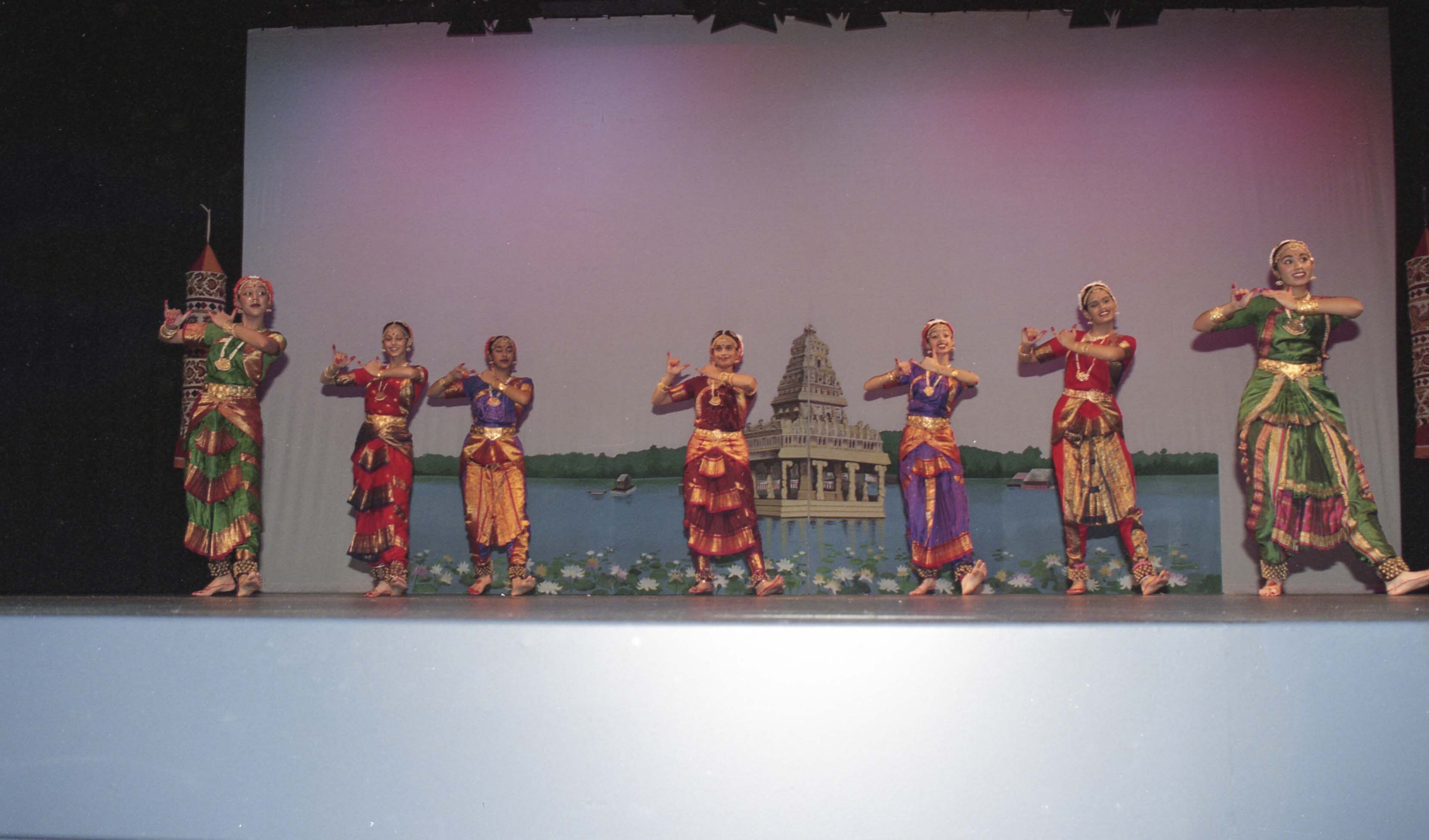
Photograph of a group of unidentified individuals performing bharatanatyam at an indoor venue.
Bharatanatyam, a classical dance style of India, is indigenous to the Tamil Nadu region and prevalent in southern India. Bharatanatyam serves the expression of Hindu religious themes and devotions. Bharatanatyam was originally performed exclusively by female temple dancers and was not brought to the stage for public performance until about 1930. A vital tradition of Bharatanatyam is a graduation performance, called Arangetram, in which graduates showcase their talents.
Bharatanatyam, a classical dance style of India, is indigenous to the Tamil Nadu region and prevalent in southern India. Bharatanatyam serves the expression of Hindu religious themes and devotions. Bharatanatyam was originally performed exclusively by female temple dancers and was not brought to the stage for public performance until about 1930. A vital tradition of Bharatanatyam is a graduation performance, called Arangetram, in which graduates showcase their talents.
Member of
Creator: Bodalia, Chandra
Description
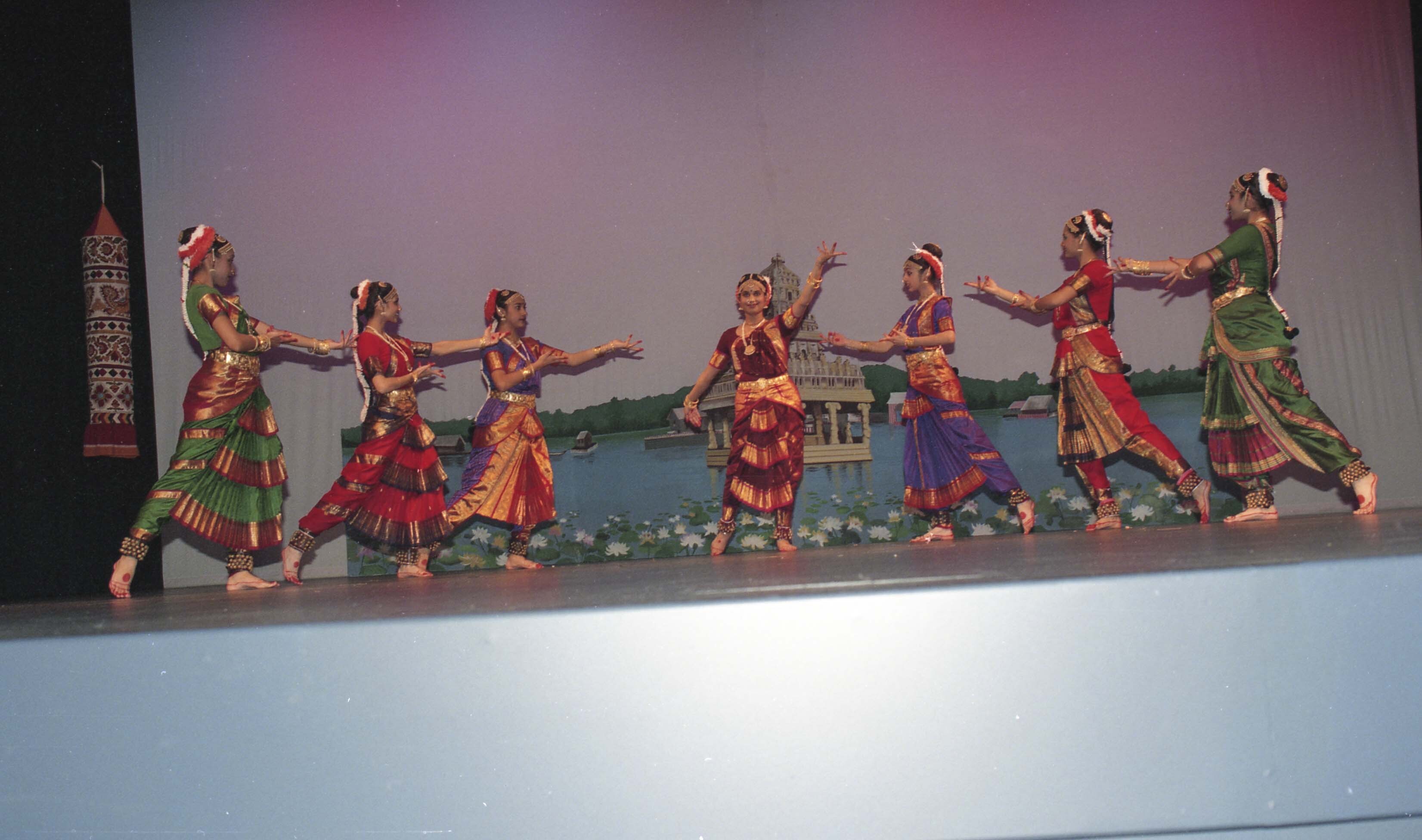
Photograph of a group of unidentified individuals performing bharatanatyam at an indoor venue.
Bharatanatyam, a classical dance style of India, is indigenous to the Tamil Nadu region and prevalent in southern India. Bharatanatyam serves the expression of Hindu religious themes and devotions. Bharatanatyam was originally performed exclusively by female temple dancers and was not brought to the stage for public performance until about 1930. A vital tradition of Bharatanatyam is a graduation performance, called Arangetram, in which graduates showcase their talents.
Bharatanatyam, a classical dance style of India, is indigenous to the Tamil Nadu region and prevalent in southern India. Bharatanatyam serves the expression of Hindu religious themes and devotions. Bharatanatyam was originally performed exclusively by female temple dancers and was not brought to the stage for public performance until about 1930. A vital tradition of Bharatanatyam is a graduation performance, called Arangetram, in which graduates showcase their talents.
Member of
Creator: Bodalia, Chandra
Description
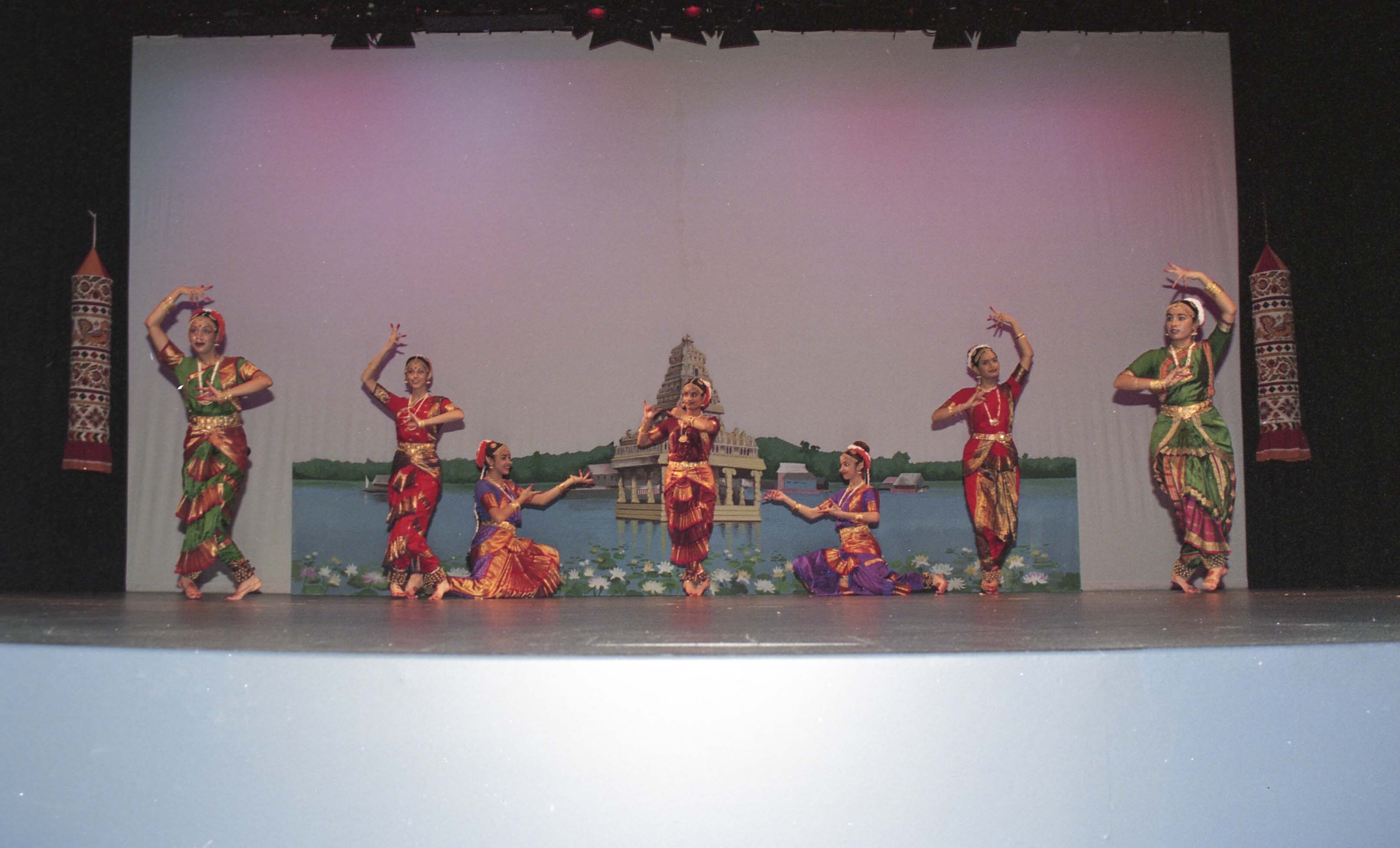
Photograph of a group of unidentified individuals performing bharatanatyam at an indoor venue.
Bharatanatyam, a classical dance style of India, is indigenous to the Tamil Nadu region and prevalent in southern India. Bharatanatyam serves the expression of Hindu religious themes and devotions. Bharatanatyam was originally performed exclusively by female temple dancers and was not brought to the stage for public performance until about 1930. A vital tradition of Bharatanatyam is a graduation performance, called Arangetram, in which graduates showcase their talents.
Bharatanatyam, a classical dance style of India, is indigenous to the Tamil Nadu region and prevalent in southern India. Bharatanatyam serves the expression of Hindu religious themes and devotions. Bharatanatyam was originally performed exclusively by female temple dancers and was not brought to the stage for public performance until about 1930. A vital tradition of Bharatanatyam is a graduation performance, called Arangetram, in which graduates showcase their talents.
Member of
Creator: Bodalia, Chandra
Description
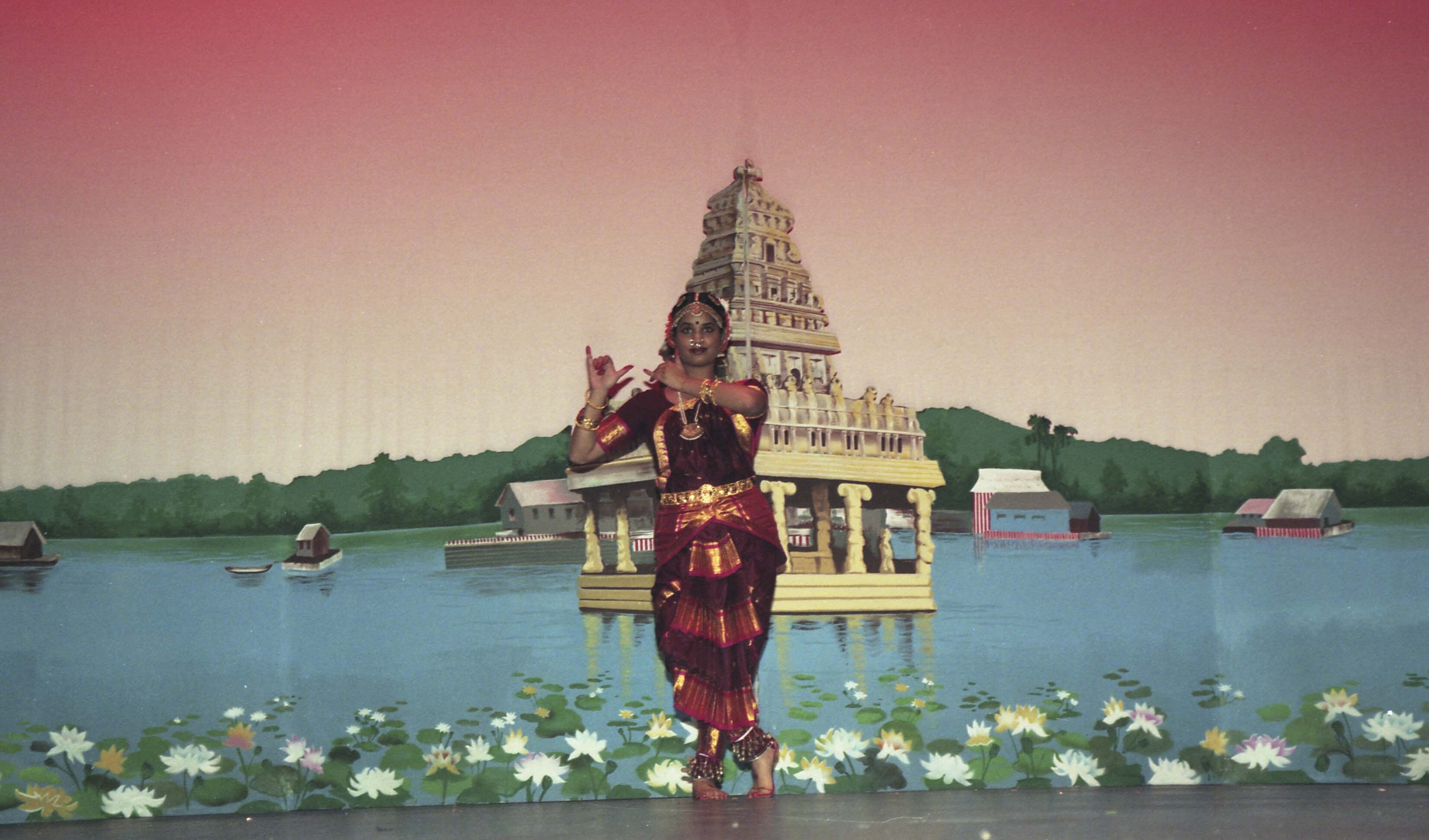
Photograph of an unidentified individual performing bharatanatyam at an indoor venue.
Bharatanatyam, a classical dance style of India, is indigenous to the Tamil Nadu region and prevalent in southern India. Bharatanatyam serves the expression of Hindu religious themes and devotions. Bharatanatyam was originally performed exclusively by female temple dancers and was not brought to the stage for public performance until about 1930. A vital tradition of Bharatanatyam is a graduation performance, called Arangetram, in which graduates showcase their talents.
Bharatanatyam, a classical dance style of India, is indigenous to the Tamil Nadu region and prevalent in southern India. Bharatanatyam serves the expression of Hindu religious themes and devotions. Bharatanatyam was originally performed exclusively by female temple dancers and was not brought to the stage for public performance until about 1930. A vital tradition of Bharatanatyam is a graduation performance, called Arangetram, in which graduates showcase their talents.
Member of
Creator: Bodalia, Chandra
Description
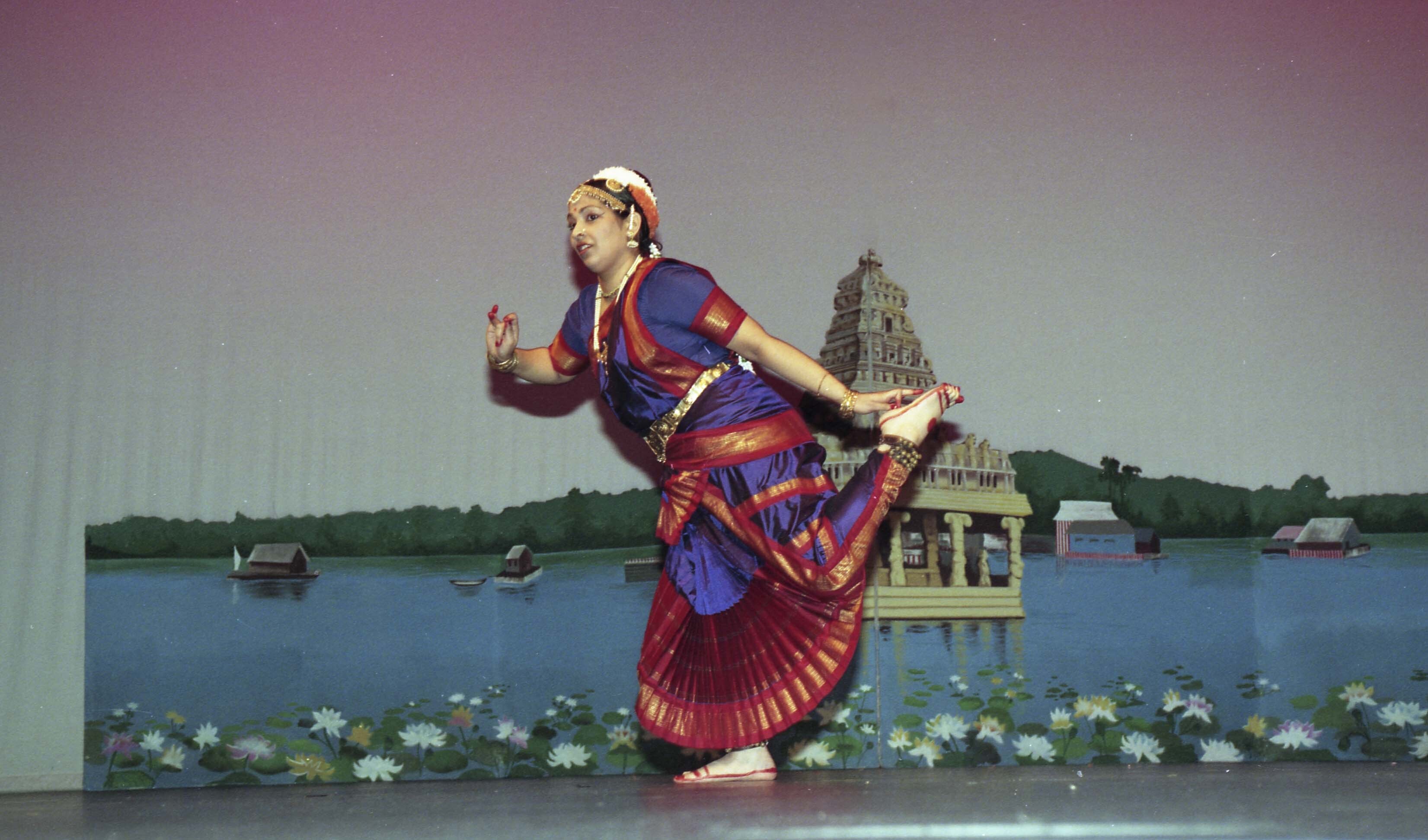
Photograph of an unidentified individual performing bharatanatyam at an indoor venue.
Bharatanatyam, a classical dance style of India, is indigenous to the Tamil Nadu region and prevalent in southern India. Bharatanatyam serves the expression of Hindu religious themes and devotions. Bharatanatyam was originally performed exclusively by female temple dancers and was not brought to the stage for public performance until about 1930. A vital tradition of Bharatanatyam is a graduation performance, called Arangetram, in which graduates showcase their talents.
Bharatanatyam, a classical dance style of India, is indigenous to the Tamil Nadu region and prevalent in southern India. Bharatanatyam serves the expression of Hindu religious themes and devotions. Bharatanatyam was originally performed exclusively by female temple dancers and was not brought to the stage for public performance until about 1930. A vital tradition of Bharatanatyam is a graduation performance, called Arangetram, in which graduates showcase their talents.
Member of
Creator: Bodalia, Chandra
Description
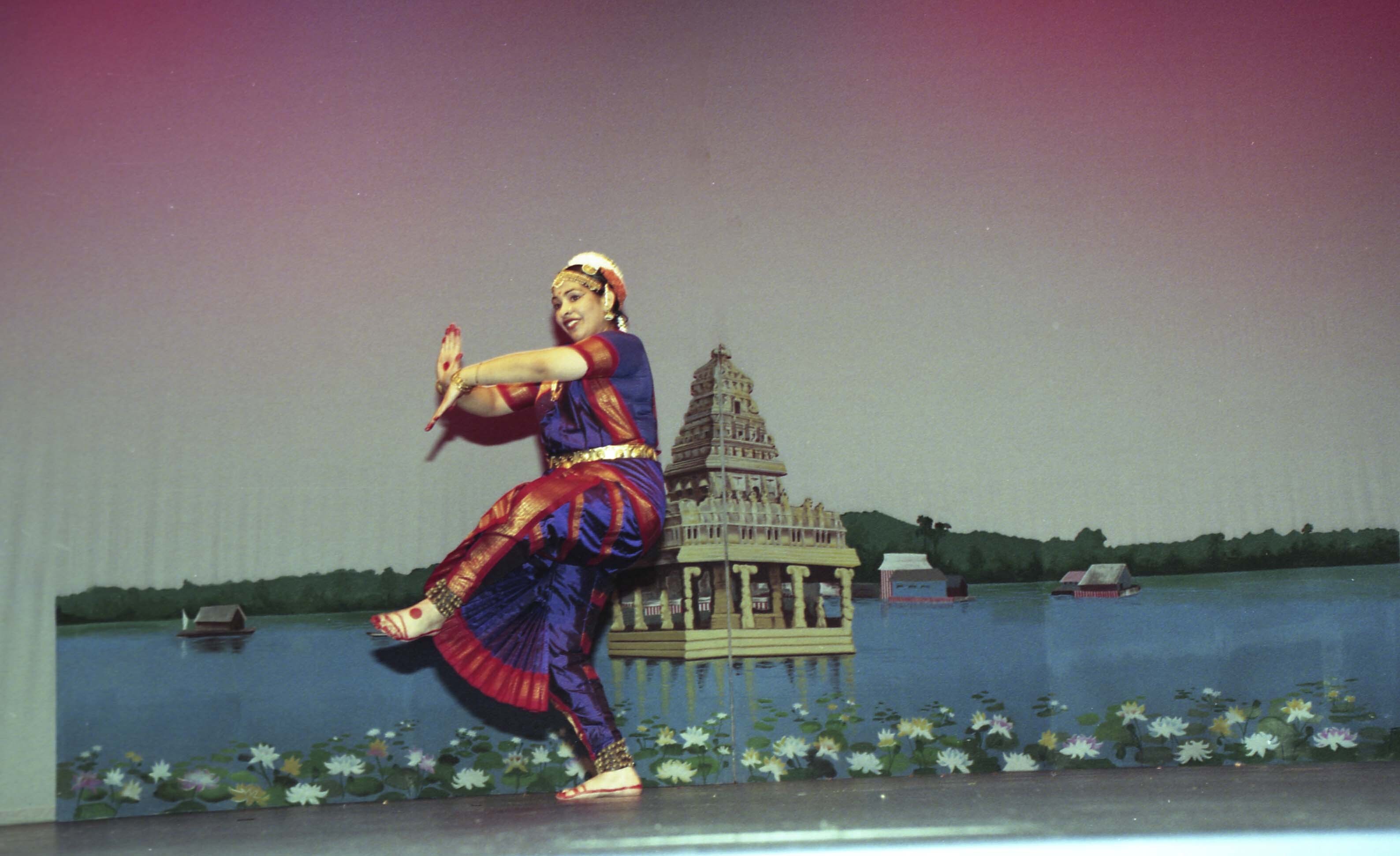
Photograph of an unidentified individual performing bharatanatyam at an indoor venue.
Bharatanatyam, a classical dance style of India, is indigenous to the Tamil Nadu region and prevalent in southern India. Bharatanatyam serves the expression of Hindu religious themes and devotions. Bharatanatyam was originally performed exclusively by female temple dancers and was not brought to the stage for public performance until about 1930. A vital tradition of Bharatanatyam is a graduation performance, called Arangetram, in which graduates showcase their talents.
Bharatanatyam, a classical dance style of India, is indigenous to the Tamil Nadu region and prevalent in southern India. Bharatanatyam serves the expression of Hindu religious themes and devotions. Bharatanatyam was originally performed exclusively by female temple dancers and was not brought to the stage for public performance until about 1930. A vital tradition of Bharatanatyam is a graduation performance, called Arangetram, in which graduates showcase their talents.
Member of
Creator: Bodalia, Chandra
Description
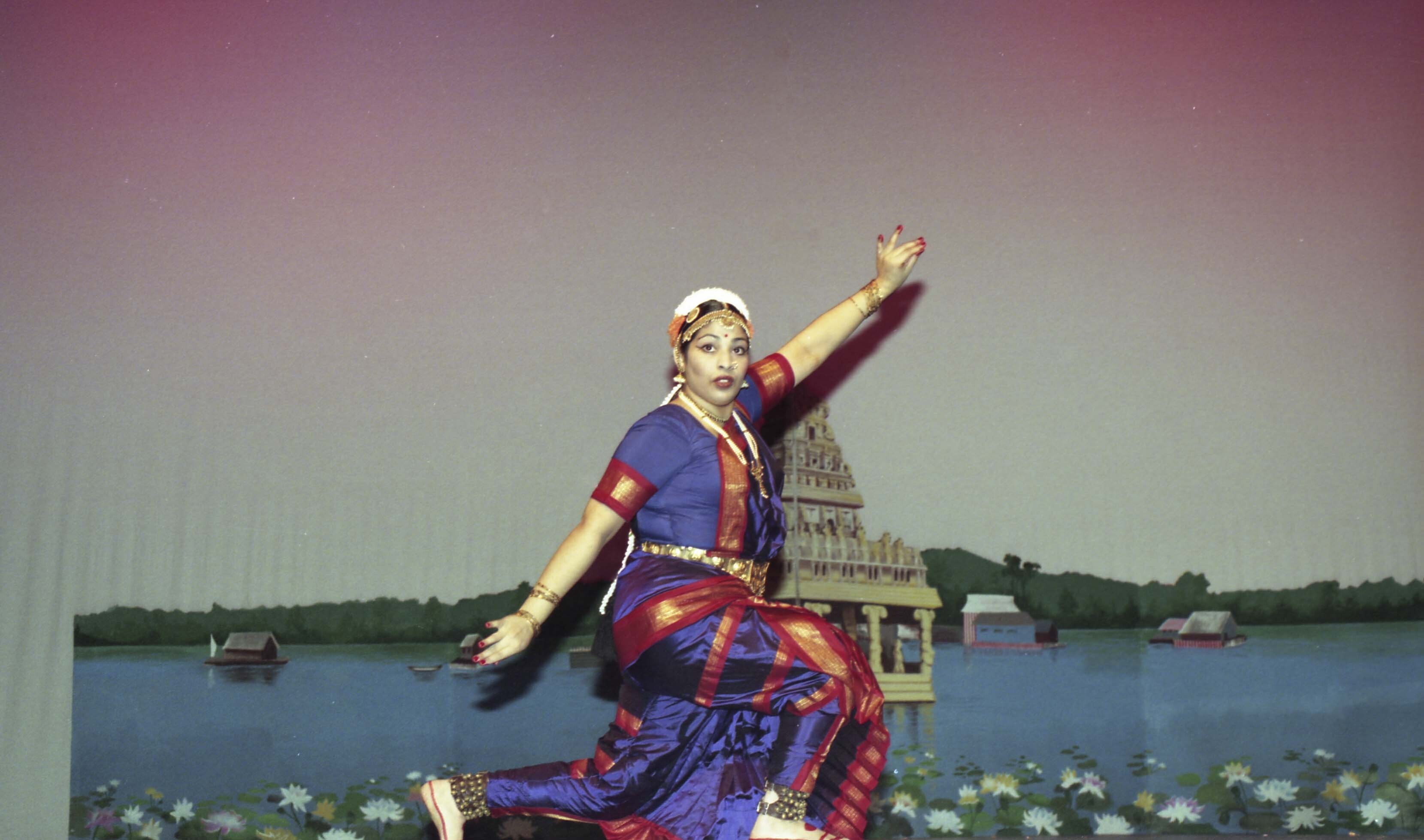
Photograph of an unidentified individual performing bharatanatyam at an indoor venue.
Bharatanatyam, a classical dance style of India, is indigenous to the Tamil Nadu region and prevalent in southern India. Bharatanatyam serves the expression of Hindu religious themes and devotions. Bharatanatyam was originally performed exclusively by female temple dancers and was not brought to the stage for public performance until about 1930. A vital tradition of Bharatanatyam is a graduation performance, called Arangetram, in which graduates showcase their talents.
Bharatanatyam, a classical dance style of India, is indigenous to the Tamil Nadu region and prevalent in southern India. Bharatanatyam serves the expression of Hindu religious themes and devotions. Bharatanatyam was originally performed exclusively by female temple dancers and was not brought to the stage for public performance until about 1930. A vital tradition of Bharatanatyam is a graduation performance, called Arangetram, in which graduates showcase their talents.