
Discrimination
Authority Sources
2022_16_41_025.pdf
(97.96 KB)
Member of
Description
Transcription of interview with Sukhdev Singh Dhaliwal in which he discusses his personal history, educational background, and working in a sawmill in Canada. Dhaliwal also mentions living in bunkhouses, his co-workers, and his wages. He talks about the types of jobs he had, discrimination in Canada, and his leisure time with family/friends.
2022_16_41_024.pdf
(86.77 KB)
Member of
Description
Narrative of Sukhdev Singh Dhaliwal discusses his personal history and schooling in Canada. Dhaliwal also mentions his co-workers at the sawmills, his wages, and marriage. He speaks about the jobs he had while working in a sawmill and the discrimination South Asian men faced in Canada. Dhaliwal concludes by discussing purchasing his own business, a gas station.
Audio file
Member of
Description
Audio interview with Amarjit Singh Heer conducted by SB. Amarjit Singh Heer is a Canadian citizen who came to Canada in 1972. He began his first job at a mill near Williams lake. He also discusses his immigration to Canada, his immigration status, his personal history, and his experience working in various positions at sawmills such as Nanoose Forest Products, Nanaimo Forest Products and Western Forest Products. He also discusses how he was paid low wages and how it was difficult to gain seniority at the sawmills. Heer's encounters with racism and discrimination is also discussed.
2022_16_01_006.pdf
(226.19 KB)
Member of
Description
Transcription of interview with Amarjit Singh Heer discussing his immigration to Canada, his immigration status, his personal history, and his experience working in various positions at sawmills such as Nanoose Forest Products, Nanaimo Forest Products and Western Forest Products. He also discusses how he was paid low wages and how it was difficult to gain seniority at the sawmills. Heer also mentions his encounters with racism and discrimination in Canada.
2022_16_01_005.pdf
(137.34 KB)
Member of
Description
Amarjit Singh Heer's narrative discusses his immigration to Canada from Punjab, India. Heer became a Canadian citizen shortly after arriving in Canada and started working in sawmills. He worked in various sawmills in British Columbia including William's Lake, Merritt, Duncan, Nanaimo, Cowichan Bay and in Chemainus. Heer also had a variety of roles in the sawmills such as the green chain position, a plainer shift, a graveyard planer shift, and a foreman. Heer concludes by discussing how during his time in Canada, he commonly faced discrimination and racism from the European White settler community.
Member of
Description
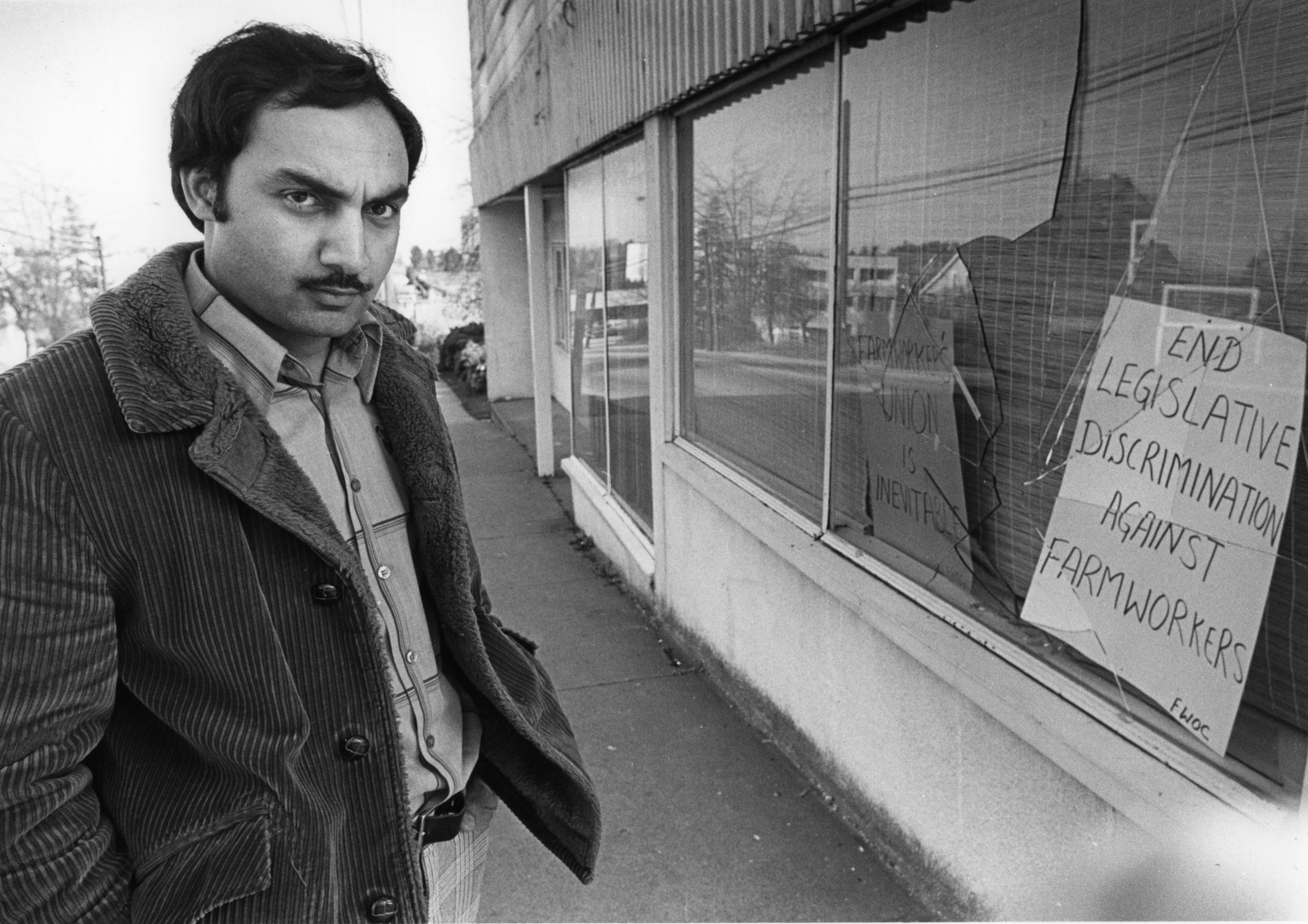
Portrait of Farm Workers Organizing Committee President, Raj Chouhan, stands in front of vandalized storefront office window.
Creator:
Description
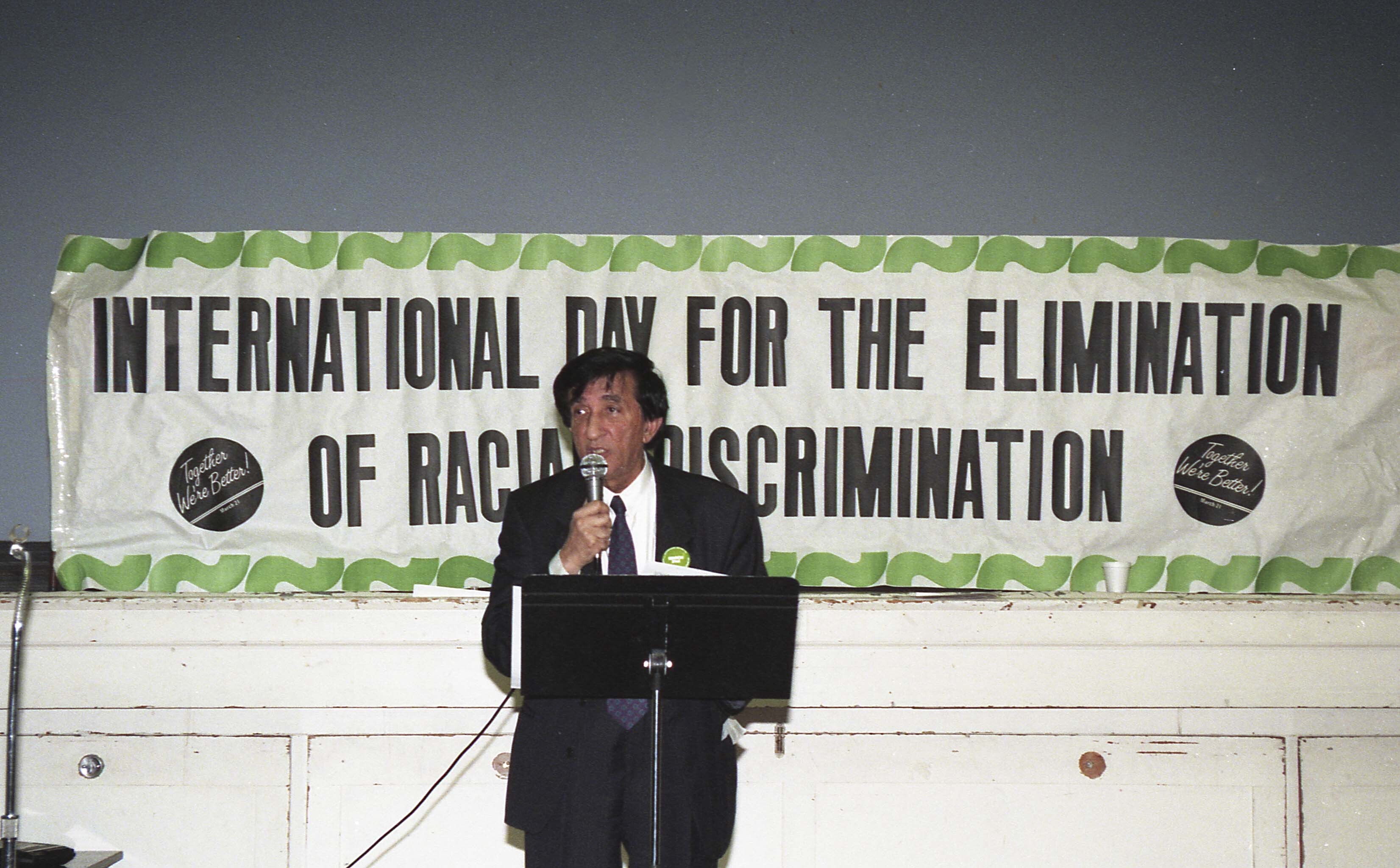
Photograph of Aziz Khaki addressing the audience at the International Day for the Elimination of Racial Discrimination event held in Vancouver, British Columbia.
Dr. Abdulaziz 'Aziz' Khaki was an activist and leader in the Canadian Muslim community. He served as vice-president of the Canadian Muslim Federation and the Council of Muslim Communities of Canada. Dr. Khaki was a strong advocate for human rights, interfaith dialogue, and the integration of Muslim communities into Canadian society.
The International Day for the Elimination of Racial Discrimination is guided by the United Nations International Convention on the Elimination of All Forms of Racial Discrimination and recognizes that the injustices and prejudices fueled by racial discrimination take place every day. Observed annually on March 21, it commemorates the day police in Sharpeville, South Africa, opened fire and killed 69 people at a peaceful demonstration against apartheid "pass laws" in 1960. This day serves as a call to action for individuals, organizations, and all levels of government to actively work to eliminate all forms of racial discrimination, injustice, systemic racism and hate.
Dr. Abdulaziz 'Aziz' Khaki was an activist and leader in the Canadian Muslim community. He served as vice-president of the Canadian Muslim Federation and the Council of Muslim Communities of Canada. Dr. Khaki was a strong advocate for human rights, interfaith dialogue, and the integration of Muslim communities into Canadian society.
The International Day for the Elimination of Racial Discrimination is guided by the United Nations International Convention on the Elimination of All Forms of Racial Discrimination and recognizes that the injustices and prejudices fueled by racial discrimination take place every day. Observed annually on March 21, it commemorates the day police in Sharpeville, South Africa, opened fire and killed 69 people at a peaceful demonstration against apartheid "pass laws" in 1960. This day serves as a call to action for individuals, organizations, and all levels of government to actively work to eliminate all forms of racial discrimination, injustice, systemic racism and hate.
Creator:
Description
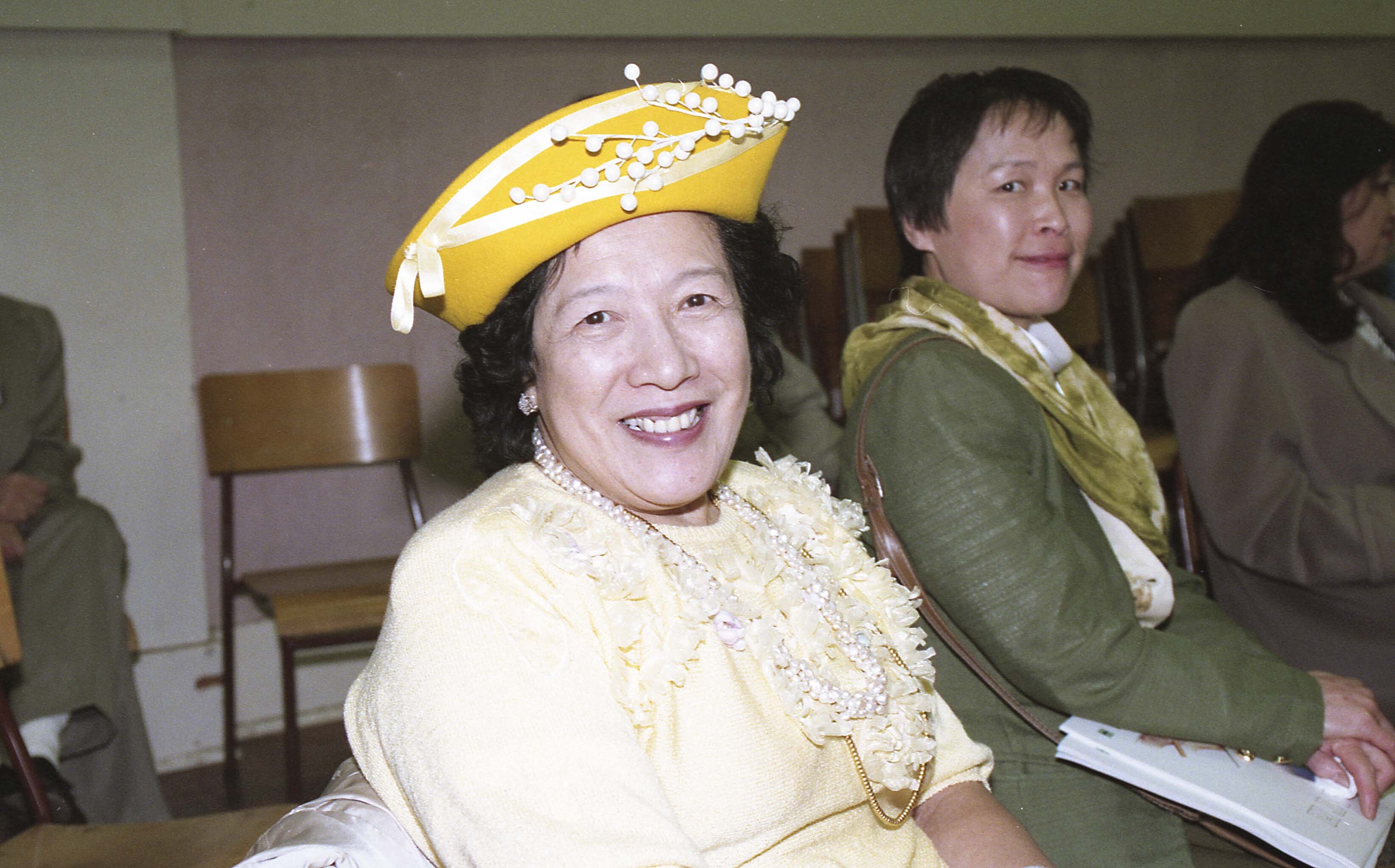
Photograph of a group of unidentified individuals at the International Day for the Elimination of Racial Discrimination event held in Vancouver, British Columbia.
The International Day for the Elimination of Racial Discrimination is guided by the United Nations International Convention on the Elimination of All Forms of Racial Discrimination and recognizes that the injustices and prejudices fueled by racial discrimination take place every day. Observed annually on March 21, it commemorates the day police in Sharpeville, South Africa, opened fire and killed 69 people at a peaceful demonstration against apartheid "pass laws" in 1960. This day serves as a call to action for individuals, organizations, and all levels of government to actively work to eliminate all forms of racial discrimination, injustice, systemic racism and hate.
The International Day for the Elimination of Racial Discrimination is guided by the United Nations International Convention on the Elimination of All Forms of Racial Discrimination and recognizes that the injustices and prejudices fueled by racial discrimination take place every day. Observed annually on March 21, it commemorates the day police in Sharpeville, South Africa, opened fire and killed 69 people at a peaceful demonstration against apartheid "pass laws" in 1960. This day serves as a call to action for individuals, organizations, and all levels of government to actively work to eliminate all forms of racial discrimination, injustice, systemic racism and hate.
Creator:
Description
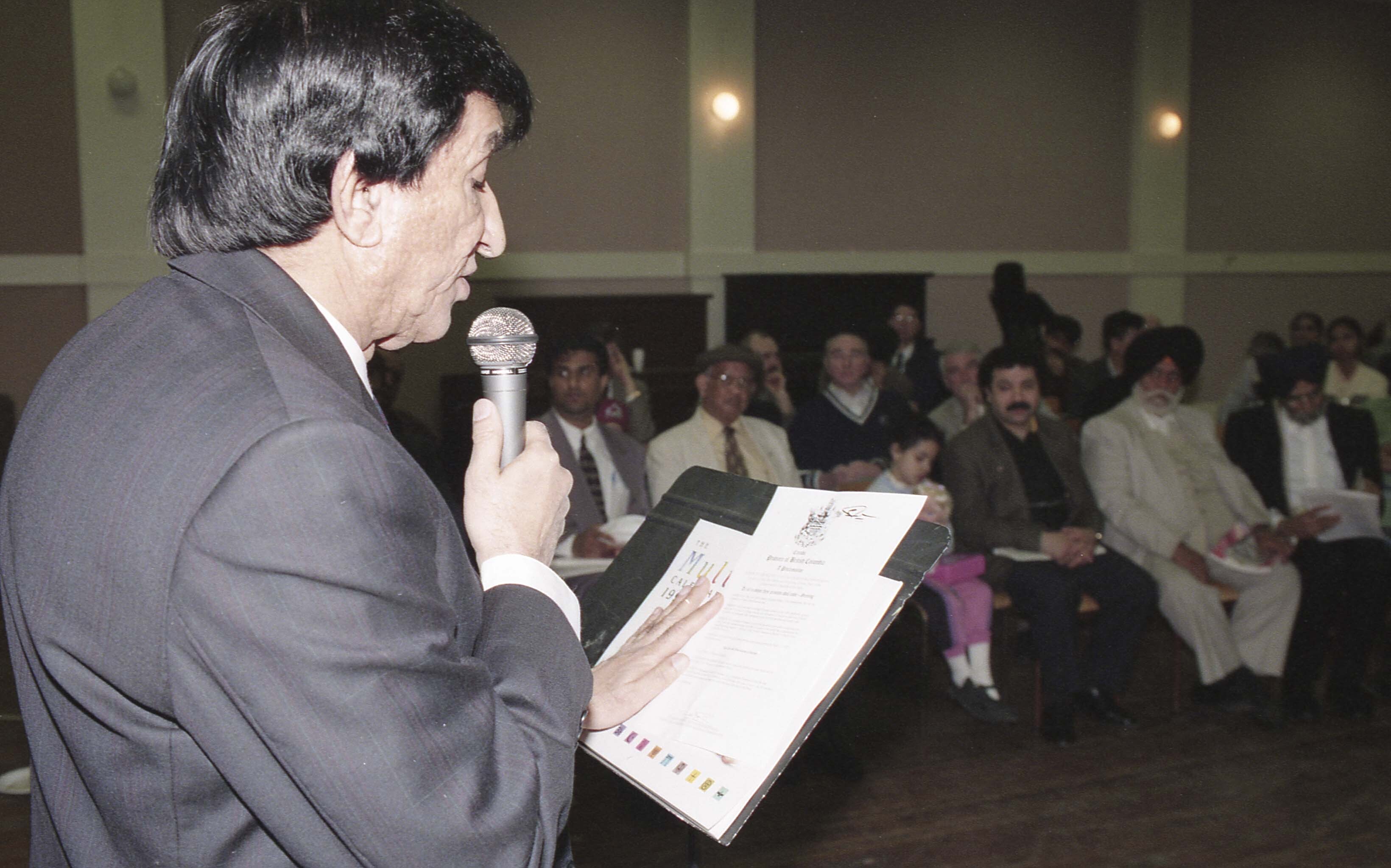
Photograph of Aziz Khaki addressing the audience at the International Day for the Elimination of Racial Discrimination event held in Vancouver, British Columbia.
Dr. Abdulaziz 'Aziz' Khaki was an activist and leader in the Canadian Muslim community. He served as vice-president of the Canadian Muslim Federation and the Council of Muslim Communities of Canada. Dr. Khaki was a strong advocate for human rights, interfaith dialogue, and the integration of Muslim communities into Canadian society.
The International Day for the Elimination of Racial Discrimination is guided by the United Nations International Convention on the Elimination of All Forms of Racial Discrimination and recognizes that the injustices and prejudices fueled by racial discrimination take place every day. Observed annually on March 21, it commemorates the day police in Sharpeville, South Africa, opened fire and killed 69 people at a peaceful demonstration against apartheid "pass laws" in 1960. This day serves as a call to action for individuals, organizations, and all levels of government to actively work to eliminate all forms of racial discrimination, injustice, systemic racism and hate.
Dr. Abdulaziz 'Aziz' Khaki was an activist and leader in the Canadian Muslim community. He served as vice-president of the Canadian Muslim Federation and the Council of Muslim Communities of Canada. Dr. Khaki was a strong advocate for human rights, interfaith dialogue, and the integration of Muslim communities into Canadian society.
The International Day for the Elimination of Racial Discrimination is guided by the United Nations International Convention on the Elimination of All Forms of Racial Discrimination and recognizes that the injustices and prejudices fueled by racial discrimination take place every day. Observed annually on March 21, it commemorates the day police in Sharpeville, South Africa, opened fire and killed 69 people at a peaceful demonstration against apartheid "pass laws" in 1960. This day serves as a call to action for individuals, organizations, and all levels of government to actively work to eliminate all forms of racial discrimination, injustice, systemic racism and hate.
Creator:
Description
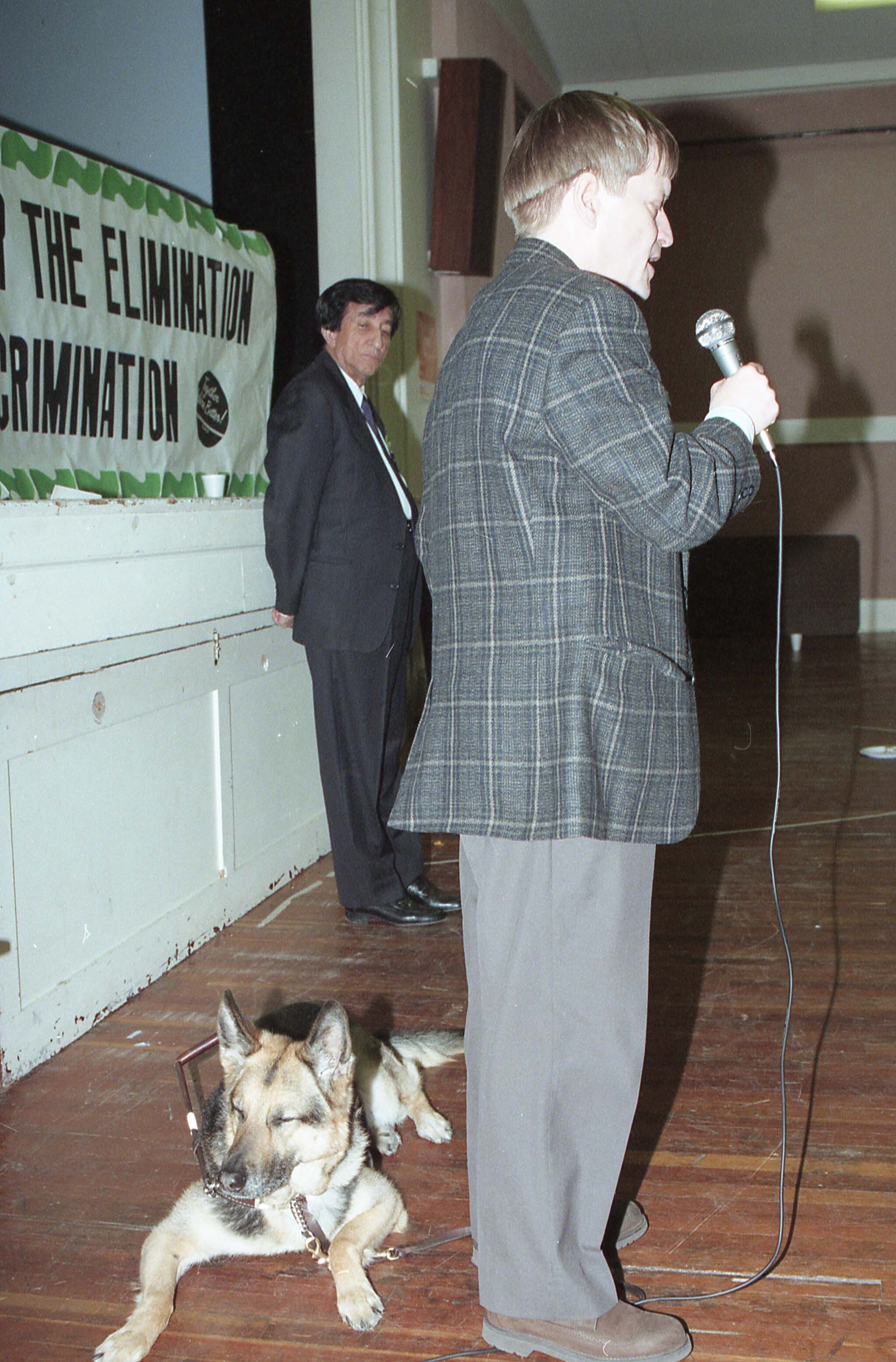
Photograph of an unidentified individual addressing the audience at the International Day for the Elimination of Racial Discrimination event held in Vancouver, British Columbia. Aziz Khaki can be seen standing in the back.
Dr. Abdulaziz 'Aziz' Khaki was an activist and leader in the Canadian Muslim community. He served as vice-president of the Canadian Muslim Federation and the Council of Muslim Communities of Canada. Dr. Khaki was a strong advocate for human rights, interfaith dialogue, and the integration of Muslim communities into Canadian society.
The International Day for the Elimination of Racial Discrimination is guided by the United Nations International Convention on the Elimination of All Forms of Racial Discrimination and recognizes that the injustices and prejudices fueled by racial discrimination take place every day. Observed annually on March 21, it commemorates the day police in Sharpeville, South Africa, opened fire and killed 69 people at a peaceful demonstration against apartheid "pass laws" in 1960. This day serves as a call to action for individuals, organizations, and all levels of government to actively work to eliminate all forms of racial discrimination, injustice, systemic racism and hate.
Dr. Abdulaziz 'Aziz' Khaki was an activist and leader in the Canadian Muslim community. He served as vice-president of the Canadian Muslim Federation and the Council of Muslim Communities of Canada. Dr. Khaki was a strong advocate for human rights, interfaith dialogue, and the integration of Muslim communities into Canadian society.
The International Day for the Elimination of Racial Discrimination is guided by the United Nations International Convention on the Elimination of All Forms of Racial Discrimination and recognizes that the injustices and prejudices fueled by racial discrimination take place every day. Observed annually on March 21, it commemorates the day police in Sharpeville, South Africa, opened fire and killed 69 people at a peaceful demonstration against apartheid "pass laws" in 1960. This day serves as a call to action for individuals, organizations, and all levels of government to actively work to eliminate all forms of racial discrimination, injustice, systemic racism and hate.