
University of British Columbia
Creator: Bodalia, Chandra
Description
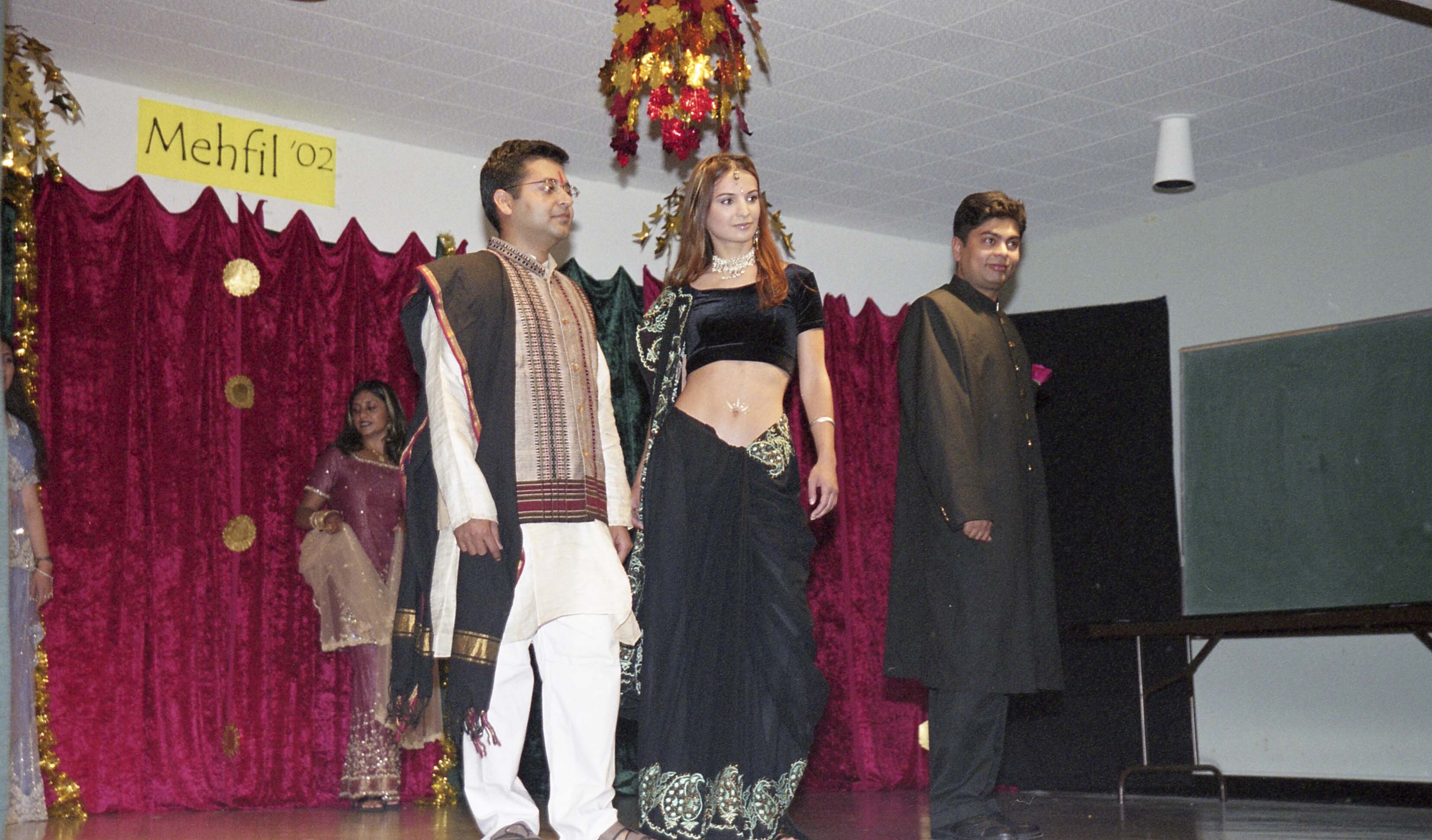
Photograph of unidentified individuals modelling South Asian clothing at an event entitled "Mehfil '02" organized by the UBC Indian Students' Association (UTSAV), and held at the University of British Columbia in Vancouver, B.C.
The UBC Indian Students' Association (UTSAV) was incepted in 1980 and is the largest student-run club at the Alma Mater Society of UBC. Their vision is to provide a "home away from home" by helping students embrace South Asian culture. They have held events in celebration of Diwali and Holi.
Established in 1915, the University of British Columbia consists of two campuses: one is situated within the ancestral and unceded territory of the Musqueam people, also known as Vancouver, B.C., and the other is on the traditional, ancestral, unceded territory of the Syilx Okanagan Nation and their peoples, also known as Kelowna, B.C. As of 2025, UBC is ranked second and third in Canada, and 38th, 41st, and 53rd in the world.
The UBC Indian Students' Association (UTSAV) was incepted in 1980 and is the largest student-run club at the Alma Mater Society of UBC. Their vision is to provide a "home away from home" by helping students embrace South Asian culture. They have held events in celebration of Diwali and Holi.
Established in 1915, the University of British Columbia consists of two campuses: one is situated within the ancestral and unceded territory of the Musqueam people, also known as Vancouver, B.C., and the other is on the traditional, ancestral, unceded territory of the Syilx Okanagan Nation and their peoples, also known as Kelowna, B.C. As of 2025, UBC is ranked second and third in Canada, and 38th, 41st, and 53rd in the world.
Creator: Bodalia, Chandra
Description
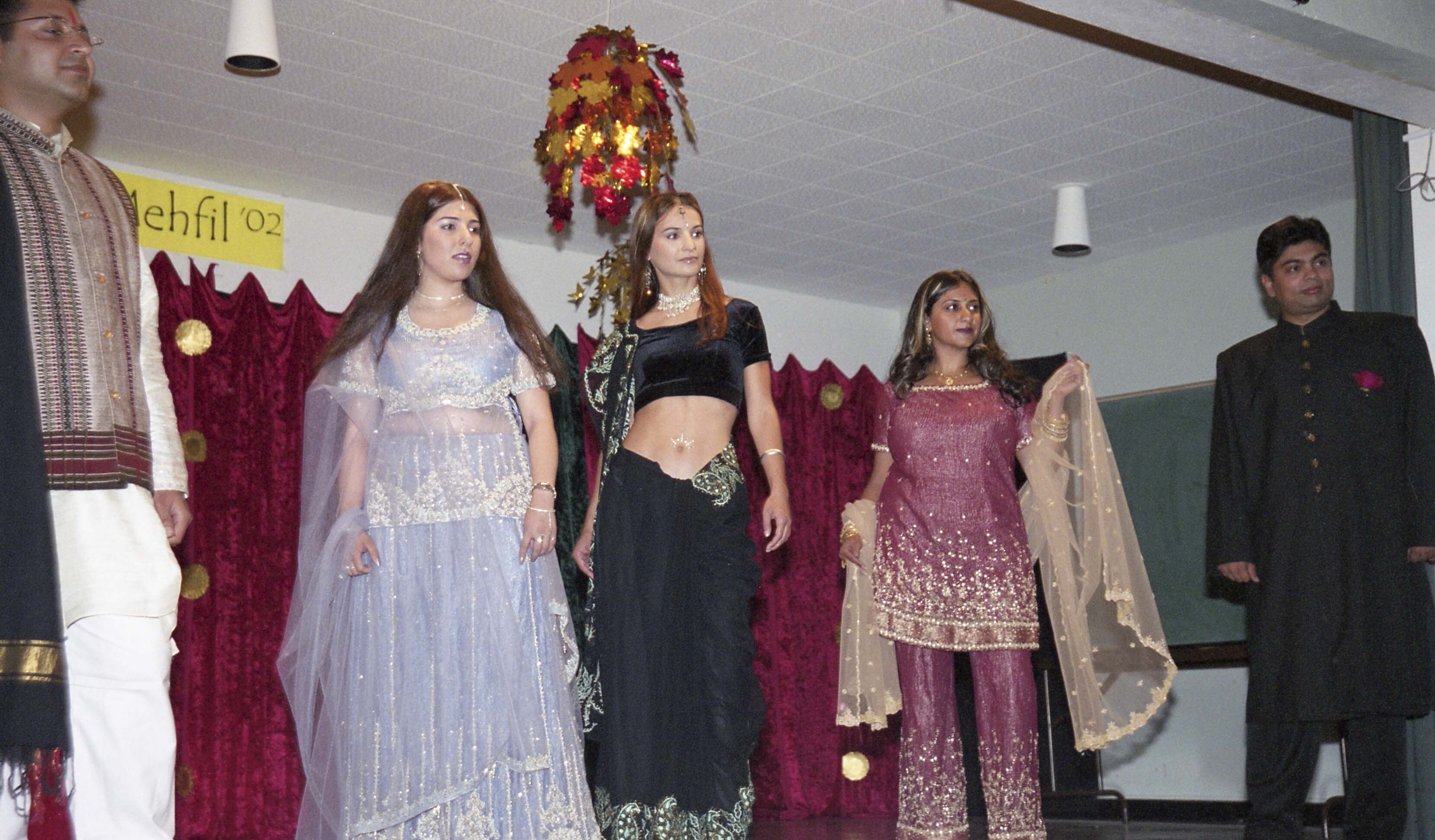
Photograph of unidentified individuals modelling South Asian clothing at an event entitled "Mehfil '02" organized by the UBC Indian Students' Association (UTSAV), and held at the University of British Columbia in Vancouver, B.C.
The UBC Indian Students' Association (UTSAV) was incepted in 1980 and is the largest student-run club at the Alma Mater Society of UBC. Their vision is to provide a "home away from home" by helping students embrace South Asian culture. They have held events in celebration of Diwali and Holi.
Established in 1915, the University of British Columbia consists of two campuses: one is situated within the ancestral and unceded territory of the Musqueam people, also known as Vancouver, B.C., and the other is on the traditional, ancestral, unceded territory of the Syilx Okanagan Nation and their peoples, also known as Kelowna, B.C. As of 2025, UBC is ranked second and third in Canada, and 38th, 41st, and 53rd in the world.
The UBC Indian Students' Association (UTSAV) was incepted in 1980 and is the largest student-run club at the Alma Mater Society of UBC. Their vision is to provide a "home away from home" by helping students embrace South Asian culture. They have held events in celebration of Diwali and Holi.
Established in 1915, the University of British Columbia consists of two campuses: one is situated within the ancestral and unceded territory of the Musqueam people, also known as Vancouver, B.C., and the other is on the traditional, ancestral, unceded territory of the Syilx Okanagan Nation and their peoples, also known as Kelowna, B.C. As of 2025, UBC is ranked second and third in Canada, and 38th, 41st, and 53rd in the world.
Creator: Bodalia, Chandra
Description
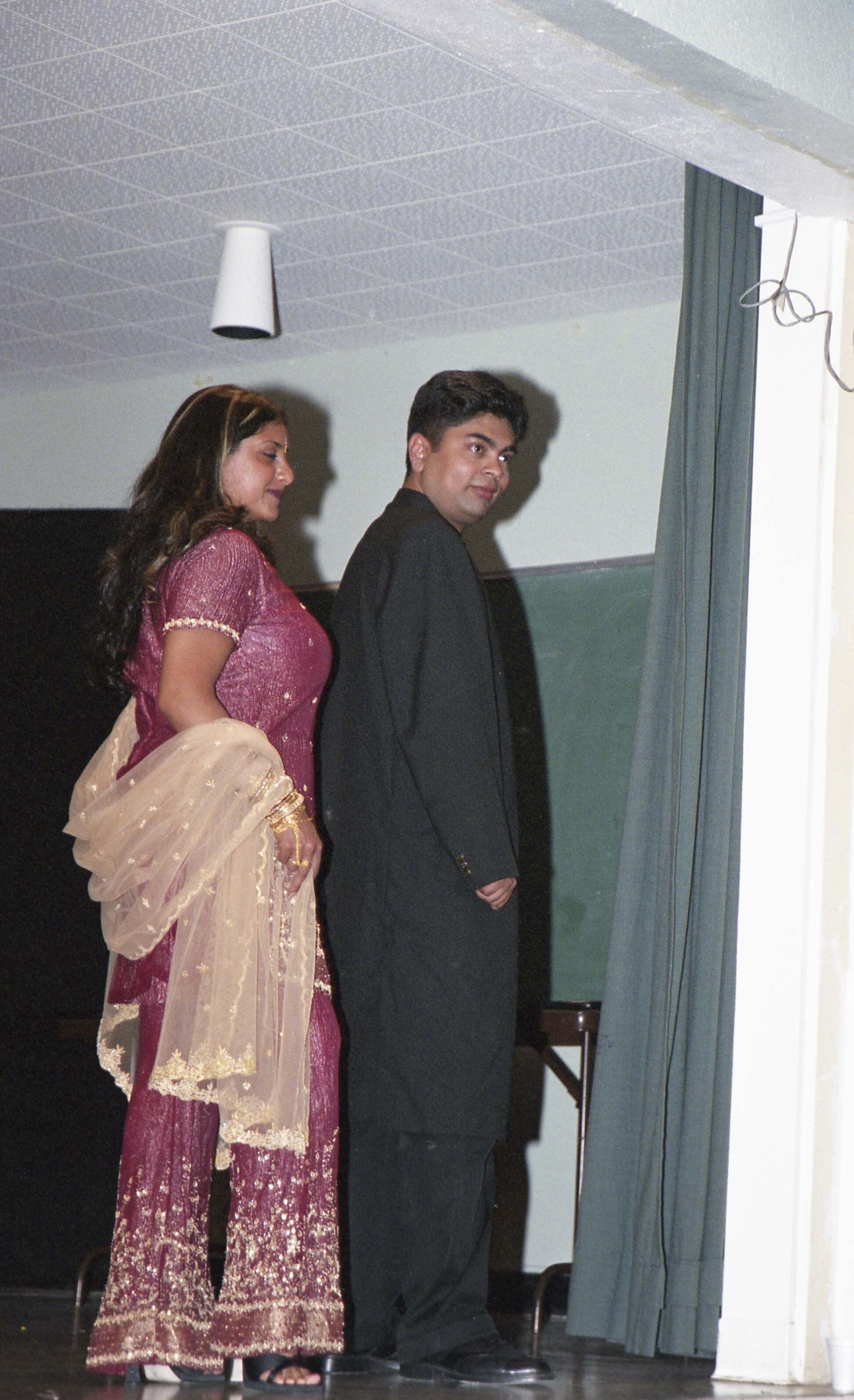
Photograph of two unidentified individuals modelling South Asian clothing at an event entitled "Mehfil '02" organized by the UBC Indian Students' Association (UTSAV), and held at the University of British Columbia in Vancouver, B.C.
The UBC Indian Students' Association (UTSAV) was incepted in 1980 and is the largest student-run club at the Alma Mater Society of UBC. Their vision is to provide a "home away from home" by helping students embrace South Asian culture. They have held events in celebration of Diwali and Holi.
Established in 1915, the University of British Columbia consists of two campuses: one is situated within the ancestral and unceded territory of the Musqueam people, also known as Vancouver, B.C., and the other is on the traditional, ancestral, unceded territory of the Syilx Okanagan Nation and their peoples, also known as Kelowna, B.C. As of 2025, UBC is ranked second and third in Canada, and 38th, 41st, and 53rd in the world.
The UBC Indian Students' Association (UTSAV) was incepted in 1980 and is the largest student-run club at the Alma Mater Society of UBC. Their vision is to provide a "home away from home" by helping students embrace South Asian culture. They have held events in celebration of Diwali and Holi.
Established in 1915, the University of British Columbia consists of two campuses: one is situated within the ancestral and unceded territory of the Musqueam people, also known as Vancouver, B.C., and the other is on the traditional, ancestral, unceded territory of the Syilx Okanagan Nation and their peoples, also known as Kelowna, B.C. As of 2025, UBC is ranked second and third in Canada, and 38th, 41st, and 53rd in the world.
Creator: Bodalia, Chandra
Description
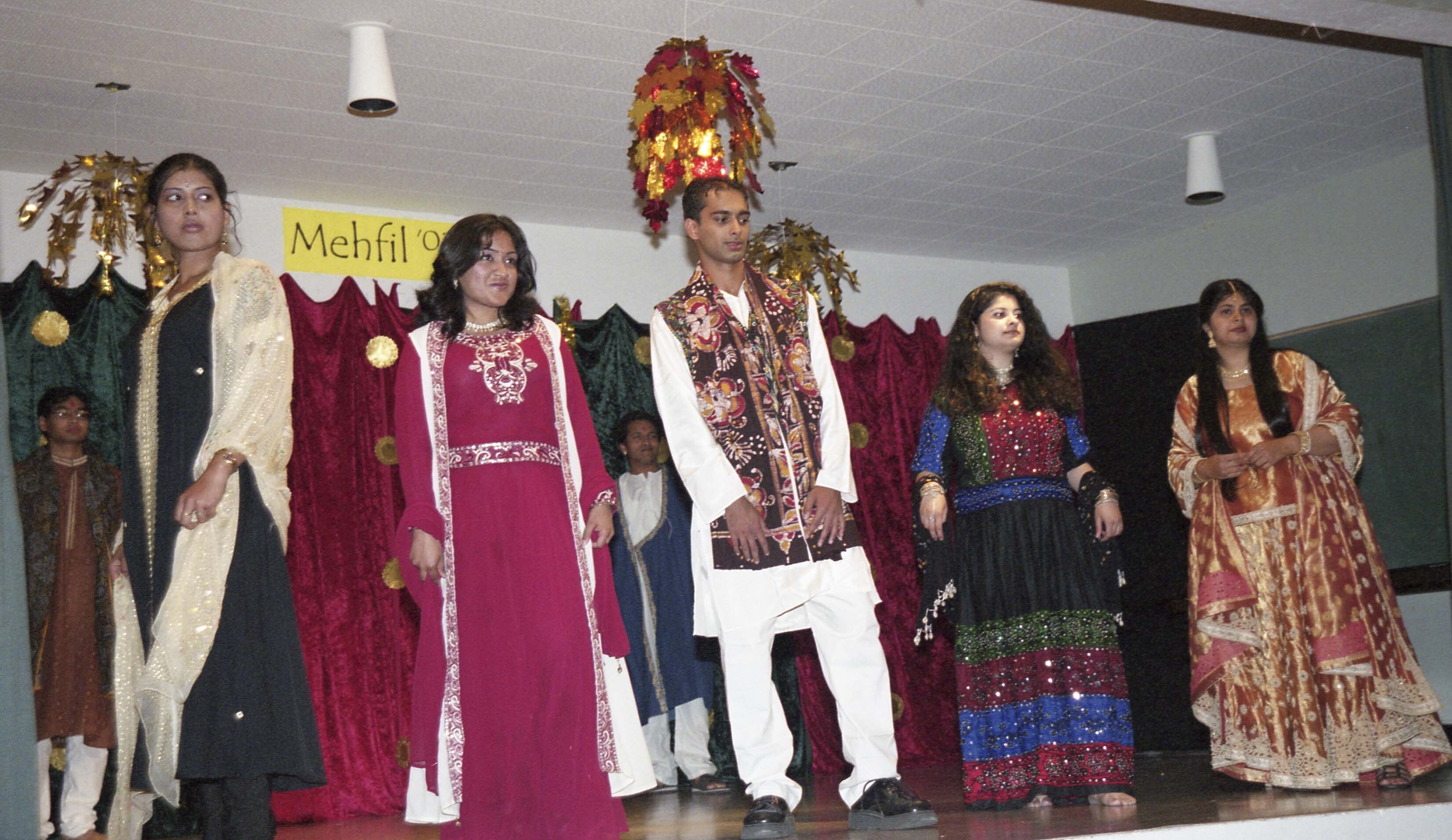
Photograph of unidentified individuals modelling South Asian clothing at an event entitled "Mehfil '02" organized by the UBC Indian Students' Association (UTSAV), and held at the University of British Columbia in Vancouver, B.C.
The UBC Indian Students' Association (UTSAV) was incepted in 1980 and is the largest student-run club at the Alma Mater Society of UBC. Their vision is to provide a "home away from home" by helping students embrace South Asian culture. They have held events in celebration of Diwali and Holi.
Established in 1915, the University of British Columbia consists of two campuses: one is situated within the ancestral and unceded territory of the Musqueam people, also known as Vancouver, B.C., and the other is on the traditional, ancestral, unceded territory of the Syilx Okanagan Nation and their peoples, also known as Kelowna, B.C. As of 2025, UBC is ranked second and third in Canada, and 38th, 41st, and 53rd in the world.
The UBC Indian Students' Association (UTSAV) was incepted in 1980 and is the largest student-run club at the Alma Mater Society of UBC. Their vision is to provide a "home away from home" by helping students embrace South Asian culture. They have held events in celebration of Diwali and Holi.
Established in 1915, the University of British Columbia consists of two campuses: one is situated within the ancestral and unceded territory of the Musqueam people, also known as Vancouver, B.C., and the other is on the traditional, ancestral, unceded territory of the Syilx Okanagan Nation and their peoples, also known as Kelowna, B.C. As of 2025, UBC is ranked second and third in Canada, and 38th, 41st, and 53rd in the world.
Creator: Bodalia, Chandra
Description
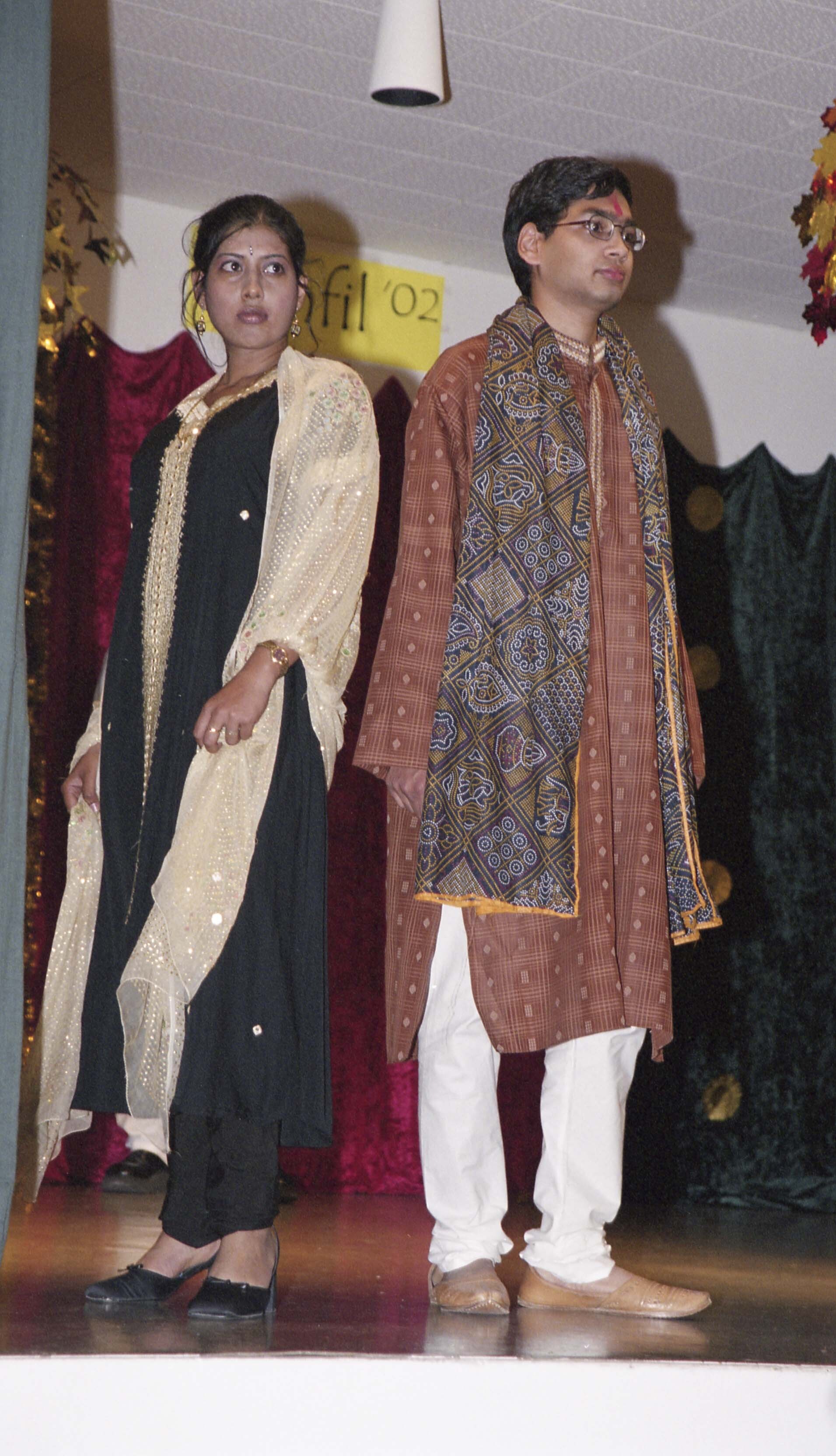
Photograph of two unidentified individuals modelling South Asian clothing at an event entitled "Mehfil '02" organized by the UBC Indian Students' Association (UTSAV), and held at the University of British Columbia in Vancouver, B.C.
The UBC Indian Students' Association (UTSAV) was incepted in 1980 and is the largest student-run club at the Alma Mater Society of UBC. Their vision is to provide a "home away from home" by helping students embrace South Asian culture. They have held events in celebration of Diwali and Holi.
Established in 1915, the University of British Columbia consists of two campuses: one is situated within the ancestral and unceded territory of the Musqueam people, also known as Vancouver, B.C., and the other is on the traditional, ancestral, unceded territory of the Syilx Okanagan Nation and their peoples, also known as Kelowna, B.C. As of 2025, UBC is ranked second and third in Canada, and 38th, 41st, and 53rd in the world.
The UBC Indian Students' Association (UTSAV) was incepted in 1980 and is the largest student-run club at the Alma Mater Society of UBC. Their vision is to provide a "home away from home" by helping students embrace South Asian culture. They have held events in celebration of Diwali and Holi.
Established in 1915, the University of British Columbia consists of two campuses: one is situated within the ancestral and unceded territory of the Musqueam people, also known as Vancouver, B.C., and the other is on the traditional, ancestral, unceded territory of the Syilx Okanagan Nation and their peoples, also known as Kelowna, B.C. As of 2025, UBC is ranked second and third in Canada, and 38th, 41st, and 53rd in the world.
Creator: Bodalia, Chandra
Description
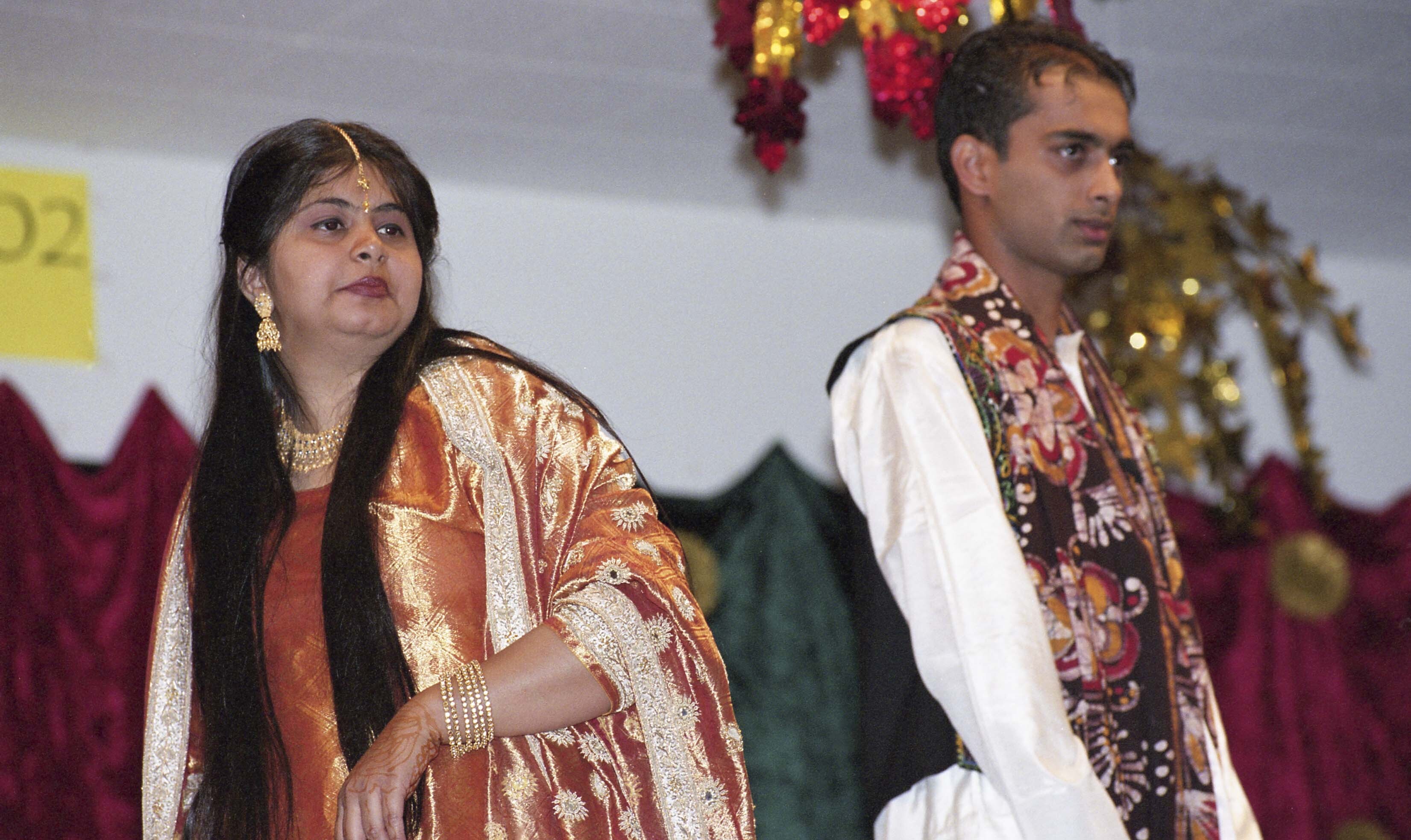
Photograph of two unidentified individuals modelling South Asian clothing at an event entitled "Mehfil '02" organized by the UBC Indian Students' Association (UTSAV), and held at the University of British Columbia in Vancouver, B.C.
The UBC Indian Students' Association (UTSAV) was incepted in 1980 and is the largest student-run club at the Alma Mater Society of UBC. Their vision is to provide a "home away from home" by helping students embrace South Asian culture. They have held events in celebration of Diwali and Holi.
Established in 1915, the University of British Columbia consists of two campuses: one is situated within the ancestral and unceded territory of the Musqueam people, also known as Vancouver, B.C., and the other is on the traditional, ancestral, unceded territory of the Syilx Okanagan Nation and their peoples, also known as Kelowna, B.C. As of 2025, UBC is ranked second and third in Canada, and 38th, 41st, and 53rd in the world.
The UBC Indian Students' Association (UTSAV) was incepted in 1980 and is the largest student-run club at the Alma Mater Society of UBC. Their vision is to provide a "home away from home" by helping students embrace South Asian culture. They have held events in celebration of Diwali and Holi.
Established in 1915, the University of British Columbia consists of two campuses: one is situated within the ancestral and unceded territory of the Musqueam people, also known as Vancouver, B.C., and the other is on the traditional, ancestral, unceded territory of the Syilx Okanagan Nation and their peoples, also known as Kelowna, B.C. As of 2025, UBC is ranked second and third in Canada, and 38th, 41st, and 53rd in the world.
Creator: Bodalia, Chandra
Description
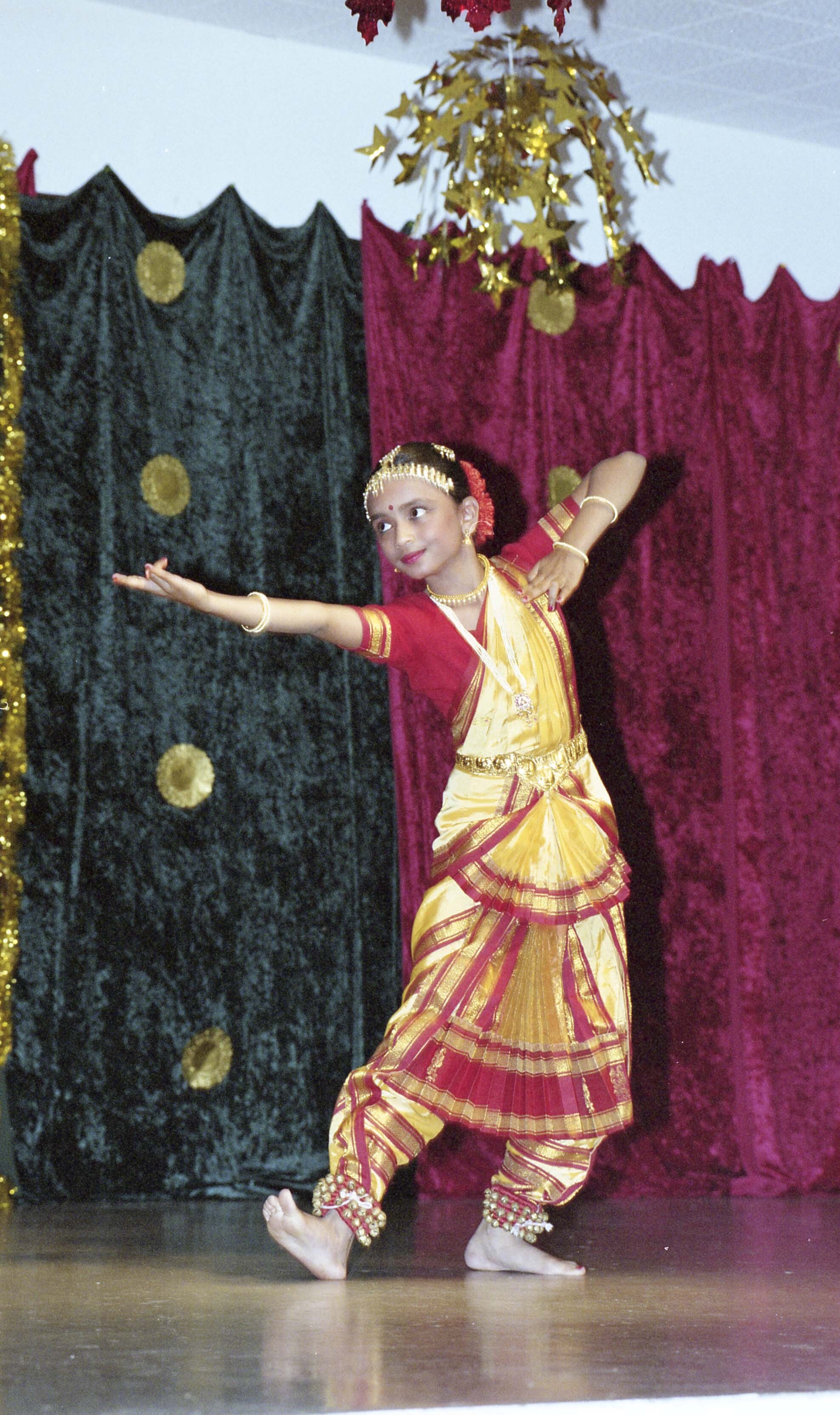
Photograph of a young girl dancing in cultural attire at an event entitled "Mehfil '02" organized by the UBC Indian Students' Association (UTSAV), and held at the University of British Columbia in Vancouver, B.C.
The UBC Indian Students' Association (UTSAV) was incepted in 1980 and is the largest student-run club at the Alma Mater Society of UBC. Their vision is to provide a "home away from home" by helping students embrace South Asian culture. They have held events in celebration of Diwali and Holi.
Established in 1915, the University of British Columbia consists of two campuses: one is situated within the ancestral and unceded territory of the Musqueam people, also known as Vancouver, B.C., and the other is on the traditional, ancestral, unceded territory of the Syilx Okanagan Nation and their peoples, also known as Kelowna, B.C. As of 2025, UBC is ranked second and third in Canada, and 38th, 41st, and 53rd in the world.
The UBC Indian Students' Association (UTSAV) was incepted in 1980 and is the largest student-run club at the Alma Mater Society of UBC. Their vision is to provide a "home away from home" by helping students embrace South Asian culture. They have held events in celebration of Diwali and Holi.
Established in 1915, the University of British Columbia consists of two campuses: one is situated within the ancestral and unceded territory of the Musqueam people, also known as Vancouver, B.C., and the other is on the traditional, ancestral, unceded territory of the Syilx Okanagan Nation and their peoples, also known as Kelowna, B.C. As of 2025, UBC is ranked second and third in Canada, and 38th, 41st, and 53rd in the world.
Creator: Bodalia, Chandra
Description
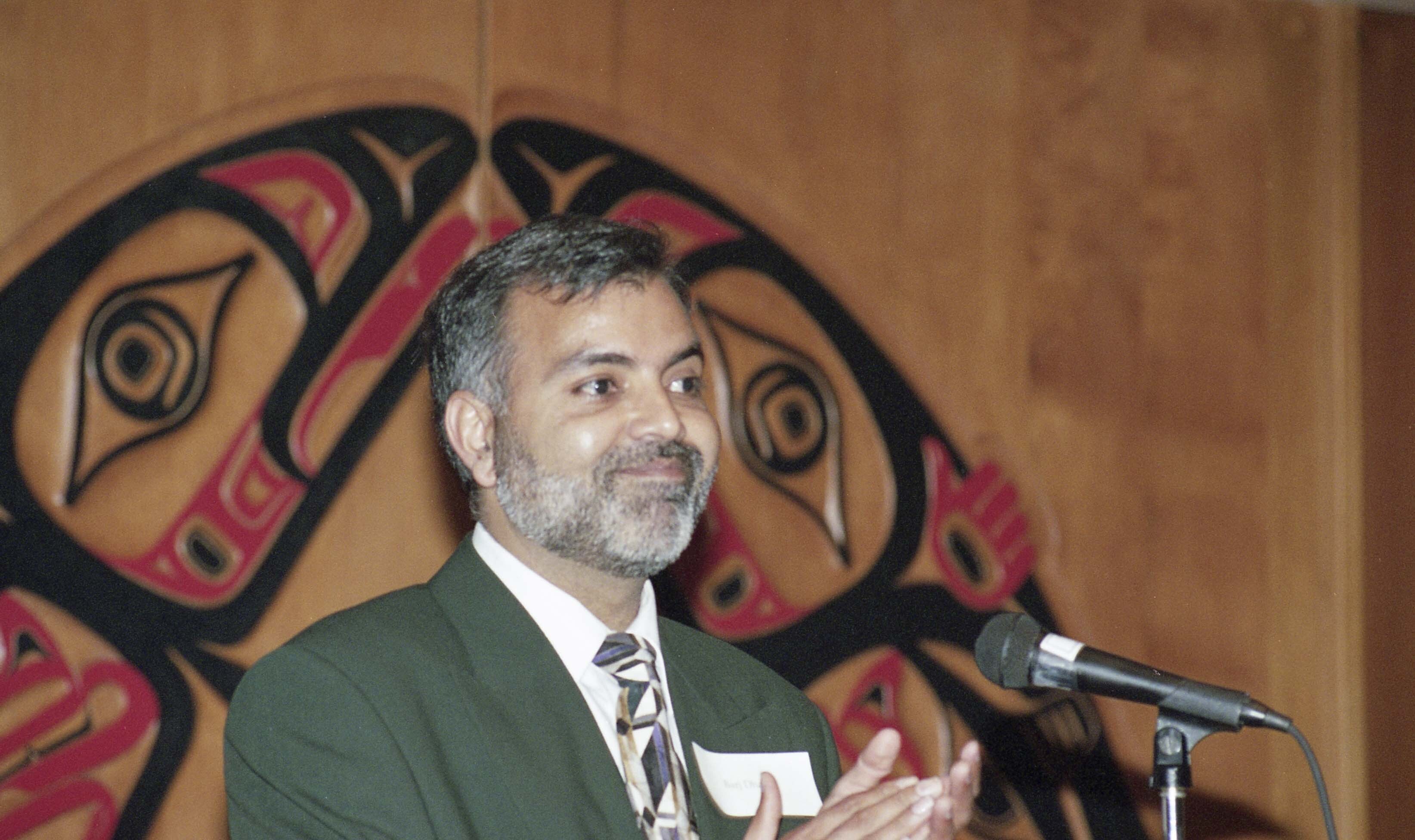
Photograph of Barj Singh Dhahan addressing the audience at an event hosted at the University of British Columbia (UBC) in Vancouver, British Columbia (B.C.).
Barjinder "Barj" Singh Dhahan was born in rural Panjab, India. In 1967, at the age of 10, Dhahan joined his father, Budh Singh Dhahan in Port Alberni, B.C. The family moved to Vancouver, B.C. in 1973. As a young parent, and while studying at the University of British Columbia and Regent College, Dhahan opened his first gas station at age 22. Eventually he founded the Sandhurst Group of Companies, a business that specializes in commercial real estate development, food service and convenience centres. Along with being Founder and President of Sandhurst Group of Companies, Dhahan is a founding donor and Board Member of the Canada-India Centre for Excellence at Carleton University in Ottawa, and a founder of the Dhahan International Panjabi Literature Prize. He is also a member of the Royal Roads University Board of Governors, the University of British Columbia Nursing Advisory Council, and the RCMP's Cultural Diversity Advisory Committee in British Columbia. As a co-founder and Director of the Canada India Education Society (CIES), Dhahan helped launch one of the first international collaborations in nursing education between Canada and India.
Barjinder "Barj" Singh Dhahan was born in rural Panjab, India. In 1967, at the age of 10, Dhahan joined his father, Budh Singh Dhahan in Port Alberni, B.C. The family moved to Vancouver, B.C. in 1973. As a young parent, and while studying at the University of British Columbia and Regent College, Dhahan opened his first gas station at age 22. Eventually he founded the Sandhurst Group of Companies, a business that specializes in commercial real estate development, food service and convenience centres. Along with being Founder and President of Sandhurst Group of Companies, Dhahan is a founding donor and Board Member of the Canada-India Centre for Excellence at Carleton University in Ottawa, and a founder of the Dhahan International Panjabi Literature Prize. He is also a member of the Royal Roads University Board of Governors, the University of British Columbia Nursing Advisory Council, and the RCMP's Cultural Diversity Advisory Committee in British Columbia. As a co-founder and Director of the Canada India Education Society (CIES), Dhahan helped launch one of the first international collaborations in nursing education between Canada and India.
Creator: Bodalia, Chandra
Description
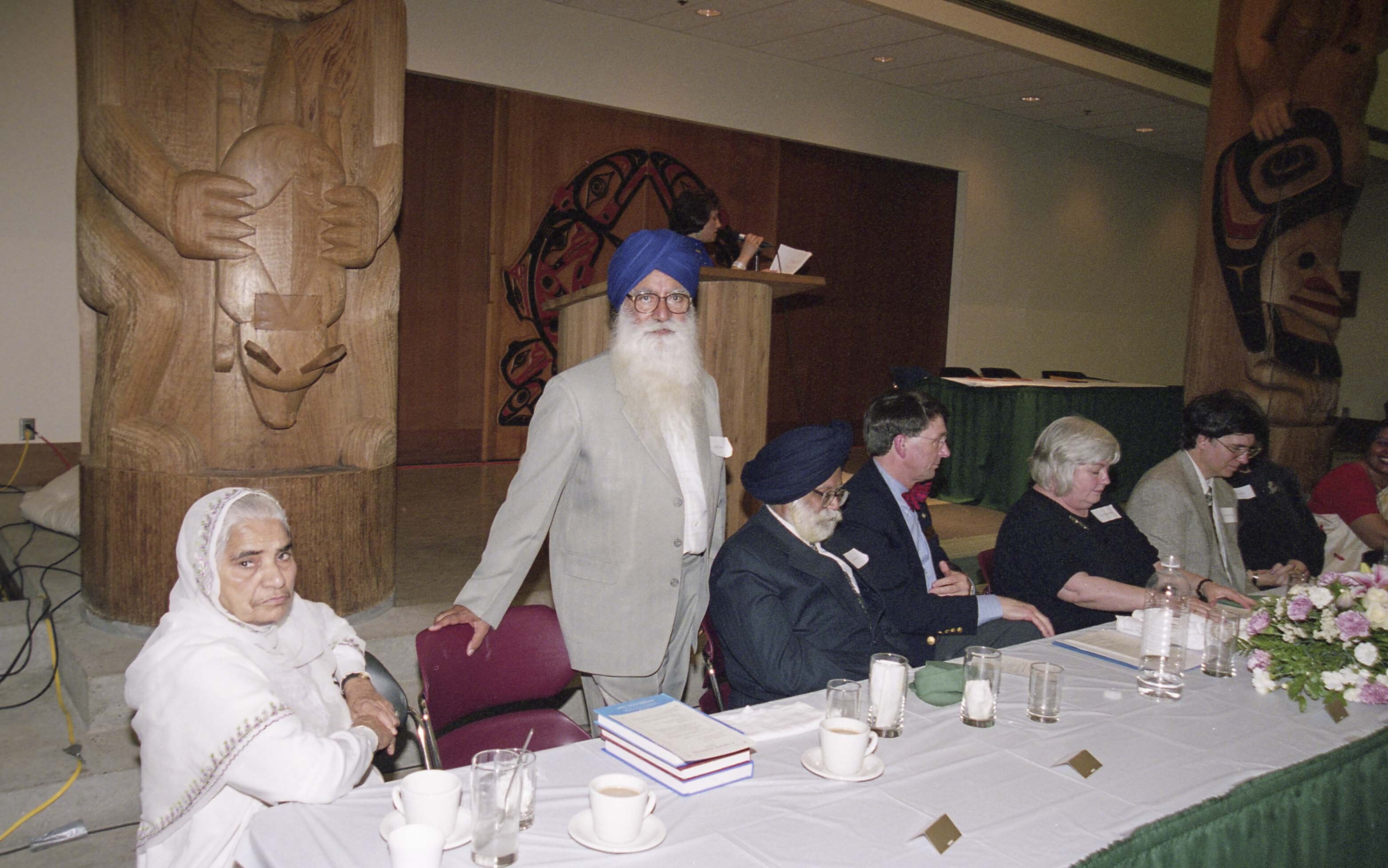
Photograph of Budh Singh Dhahan with a group of unidentified individuals at an event hosted at the University of British Columbia (UBC) in Vancouver, British Columbia (B.C.).
Budh Singh Dhahan (December 5, 1925 - April 20, 2018) was born and raised in rural India in a Panjabi Sikh family. During his time in India, Dhahan fought for greater autonomy for Panjab within India and for equal language rights for Panjabi. During the aftermath of the 1947 partition between India and Pakistan, he helped provide safe passage to people forced to leave for Pakistan while assisting the dislocated refugees from Pakistan to settle and receive proper land allotments in the Indian Panjab. He also mobilized people and resources to build shelters, schools, Sikh temples and worked actively on social and political causes to ensure a better community life. In 1960 Dhahan came to Canada and settled in the lumber town of Port Alberni, B.C. In the summer of 1967, Dhahan was reunited with his wife and four of his five children who also arrived from India. The family moved to Vancouver in 1973, where Dhahan established a successful construction enterprise building single family homes in Richmond and Vancouver. Dhanan played an active leadership role in the growing South Asian Canadian community. In 1975, he was elected as the general secretary of Khalsa Diwan Society in Vancouver, the oldest and largest Sikh organization in Canada. Under his guidance new initiatives were launched including English classes for new immigrants and Panjabi language classes for children. Programs to help strengthen the relationships between the South Asian Canadian community and the larger community were also launched. In 1979, Dhahan returned to Panjab and through his organization, the Guru Nanak Mission Medical and Educational Trust, he built a rural medical and educational complex that would provide healthcare services and education for locals. In 2010, Dhahan founded Guru Nanak Mission International Charitable Trust. He was a recipient of many awards, including the Honorary Doctor of Law from Kwantlen University College (now Kwantlen Polytechnic University) recognizing his exemplary contributions to Canada and India.
Budh Singh Dhahan (December 5, 1925 - April 20, 2018) was born and raised in rural India in a Panjabi Sikh family. During his time in India, Dhahan fought for greater autonomy for Panjab within India and for equal language rights for Panjabi. During the aftermath of the 1947 partition between India and Pakistan, he helped provide safe passage to people forced to leave for Pakistan while assisting the dislocated refugees from Pakistan to settle and receive proper land allotments in the Indian Panjab. He also mobilized people and resources to build shelters, schools, Sikh temples and worked actively on social and political causes to ensure a better community life. In 1960 Dhahan came to Canada and settled in the lumber town of Port Alberni, B.C. In the summer of 1967, Dhahan was reunited with his wife and four of his five children who also arrived from India. The family moved to Vancouver in 1973, where Dhahan established a successful construction enterprise building single family homes in Richmond and Vancouver. Dhanan played an active leadership role in the growing South Asian Canadian community. In 1975, he was elected as the general secretary of Khalsa Diwan Society in Vancouver, the oldest and largest Sikh organization in Canada. Under his guidance new initiatives were launched including English classes for new immigrants and Panjabi language classes for children. Programs to help strengthen the relationships between the South Asian Canadian community and the larger community were also launched. In 1979, Dhahan returned to Panjab and through his organization, the Guru Nanak Mission Medical and Educational Trust, he built a rural medical and educational complex that would provide healthcare services and education for locals. In 2010, Dhahan founded Guru Nanak Mission International Charitable Trust. He was a recipient of many awards, including the Honorary Doctor of Law from Kwantlen University College (now Kwantlen Polytechnic University) recognizing his exemplary contributions to Canada and India.
Creator: Bodalia, Chandra
Description
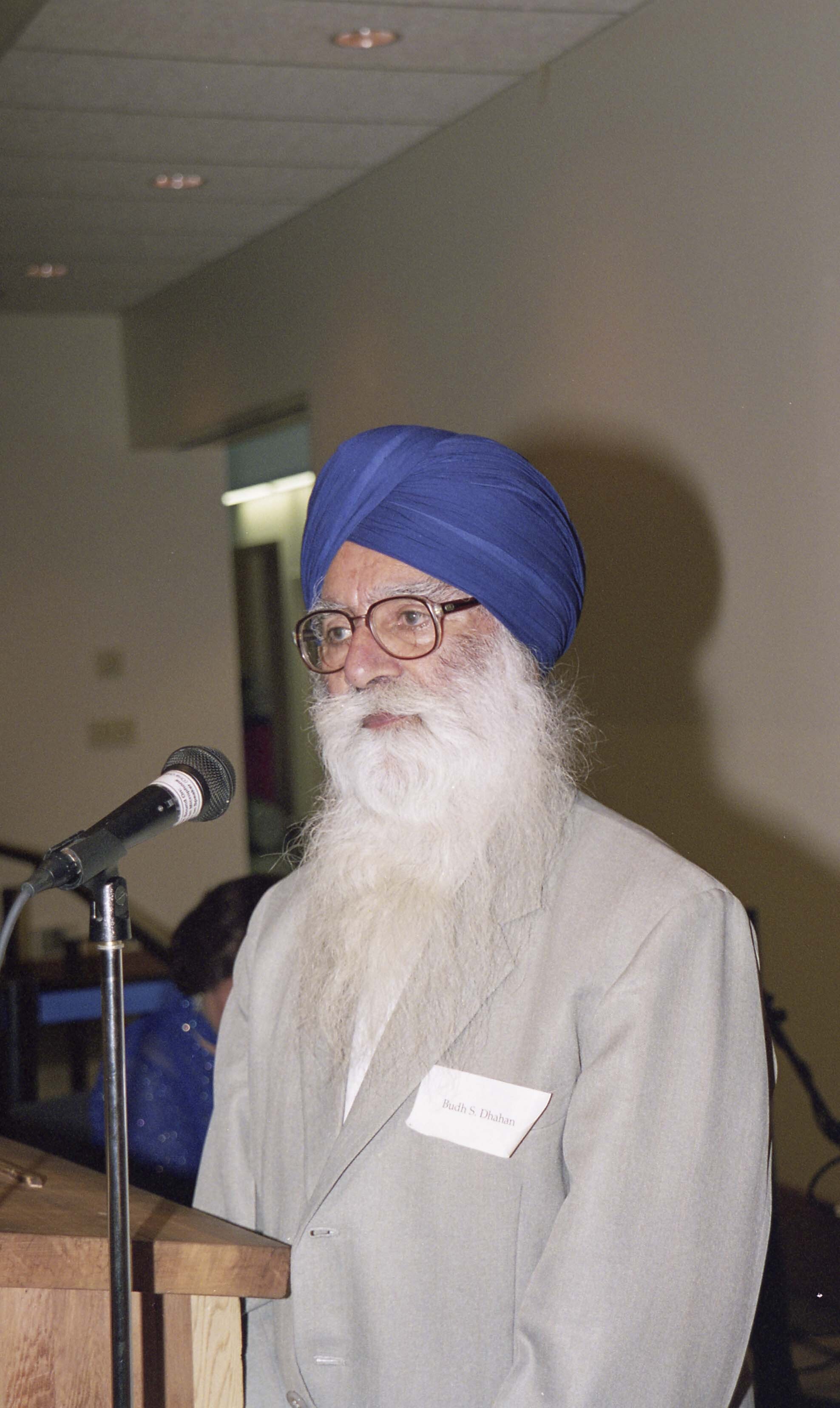
Photograph of Budh Singh Dhahan addressing the audience at an event hosted at the University of British Columbia (UBC) in Vancouver, British Columbia (B.C.).
Budh Singh Dhahan (December 5, 1925 - April 20, 2018) was born and raised in rural India in a Panjabi Sikh family. During his time in India, Dhahan fought for greater autonomy for Panjab within India and for equal language rights for Panjabi. During the aftermath of the 1947 partition between India and Pakistan, he helped provide safe passage to people forced to leave for Pakistan while assisting the dislocated refugees from Pakistan to settle and receive proper land allotments in the Indian Panjab. He also mobilized people and resources to build shelters, schools, Sikh temples and worked actively on social and political causes to ensure a better community life. In 1960 Dhahan came to Canada and settled in the lumber town of Port Alberni, B.C. In the summer of 1967, Dhahan was reunited with his wife and four of his five children who also arrived from India. The family moved to Vancouver in 1973, where Dhahan established a successful construction enterprise building single family homes in Richmond and Vancouver. Dhanan played an active leadership role in the growing South Asian Canadian community. In 1975, he was elected as the general secretary of Khalsa Diwan Society in Vancouver, the oldest and largest Sikh organization in Canada. Under his guidance new initiatives were launched including English classes for new immigrants and Panjabi language classes for children. Programs to help strengthen the relationships between the South Asian Canadian community and the larger community were also launched. In 1979, Dhahan returned to Panjab and through his organization, the Guru Nanak Mission Medical and Educational Trust, he built a rural medical and educational complex that would provide healthcare services and education for locals. In 2010, Dhahan founded Guru Nanak Mission International Charitable Trust. He was a recipient of many awards, including the Honorary Doctor of Law from Kwantlen University College (now Kwantlen Polytechnic University) recognizing his exemplary contributions to Canada and India.
Budh Singh Dhahan (December 5, 1925 - April 20, 2018) was born and raised in rural India in a Panjabi Sikh family. During his time in India, Dhahan fought for greater autonomy for Panjab within India and for equal language rights for Panjabi. During the aftermath of the 1947 partition between India and Pakistan, he helped provide safe passage to people forced to leave for Pakistan while assisting the dislocated refugees from Pakistan to settle and receive proper land allotments in the Indian Panjab. He also mobilized people and resources to build shelters, schools, Sikh temples and worked actively on social and political causes to ensure a better community life. In 1960 Dhahan came to Canada and settled in the lumber town of Port Alberni, B.C. In the summer of 1967, Dhahan was reunited with his wife and four of his five children who also arrived from India. The family moved to Vancouver in 1973, where Dhahan established a successful construction enterprise building single family homes in Richmond and Vancouver. Dhanan played an active leadership role in the growing South Asian Canadian community. In 1975, he was elected as the general secretary of Khalsa Diwan Society in Vancouver, the oldest and largest Sikh organization in Canada. Under his guidance new initiatives were launched including English classes for new immigrants and Panjabi language classes for children. Programs to help strengthen the relationships between the South Asian Canadian community and the larger community were also launched. In 1979, Dhahan returned to Panjab and through his organization, the Guru Nanak Mission Medical and Educational Trust, he built a rural medical and educational complex that would provide healthcare services and education for locals. In 2010, Dhahan founded Guru Nanak Mission International Charitable Trust. He was a recipient of many awards, including the Honorary Doctor of Law from Kwantlen University College (now Kwantlen Polytechnic University) recognizing his exemplary contributions to Canada and India.