
Richmond
Creator: Bodalia, Chandra
Description
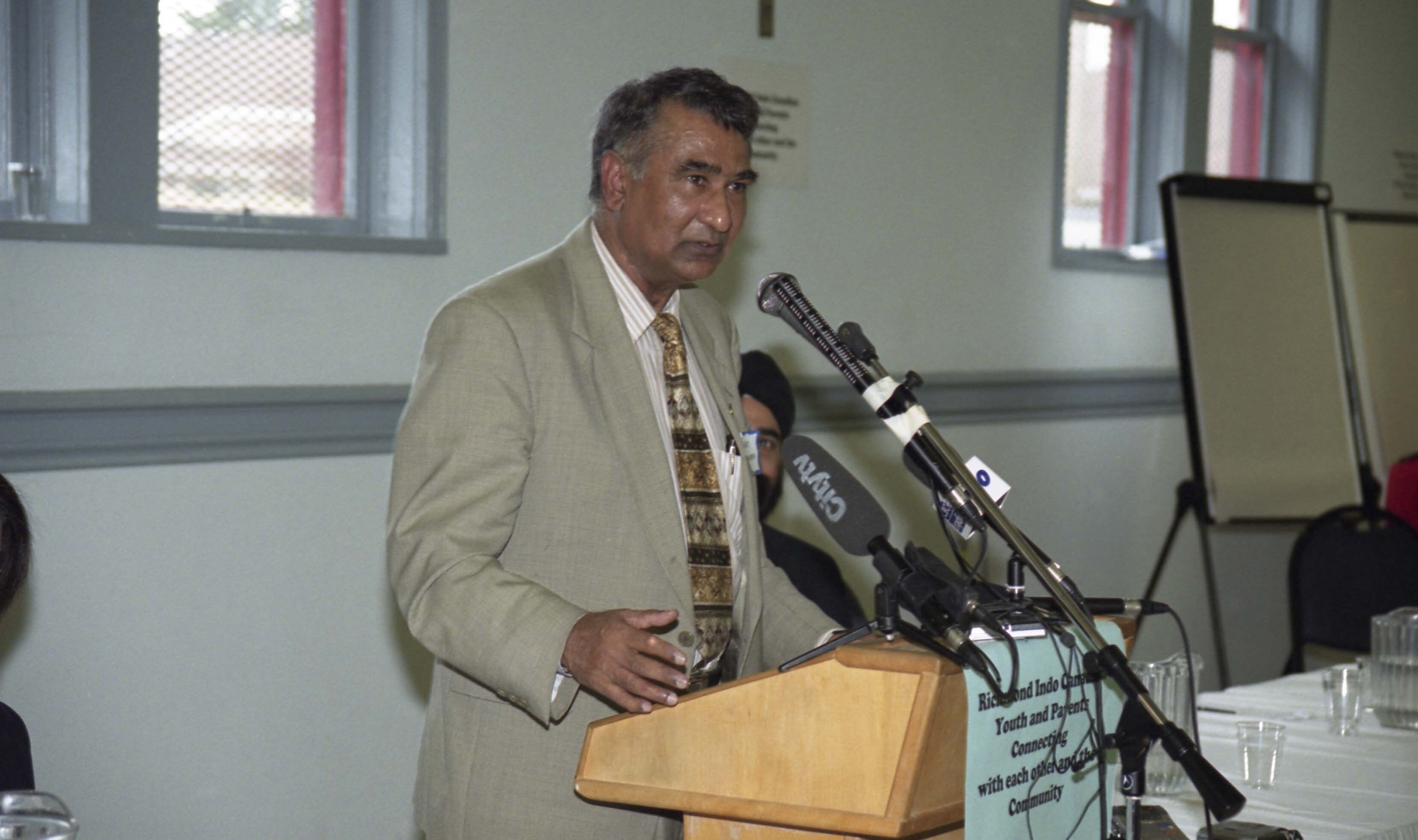
Photograph of Balwant Sanghera speaking at the Richmond Indo Canadian Youth and Parents Connecting with Each Other and the Community Conference in Richmond, B.C.
Balwant Sanghera immigrated to Canada in 1966, starting his teaching career in Northern B.C. before earning a Master of Education from the University of British Columbia and becoming a school psychologist. He developed innovative programs for youth with mental health challenges and played a key role in mentoring and expanding similar initiatives across the province. He has held leadership positions in Richmond's multicultural and community organizations, including being president of the Richmond Multicultural Concerns Society and the Punjabi Language Education Association of British Columbia, chair of Richmond's Intercultural Advisory Committee, President of the East Richmond Community Association and an organizer of Multi-Fest, a summer festival to celebrate Richmond's diversity. His contributions to education and public service have earned him the Order of British Columbia and multiple Jubilee Medals, including the Queen's Golden, Diamond and Platinum Jubilee Medals.
Balwant Sanghera immigrated to Canada in 1966, starting his teaching career in Northern B.C. before earning a Master of Education from the University of British Columbia and becoming a school psychologist. He developed innovative programs for youth with mental health challenges and played a key role in mentoring and expanding similar initiatives across the province. He has held leadership positions in Richmond's multicultural and community organizations, including being president of the Richmond Multicultural Concerns Society and the Punjabi Language Education Association of British Columbia, chair of Richmond's Intercultural Advisory Committee, President of the East Richmond Community Association and an organizer of Multi-Fest, a summer festival to celebrate Richmond's diversity. His contributions to education and public service have earned him the Order of British Columbia and multiple Jubilee Medals, including the Queen's Golden, Diamond and Platinum Jubilee Medals.
Creator: Bodalia, Chandra
Description
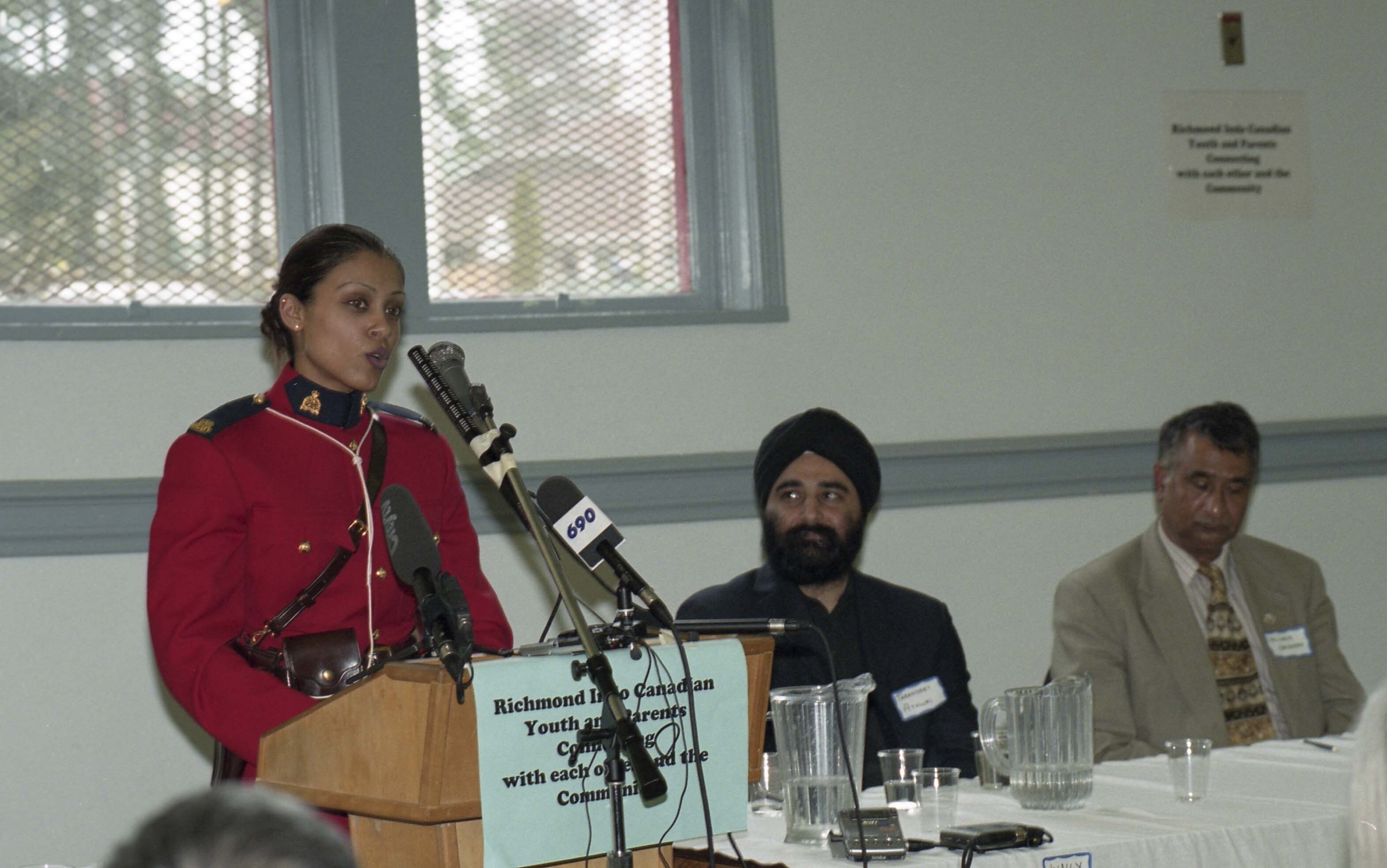
Photograph of an RCMP officer speaking at the Richmond Indo Canadian Youth and Parents Connecting with Each Other and the Community Conference in Richmond, B.C.
Taranjeet Athwal and another unidentified man are sitting in the background.
Taranjeet Athwal and another unidentified man are sitting in the background.
Creator: Bodalia, Chandra
Description
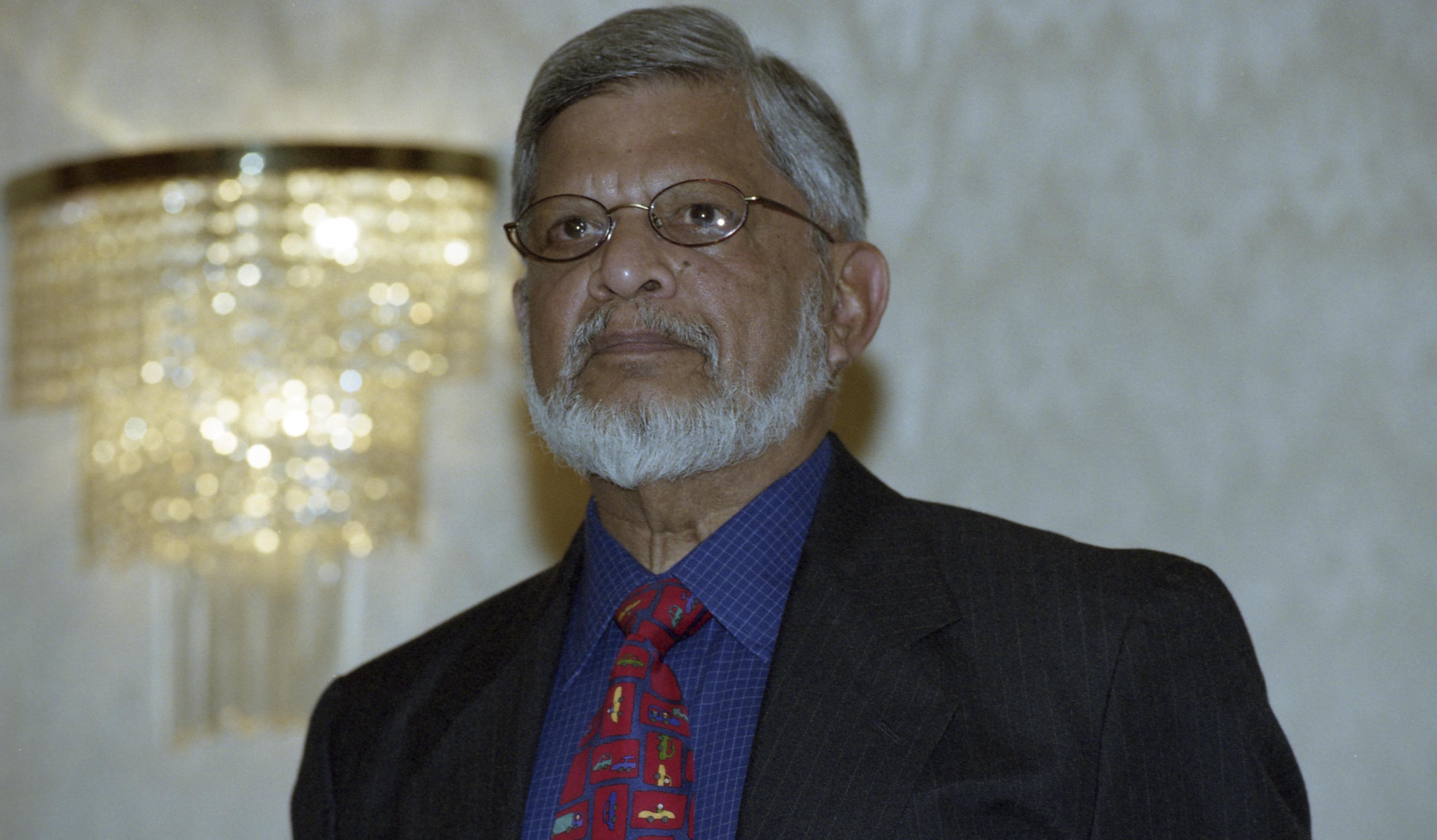
Photograph of Arun Gandhi at his lecture and book signing event, which was organized by the International Network on Personal Meaning in Richmond, B.C.
Born in 1934 in Durban, South Africa, Arun Manilal Gandhi was the fifth grandson of Mohandas K. "Mahatma" Gandhi and was a socio-political activist, author, lecturer, and journalist. Having grown up under the apartheid laws of South Asian, both his parents and his grandfather taught him the importance of justice through love, suffering, understanding, and nonviolence. He and his late spouse, Sunanda, lived in India for thirty years, and then in 1987, they moved to the United States. The couple was extremely involved in activism, which included rescuing orphan children from the street, social and economic uplifting programs, starting the M. K. Gandhi Institute for Nonviolence, establishing residential-school in poorest rural India, and founding the Gandhi Worldwide Education Institute, among other contributions.
International Network on Personal Meaning (INPM) follows the vision of Dr. Viktor Frankl, an Austrian neurologist and psychiatrist, and Dr. Paul T. P. Wong, a Canadian clinical psychologist. They advocate for research on meaning, by extending logotherapy and integrating it with the positive psychology. They engage in meaning research, meaning-centred practice, meaningful living group, as well as websites, publications, education, meaningful living groups, and meaning-centered counseling, coaching, and consultation.
Born in 1934 in Durban, South Africa, Arun Manilal Gandhi was the fifth grandson of Mohandas K. "Mahatma" Gandhi and was a socio-political activist, author, lecturer, and journalist. Having grown up under the apartheid laws of South Asian, both his parents and his grandfather taught him the importance of justice through love, suffering, understanding, and nonviolence. He and his late spouse, Sunanda, lived in India for thirty years, and then in 1987, they moved to the United States. The couple was extremely involved in activism, which included rescuing orphan children from the street, social and economic uplifting programs, starting the M. K. Gandhi Institute for Nonviolence, establishing residential-school in poorest rural India, and founding the Gandhi Worldwide Education Institute, among other contributions.
International Network on Personal Meaning (INPM) follows the vision of Dr. Viktor Frankl, an Austrian neurologist and psychiatrist, and Dr. Paul T. P. Wong, a Canadian clinical psychologist. They advocate for research on meaning, by extending logotherapy and integrating it with the positive psychology. They engage in meaning research, meaning-centred practice, meaningful living group, as well as websites, publications, education, meaningful living groups, and meaning-centered counseling, coaching, and consultation.
Creator: Bodalia, Chandra
Description
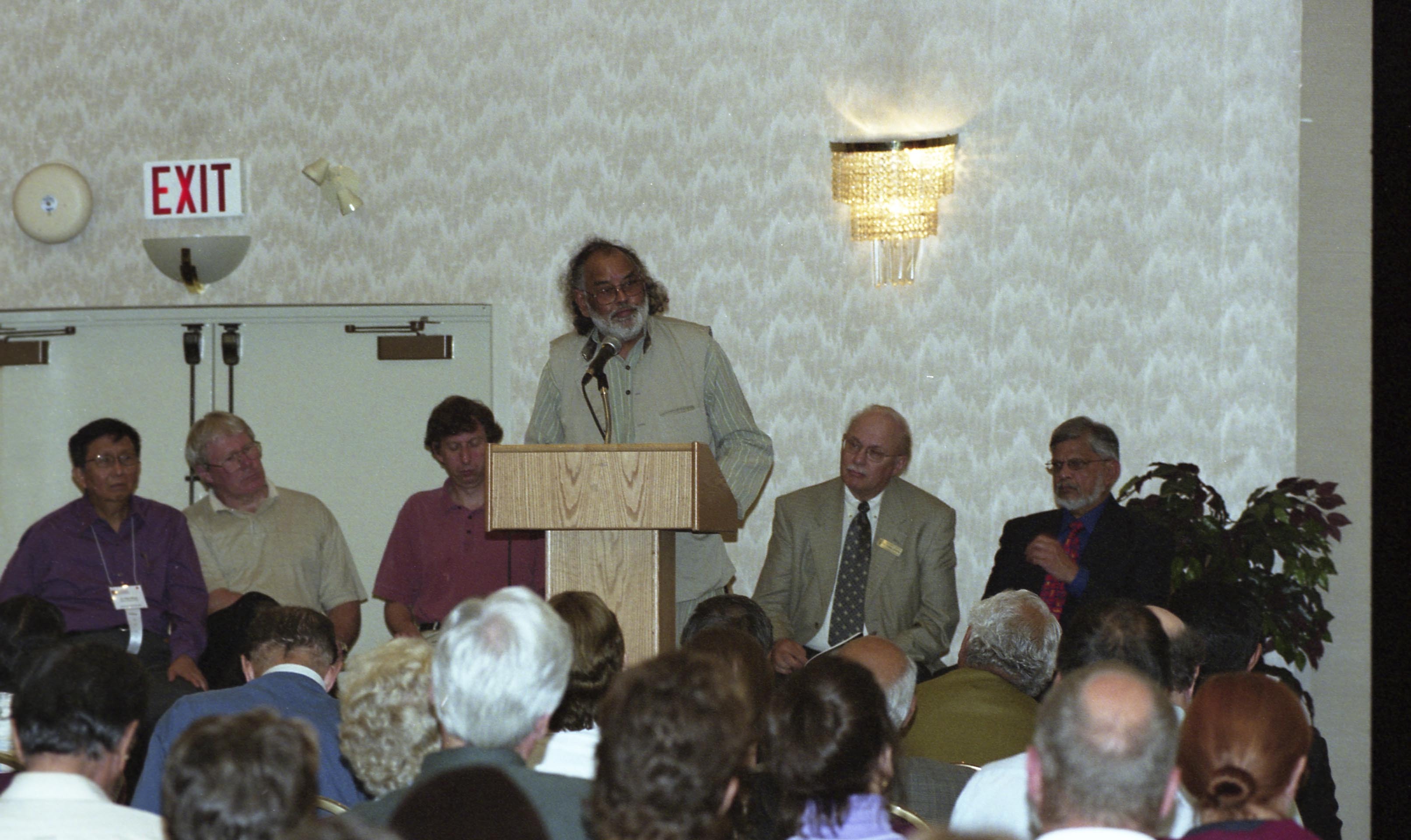
Photograph of an unidentified man speaking at a lecture and book signing event for Arun Gandhi, which was organized by the International Network on Personal Meaning in Richmond, B.C.
Born in 1934 in Durban, South Africa, Arun Manilal Gandhi was the fifth grandson of Mohandas K. "Mahatma" Gandhi and was a socio-political activist, author, lecturer, and journalist. Having grown up under the apartheid laws of South Asian, both his parents and his grandfather taught him the importance of justice through love, suffering, understanding, and nonviolence. He and his late spouse, Sunanda, lived in India for thirty years, and then in 1987, they moved to the United States. The couple was extremely involved in activism, which included rescuing orphan children from the street, social and economic uplifting programs, starting the M. K. Gandhi Institute for Nonviolence, establishing residential-school in poorest rural India, and founding the Gandhi Worldwide Education Institute, among other contributions.
International Network on Personal Meaning (INPM) follows the vision of Dr. Viktor Frankl, an Austrian neurologist and psychiatrist, and Dr. Paul T. P. Wong, a Canadian clinical psychologist. They advocate for research on meaning, by extending logotherapy and integrating it with the positive psychology. They engage in meaning research, meaning-centred practice, meaningful living group, as well as websites, publications, education, meaningful living groups, and meaning-centered counseling, coaching, and consultation.
Born in 1934 in Durban, South Africa, Arun Manilal Gandhi was the fifth grandson of Mohandas K. "Mahatma" Gandhi and was a socio-political activist, author, lecturer, and journalist. Having grown up under the apartheid laws of South Asian, both his parents and his grandfather taught him the importance of justice through love, suffering, understanding, and nonviolence. He and his late spouse, Sunanda, lived in India for thirty years, and then in 1987, they moved to the United States. The couple was extremely involved in activism, which included rescuing orphan children from the street, social and economic uplifting programs, starting the M. K. Gandhi Institute for Nonviolence, establishing residential-school in poorest rural India, and founding the Gandhi Worldwide Education Institute, among other contributions.
International Network on Personal Meaning (INPM) follows the vision of Dr. Viktor Frankl, an Austrian neurologist and psychiatrist, and Dr. Paul T. P. Wong, a Canadian clinical psychologist. They advocate for research on meaning, by extending logotherapy and integrating it with the positive psychology. They engage in meaning research, meaning-centred practice, meaningful living group, as well as websites, publications, education, meaningful living groups, and meaning-centered counseling, coaching, and consultation.
Creator: Bodalia, Chandra
Description
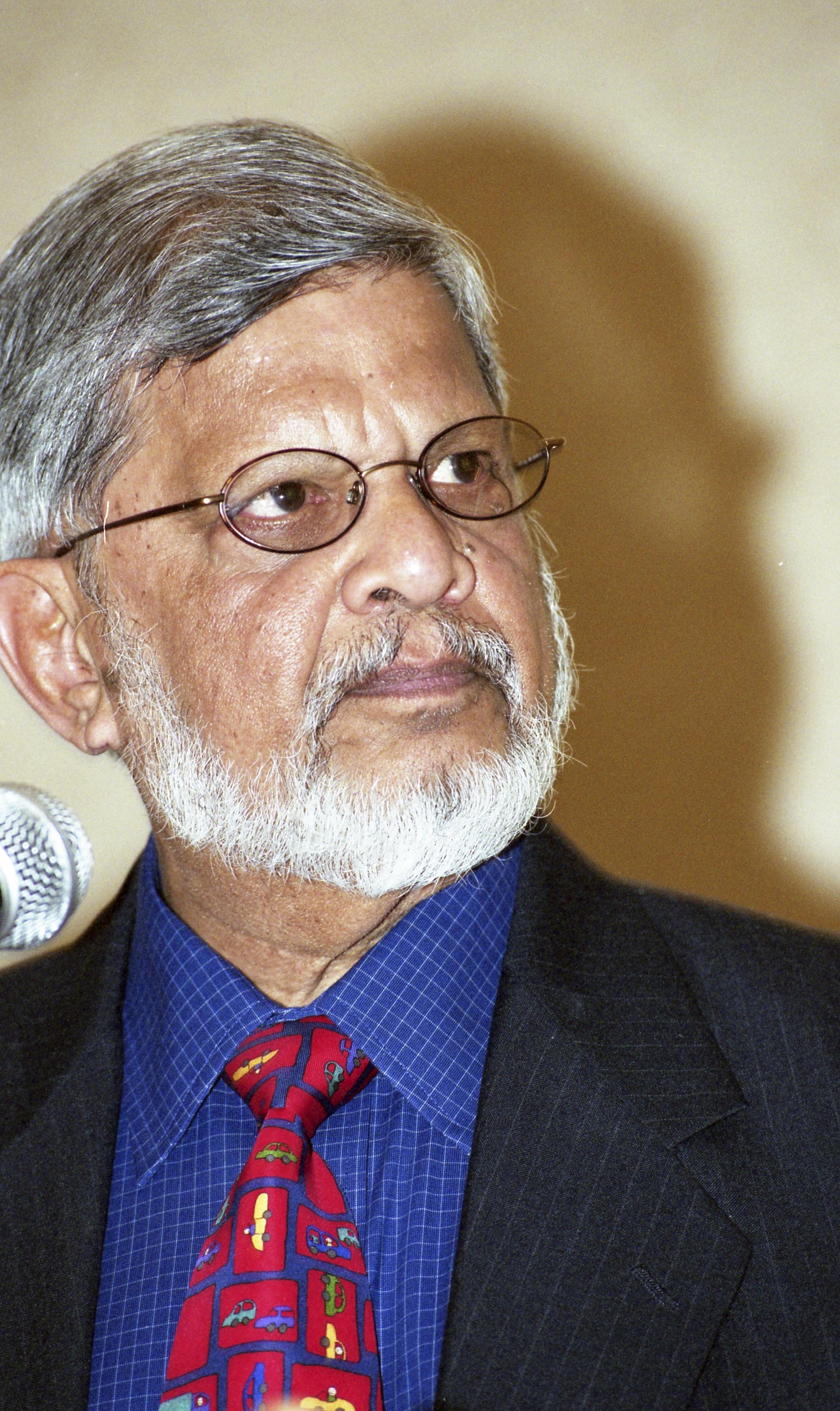
Photograph of Arun Gandhi at his lecture and book signing event, which was organized by the International Network on Personal Meaning in Richmond, B.C.
Born in 1934 in Durban, South Africa, Arun Manilal Gandhi was the fifth grandson of Mohandas K. "Mahatma" Gandhi and was a socio-political activist, author, lecturer, and journalist. Having grown up under the apartheid laws of South Asian, both his parents and his grandfather taught him the importance of justice through love, suffering, understanding, and nonviolence. He and his late spouse, Sunanda, lived in India for thirty years, and then in 1987, they moved to the United States. The couple was extremely involved in activism, which included rescuing orphan children from the street, social and economic uplifting programs, starting the M. K. Gandhi Institute for Nonviolence, establishing residential-school in poorest rural India, and founding the Gandhi Worldwide Education Institute, among other contributions.
International Network on Personal Meaning (INPM) follows the vision of Dr. Viktor Frankl, an Austrian neurologist and psychiatrist, and Dr. Paul T. P. Wong, a Canadian clinical psychologist. They advocate for research on meaning, by extending logotherapy and integrating it with the positive psychology. They engage in meaning research, meaning-centred practice, meaningful living group, as well as websites, publications, education, meaningful living groups, and meaning-centered counseling, coaching, and consultation.
Born in 1934 in Durban, South Africa, Arun Manilal Gandhi was the fifth grandson of Mohandas K. "Mahatma" Gandhi and was a socio-political activist, author, lecturer, and journalist. Having grown up under the apartheid laws of South Asian, both his parents and his grandfather taught him the importance of justice through love, suffering, understanding, and nonviolence. He and his late spouse, Sunanda, lived in India for thirty years, and then in 1987, they moved to the United States. The couple was extremely involved in activism, which included rescuing orphan children from the street, social and economic uplifting programs, starting the M. K. Gandhi Institute for Nonviolence, establishing residential-school in poorest rural India, and founding the Gandhi Worldwide Education Institute, among other contributions.
International Network on Personal Meaning (INPM) follows the vision of Dr. Viktor Frankl, an Austrian neurologist and psychiatrist, and Dr. Paul T. P. Wong, a Canadian clinical psychologist. They advocate for research on meaning, by extending logotherapy and integrating it with the positive psychology. They engage in meaning research, meaning-centred practice, meaningful living group, as well as websites, publications, education, meaningful living groups, and meaning-centered counseling, coaching, and consultation.
Creator: Bodalia, Chandra
Description
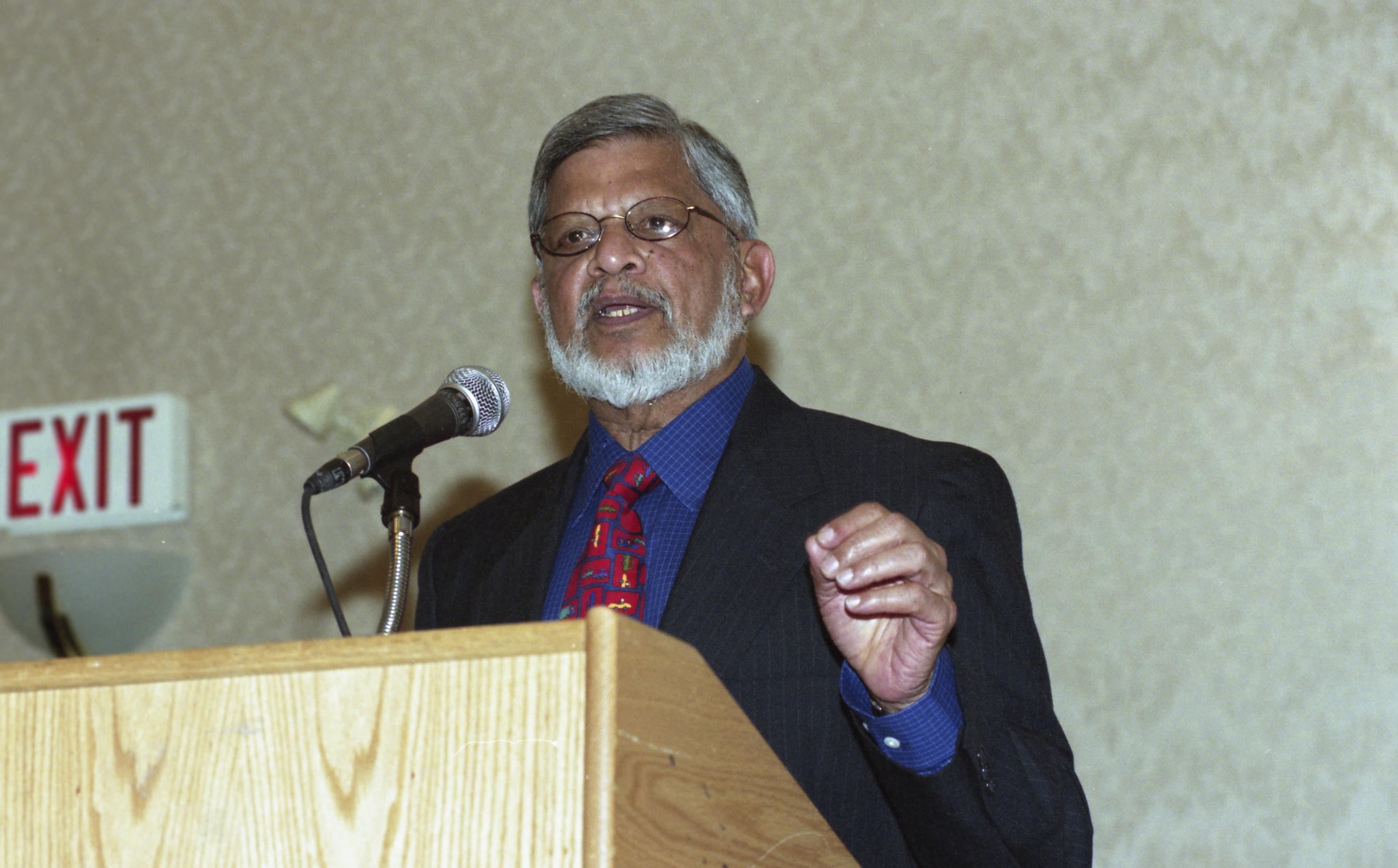
Photograph of Arun Gandhi speaking at his lecture and book signing event, which was organized by the International Network on Personal Meaning in Richmond, B.C.
Born in 1934 in Durban, South Africa, Arun Manilal Gandhi was the fifth grandson of Mohandas K. "Mahatma" Gandhi and was a socio-political activist, author, lecturer, and journalist. Having grown up under the apartheid laws of South Asian, both his parents and his grandfather taught him the importance of justice through love, suffering, understanding, and nonviolence. He and his late spouse, Sunanda, lived in India for thirty years, and then in 1987, they moved to the United States. The couple was extremely involved in activism, which included rescuing orphan children from the street, social and economic uplifting programs, starting the M. K. Gandhi Institute for Nonviolence, establishing residential-school in poorest rural India, and founding the Gandhi Worldwide Education Institute, among other contributions.
International Network on Personal Meaning (INPM) follows the vision of Dr. Viktor Frankl, an Austrian neurologist and psychiatrist, and Dr. Paul T. P. Wong, a Canadian clinical psychologist. They advocate for research on meaning, by extending logotherapy and integrating it with the positive psychology. They engage in meaning research, meaning-centred practice, meaningful living group, as well as websites, publications, education, meaningful living groups, and meaning-centered counseling, coaching, and consultation.
Born in 1934 in Durban, South Africa, Arun Manilal Gandhi was the fifth grandson of Mohandas K. "Mahatma" Gandhi and was a socio-political activist, author, lecturer, and journalist. Having grown up under the apartheid laws of South Asian, both his parents and his grandfather taught him the importance of justice through love, suffering, understanding, and nonviolence. He and his late spouse, Sunanda, lived in India for thirty years, and then in 1987, they moved to the United States. The couple was extremely involved in activism, which included rescuing orphan children from the street, social and economic uplifting programs, starting the M. K. Gandhi Institute for Nonviolence, establishing residential-school in poorest rural India, and founding the Gandhi Worldwide Education Institute, among other contributions.
International Network on Personal Meaning (INPM) follows the vision of Dr. Viktor Frankl, an Austrian neurologist and psychiatrist, and Dr. Paul T. P. Wong, a Canadian clinical psychologist. They advocate for research on meaning, by extending logotherapy and integrating it with the positive psychology. They engage in meaning research, meaning-centred practice, meaningful living group, as well as websites, publications, education, meaningful living groups, and meaning-centered counseling, coaching, and consultation.
Creator: Bodalia, Chandra
Description
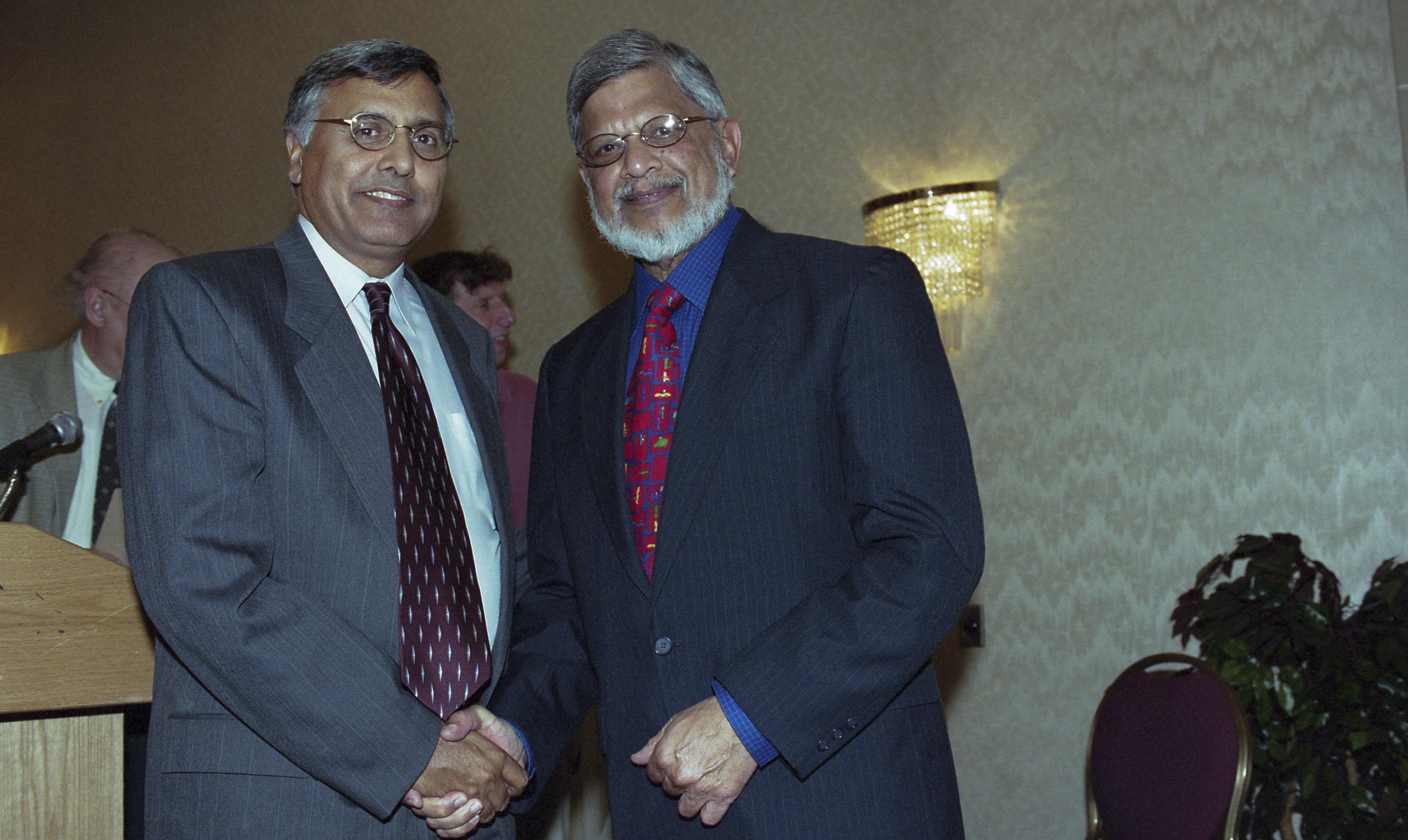
Group portrait of Premier Ujjal Dosanjh and Arun Gandhi at his lecture and book signing event, which was organized by the International Network on Personal Meaning in Richmond, B.C.
Born in 1934 in Durban, South Africa, Arun Manilal Gandhi was the fifth grandson of Mohandas K. "Mahatma" Gandhi and was a socio-political activist, author, lecturer, and journalist. Having grown up under the apartheid laws of South Asian, both his parents and his grandfather taught him the importance of justice through love, suffering, understanding, and nonviolence. He and his late spouse, Sunanda, lived in India for thirty years, and then in 1987, they moved to the United States. The couple was extremely involved in activism, which included rescuing orphan children from the street, social and economic uplifting programs, starting the M. K. Gandhi Institute for Nonviolence, establishing residential-school in poorest rural India, and founding the Gandhi Worldwide Education Institute, among other contributions.
Ujjal Dosanjh is a Canadian lawyer, civil rights activist, and politician. Born in Panjab, India in 1947, Dosanjh emigrated to England at the age of 17 and came to Canada four years later, in 1968. He started off at a Vancouver sawmill, but when a back injury hindered his career at the mill, he enrolled at Langara College and completed a degree in political science at Simon Fraser University. He earned a law degree at the University of British Columbia and established a law practice in Vancouver in 1979. First elected as MLA for Vancouver-Kensington in 1991, Dosanjh twice served as Caucus Chair and also chaired the Select Standing Committee on Parliamentary Reform, Ethical Conduct, Standing Orders and Private Bills. Dosanjh was sworn in as British Columbia's 33rd Premier and Canada's first Indo-Canadian Premier on February 24, 2000, serving until 2001. He had previously served as Minister of Government Services and Minister Responsible for Multiculturalism, Human Rights, Sports and Immigration in 1995, and served as Attorney General from August 1995 to February 2000. He was also the leader of the provincial New Democratic Party (NDP) and later served as a Member of Parliament with the Liberal Party. A long time human rights activist, his past community involvements include: South Vancouver Neighbourhood House, MOSAIC, the B.C. Multicultural Society and the B.C. Civil Liberties Association. In 1977 he helped set up the first farm workers' legal information services while he was chair of the Labour Advocacy Research Association. Throughout his career, Dosanjh has been a strong advocate for social justice, healthcare, and public policy issues.
International Network on Personal Meaning (INPM) follows the vision of Dr. Viktor Frankl, an Austrian neurologist and psychiatrist, and Dr. Paul T. P. Wong, a Canadian clinical psychologist. They advocate for research on meaning, by extending logotherapy and integrating it with the positive psychology. They engage in meaning research, meaning-centred practice, meaningful living group, as well as websites, publications, education, meaningful living groups, and meaning-centered counseling, coaching, and consultation.
Born in 1934 in Durban, South Africa, Arun Manilal Gandhi was the fifth grandson of Mohandas K. "Mahatma" Gandhi and was a socio-political activist, author, lecturer, and journalist. Having grown up under the apartheid laws of South Asian, both his parents and his grandfather taught him the importance of justice through love, suffering, understanding, and nonviolence. He and his late spouse, Sunanda, lived in India for thirty years, and then in 1987, they moved to the United States. The couple was extremely involved in activism, which included rescuing orphan children from the street, social and economic uplifting programs, starting the M. K. Gandhi Institute for Nonviolence, establishing residential-school in poorest rural India, and founding the Gandhi Worldwide Education Institute, among other contributions.
Ujjal Dosanjh is a Canadian lawyer, civil rights activist, and politician. Born in Panjab, India in 1947, Dosanjh emigrated to England at the age of 17 and came to Canada four years later, in 1968. He started off at a Vancouver sawmill, but when a back injury hindered his career at the mill, he enrolled at Langara College and completed a degree in political science at Simon Fraser University. He earned a law degree at the University of British Columbia and established a law practice in Vancouver in 1979. First elected as MLA for Vancouver-Kensington in 1991, Dosanjh twice served as Caucus Chair and also chaired the Select Standing Committee on Parliamentary Reform, Ethical Conduct, Standing Orders and Private Bills. Dosanjh was sworn in as British Columbia's 33rd Premier and Canada's first Indo-Canadian Premier on February 24, 2000, serving until 2001. He had previously served as Minister of Government Services and Minister Responsible for Multiculturalism, Human Rights, Sports and Immigration in 1995, and served as Attorney General from August 1995 to February 2000. He was also the leader of the provincial New Democratic Party (NDP) and later served as a Member of Parliament with the Liberal Party. A long time human rights activist, his past community involvements include: South Vancouver Neighbourhood House, MOSAIC, the B.C. Multicultural Society and the B.C. Civil Liberties Association. In 1977 he helped set up the first farm workers' legal information services while he was chair of the Labour Advocacy Research Association. Throughout his career, Dosanjh has been a strong advocate for social justice, healthcare, and public policy issues.
International Network on Personal Meaning (INPM) follows the vision of Dr. Viktor Frankl, an Austrian neurologist and psychiatrist, and Dr. Paul T. P. Wong, a Canadian clinical psychologist. They advocate for research on meaning, by extending logotherapy and integrating it with the positive psychology. They engage in meaning research, meaning-centred practice, meaningful living group, as well as websites, publications, education, meaningful living groups, and meaning-centered counseling, coaching, and consultation.
Creator: Bodalia, Chandra
Description
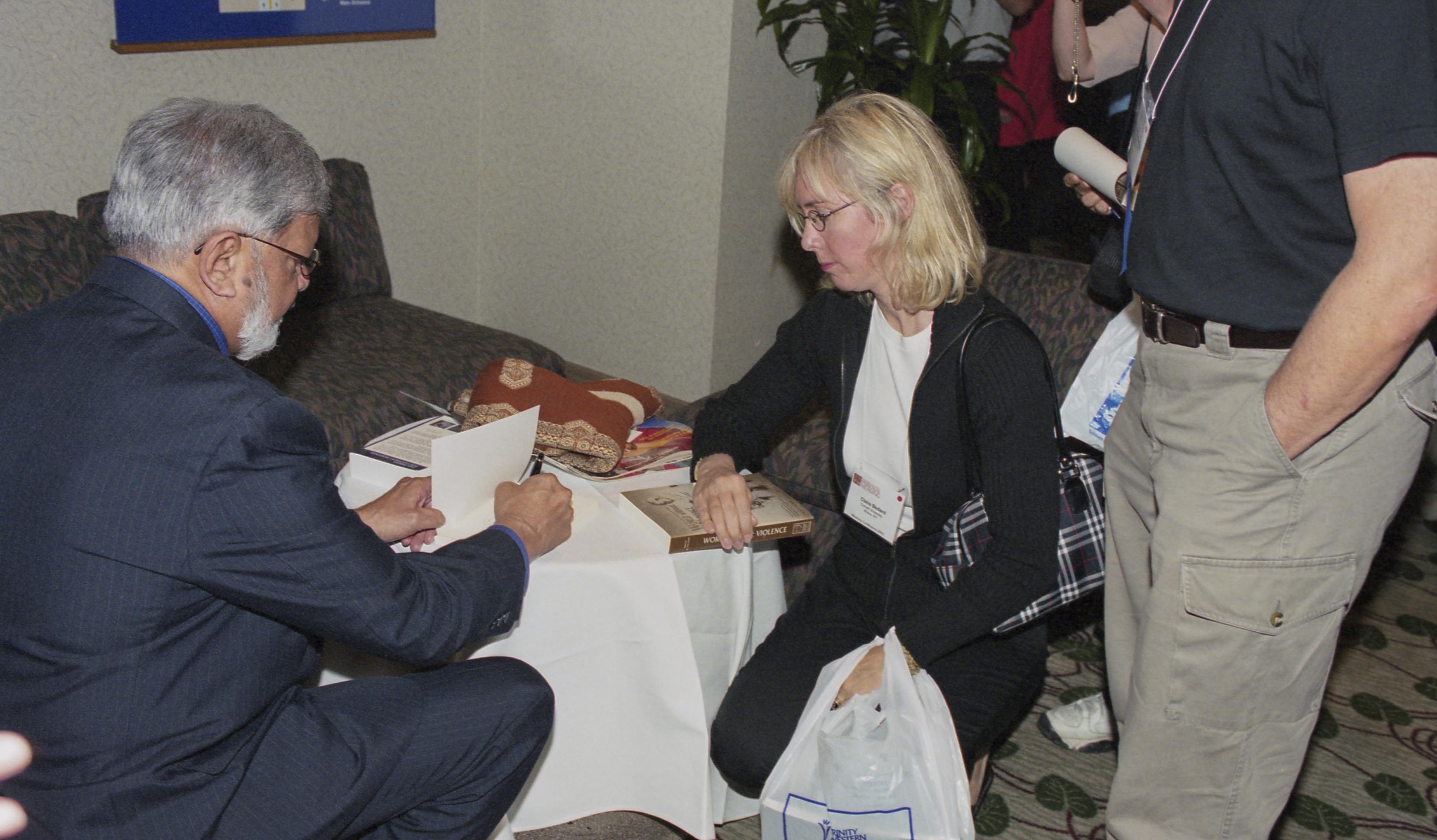
Photograph of Arun Gandhi signing a book at a lecture and book signing event for Arun Gandhi, which was organized by the International Network on Personal Meaning in Richmond, B.C.
Born in 1934 in Durban, South Africa, Arun Manilal Gandhi was the fifth grandson of Mohandas K. "Mahatma" Gandhi and was a socio-political activist, author, lecturer, and journalist. Having grown up under the apartheid laws of South Asian, both his parents and his grandfather taught him the importance of justice through love, suffering, understanding, and nonviolence. He and his late spouse, Sunanda, lived in India for thirty years, and then in 1987, they moved to the United States. The couple was extremely involved in activism, which included rescuing orphan children from the street, social and economic uplifting programs, starting the M. K. Gandhi Institute for Nonviolence, establishing residential-school in poorest rural India, and founding the Gandhi Worldwide Education Institute, among other contributions.
International Network on Personal Meaning (INPM) follows the vision of Dr. Viktor Frankl, an Austrian neurologist and psychiatrist, and Dr. Paul T. P. Wong, a Canadian clinical psychologist. They advocate for research on meaning, by extending logotherapy and integrating it with the positive psychology. They engage in meaning research, meaning-centred practice, meaningful living group, as well as websites, publications, education, meaningful living groups, and meaning-centered counseling, coaching, and consultation.
Born in 1934 in Durban, South Africa, Arun Manilal Gandhi was the fifth grandson of Mohandas K. "Mahatma" Gandhi and was a socio-political activist, author, lecturer, and journalist. Having grown up under the apartheid laws of South Asian, both his parents and his grandfather taught him the importance of justice through love, suffering, understanding, and nonviolence. He and his late spouse, Sunanda, lived in India for thirty years, and then in 1987, they moved to the United States. The couple was extremely involved in activism, which included rescuing orphan children from the street, social and economic uplifting programs, starting the M. K. Gandhi Institute for Nonviolence, establishing residential-school in poorest rural India, and founding the Gandhi Worldwide Education Institute, among other contributions.
International Network on Personal Meaning (INPM) follows the vision of Dr. Viktor Frankl, an Austrian neurologist and psychiatrist, and Dr. Paul T. P. Wong, a Canadian clinical psychologist. They advocate for research on meaning, by extending logotherapy and integrating it with the positive psychology. They engage in meaning research, meaning-centred practice, meaningful living group, as well as websites, publications, education, meaningful living groups, and meaning-centered counseling, coaching, and consultation.
Creator: Bodalia, Chandra
Description
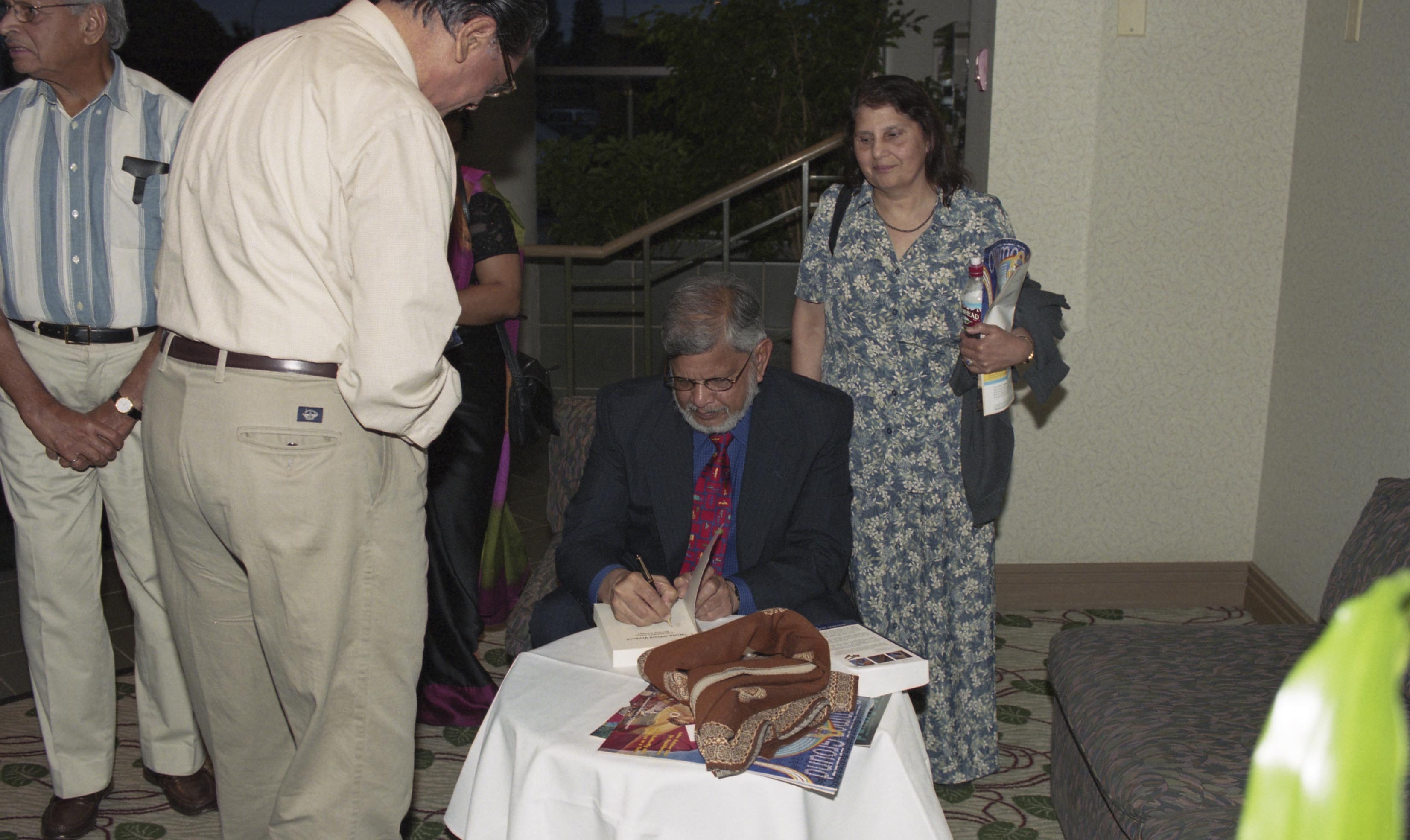
Photograph of Arun Gandhi signing a book at a lecture and book signing event for Arun Gandhi, which was organized by the International Network on Personal Meaning in Richmond, B.C.
Born in 1934 in Durban, South Africa, Arun Manilal Gandhi was the fifth grandson of Mohandas K. "Mahatma" Gandhi and was a socio-political activist, author, lecturer, and journalist. Having grown up under the apartheid laws of South Asian, both his parents and his grandfather taught him the importance of justice through love, suffering, understanding, and nonviolence. He and his late spouse, Sunanda, lived in India for thirty years, and then in 1987, they moved to the United States. The couple was extremely involved in activism, which included rescuing orphan children from the street, social and economic uplifting programs, starting the M. K. Gandhi Institute for Nonviolence, establishing residential-school in poorest rural India, and founding the Gandhi Worldwide Education Institute, among other contributions.
International Network on Personal Meaning (INPM) follows the vision of Dr. Viktor Frankl, an Austrian neurologist and psychiatrist, and Dr. Paul T. P. Wong, a Canadian clinical psychologist. They advocate for research on meaning, by extending logotherapy and integrating it with the positive psychology. They engage in meaning research, meaning-centred practice, meaningful living group, as well as websites, publications, education, meaningful living groups, and meaning-centered counseling, coaching, and consultation.
Born in 1934 in Durban, South Africa, Arun Manilal Gandhi was the fifth grandson of Mohandas K. "Mahatma" Gandhi and was a socio-political activist, author, lecturer, and journalist. Having grown up under the apartheid laws of South Asian, both his parents and his grandfather taught him the importance of justice through love, suffering, understanding, and nonviolence. He and his late spouse, Sunanda, lived in India for thirty years, and then in 1987, they moved to the United States. The couple was extremely involved in activism, which included rescuing orphan children from the street, social and economic uplifting programs, starting the M. K. Gandhi Institute for Nonviolence, establishing residential-school in poorest rural India, and founding the Gandhi Worldwide Education Institute, among other contributions.
International Network on Personal Meaning (INPM) follows the vision of Dr. Viktor Frankl, an Austrian neurologist and psychiatrist, and Dr. Paul T. P. Wong, a Canadian clinical psychologist. They advocate for research on meaning, by extending logotherapy and integrating it with the positive psychology. They engage in meaning research, meaning-centred practice, meaningful living group, as well as websites, publications, education, meaningful living groups, and meaning-centered counseling, coaching, and consultation.
Creator: Bodalia, Chandra
Description
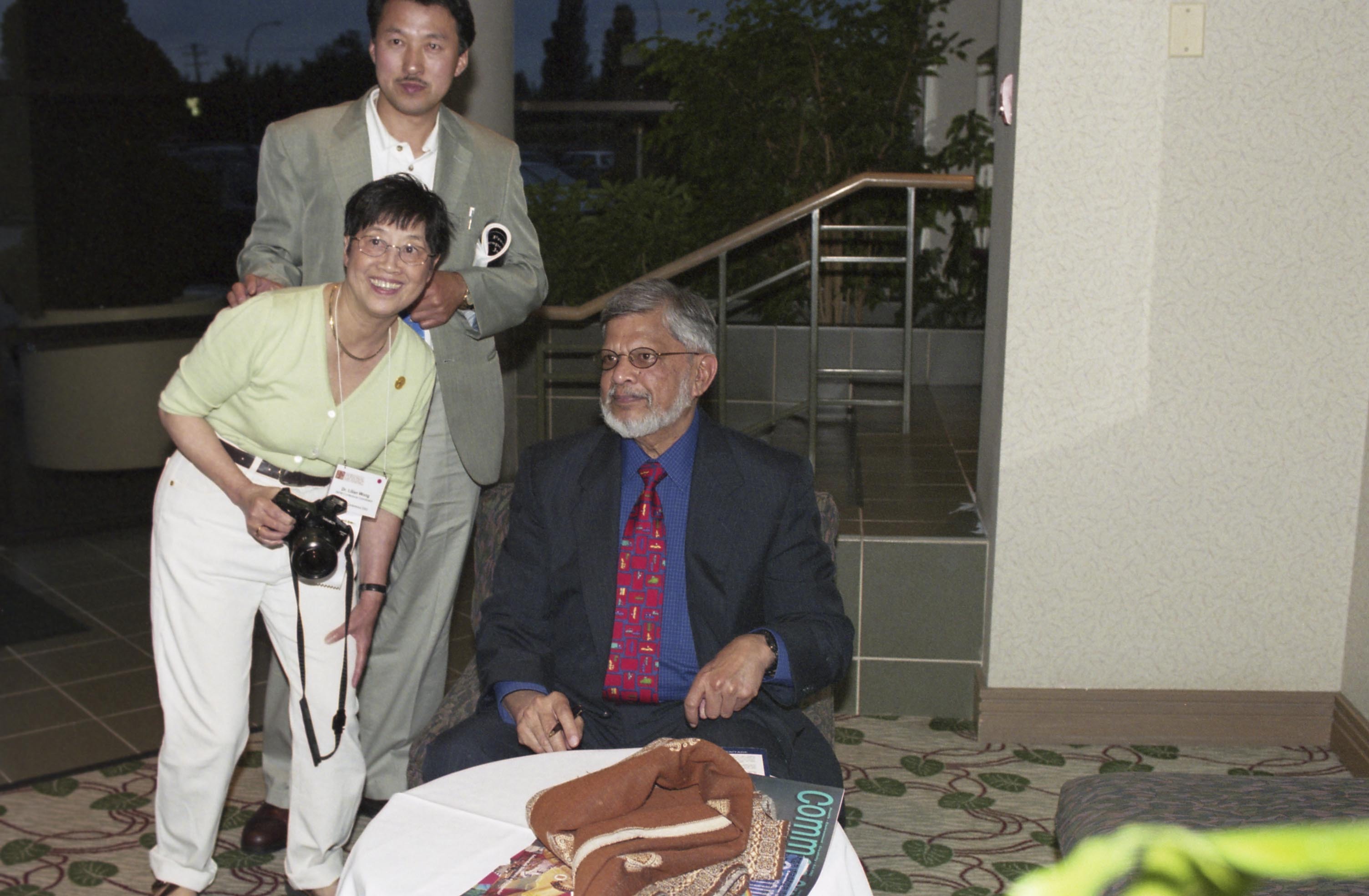
Photograph of Arun Gandhi and two unidentified individuals at a lecture and book signing event for Arun Gandhi, which was organized by the International Network on Personal Meaning in Richmond, B.C.
Born in 1934 in Durban, South Africa, Arun Manilal Gandhi was the fifth grandson of Mohandas K. "Mahatma" Gandhi and was a socio-political activist, author, lecturer, and journalist. Having grown up under the apartheid laws of South Asian, both his parents and his grandfather taught him the importance of justice through love, suffering, understanding, and nonviolence. He and his late spouse, Sunanda, lived in India for thirty years, and then in 1987, they moved to the United States. The couple was extremely involved in activism, which included rescuing orphan children from the street, social and economic uplifting programs, starting the M. K. Gandhi Institute for Nonviolence, establishing residential-school in poorest rural India, and founding the Gandhi Worldwide Education Institute, among other contributions.
International Network on Personal Meaning (INPM) follows the vision of Dr. Viktor Frankl, an Austrian neurologist and psychiatrist, and Dr. Paul T. P. Wong, a Canadian clinical psychologist. They advocate for research on meaning, by extending logotherapy and integrating it with the positive psychology. They engage in meaning research, meaning-centred practice, meaningful living group, as well as websites, publications, education, meaningful living groups, and meaning-centered counseling, coaching, and consultation.
Born in 1934 in Durban, South Africa, Arun Manilal Gandhi was the fifth grandson of Mohandas K. "Mahatma" Gandhi and was a socio-political activist, author, lecturer, and journalist. Having grown up under the apartheid laws of South Asian, both his parents and his grandfather taught him the importance of justice through love, suffering, understanding, and nonviolence. He and his late spouse, Sunanda, lived in India for thirty years, and then in 1987, they moved to the United States. The couple was extremely involved in activism, which included rescuing orphan children from the street, social and economic uplifting programs, starting the M. K. Gandhi Institute for Nonviolence, establishing residential-school in poorest rural India, and founding the Gandhi Worldwide Education Institute, among other contributions.
International Network on Personal Meaning (INPM) follows the vision of Dr. Viktor Frankl, an Austrian neurologist and psychiatrist, and Dr. Paul T. P. Wong, a Canadian clinical psychologist. They advocate for research on meaning, by extending logotherapy and integrating it with the positive psychology. They engage in meaning research, meaning-centred practice, meaningful living group, as well as websites, publications, education, meaningful living groups, and meaning-centered counseling, coaching, and consultation.